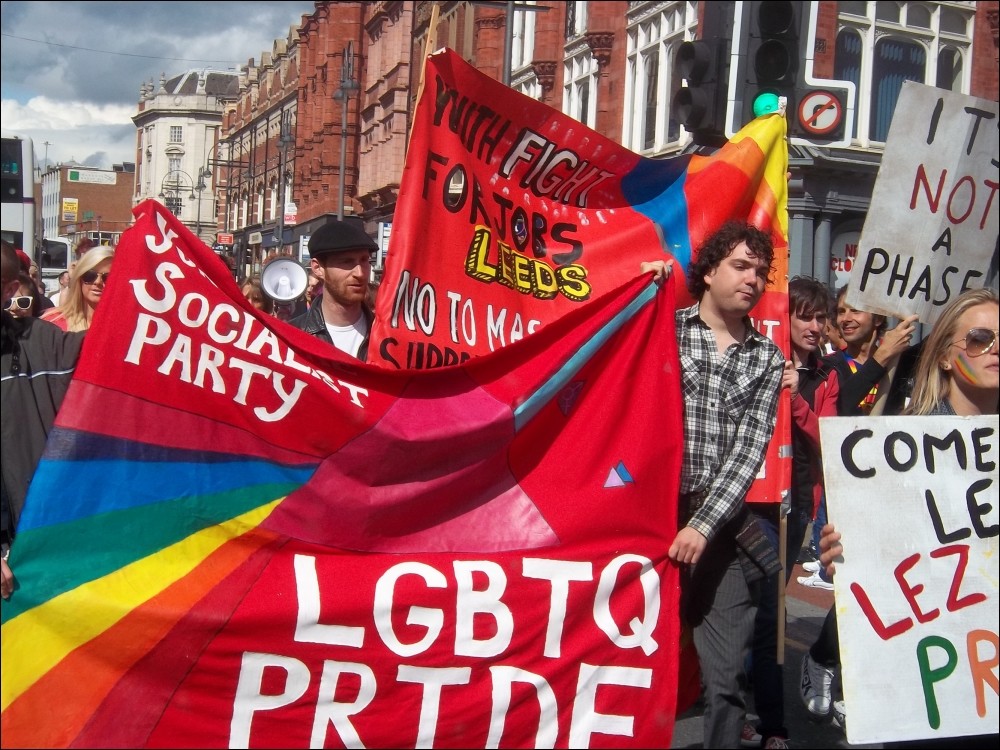
Socialist Party members at Bristol Pride
Bristol Socialist Party Public Meeting
Is Equality Possible Under Socialism?
7.30pm, Tues 11th July,
Malcolm X Centre (smaller building), BS2 8YH
We will be looking at how discrimination affects different groups of people and how it can be fought. The introduction will focus on gender and, in particular, the struggles that trans men and women face in today's society. The discussion is open for any points, questions or contributions that people wish to raise.
Call Tom on 07986 951527 if you have any trouble finding us or getting in.
The following article was carried in the centre pages of this week's The Socialist newspaper:
Lessons from the Russian revolution for LGBT+ struggle today
Michael Johnson, from the Socialist Party's LGBT group, examines the lessons of the Russian revolution for the struggle for LGBT+ rights today.

The Russian Revolution is not typically held up as a significant event in the advancement of the struggle for LGBT+ rights. In fact, it's often seen as the opposite, given the terrible oppression that LGBT+ people faced under Stalinism.
The 1934 Stalinist slogan 'Destroy the homosexual - fascism will disappear' casts quite a shadow on LGBT+ rights in the USSR. But in this centenary year of the Russian revolution, it's important to look at the genuine and significant progress that was made in the early years after 1917.
Prior to the revolution, bans on homosexuality in Russia could be traced back to the 17th century and were particularly barbaric.
Gay men and women were put to death, women explicitly by burning. By the 18th century the government had banned gay men from the armed forces and in the 19th century sexual acts between men had been criminalised.
These laws were by no means unique to Russia. In the UK, male homosexuality was punishable by death by hanging until 1861 and remained criminalised until 1967.
Decriminalised
Only a handful of countries worldwide had decriminalised homosexuality prior to 1917, starting with France in 1791 in the wake of the French revolution (though it must be noted that in 1960 France introduced indecent exposure laws targeting homosexuality that remained for 20 years).
Even today, around 80 countries have laws explicitly against homosexuality or which are used to target LGBT+ people - a number of which include the death penalty. In 28 states in the US it is still legal to fire someone for their sexuality.
Immediately prior to the 1917 revolution, the law in Russia had been applied on a very selective basis, with friends of the imperial family benefiting from a selective tolerance.
But institutions like the Eastern Orthodox Church pushed the idea that homosexuality was a sign of corruption, decadence and immorality. While gay rights movements began to develop in other countries such as Germany, this propaganda meant very little was able to develop in Russia beyond fictional representations.
At around this time, under familial and societal pressure, Georgy Chicherin - a flamboyant and openly gay man, already a committed Marxist who used an inherited fortune to support the 1905 Russian revolution and anti-war campaigning - undertook gay 'conversion therapies'.
It's unclear which therapies he attempted - at the time they ranged from psycho-analysis, to hypnotherapy, to surgical procedures and castration. Unsurprisingly, this was unsuccessful and Chicherin later described himself as self-accepting of his homosexuality.

Georgy Chicherin
Chicherin was jailed in Britain for his anti-war activities but his release was secured by Trotsky after the 1917 revolution. He went on to work closely with both Trotsky and Lenin, eventually becoming the People's Commissar for Foreign Affairs.
This appointment was in 1918 - it would have been unthinkable in any other country at that time, even where there were more active LGBT+ rights movements. It would take until the latter part of the 20th century for other countries to have out politicians in similar positions.
Given this background, it was enormously significant that when the Soviet Criminal Code was established in 1922, male homosexuality was not included as a criminal act (female homosexuality and 'crossdressing' had never been explicitly outlawed but were met with heavy repression). This was not, as some historians argue, an inadvertent omission or oversight.
The Soviet minister of health proudly spoke in Germany of the abolition of the Tsarist laws against homosexuality, stating: "No unhappy consequences of any kind whatsoever have resulted from the elimination of the offending [law], nor has the wish that the penalty in question be reintroduced been raised in any quarter."
Dr Grigorii Batkis, director of the Moscow Institute of Soviet Hygiene, echoed this, saying: "Soviet legislation bases itself on the following principle: it declares the absolute non-inference of the state and society into sexual matters, as long as nobody is injured, and no one's interests are encroached upon."
In 1926 it became legal to change your sex on passports and intersex and transgender people received access to medical care without state demonisation. The advances for women in the early days of the Bolshevik government secured lesbian and bisexual women with unprecedented freedoms.
100 years on and millions are marching in the wish that the US president could be close to being that progressive! These steps undoubtedly energised the fight for LGBT+ rights around the world at the same time as the revolution was breathing new life into the revolutionary struggle internationally.
Social attitudes
But the negative social attitudes fostered during the repressive Tsarist regime could not disappear overnight, especially within a geographical area as large as the Soviet Union.
This perhaps explains accounts such as the (only recorded) raid on a party of crossdressers and gay men gathered for a marriage ceremony. This was justified by a single Justice Commissariat lawyer, despite the decriminalisation, as he felt public displays of 'homosexual tastes' may endanger 'suggestible personalities'.
However, so far research has not shown any criminal charges due to crossdressing or public displays of homosexual affection during this early period.
Lesbian and bisexual women, who had received praise for their contributions to the soviet military and police during the civil war, are reported to have received admiration as "energetic" participants in the revolutionary landscape. 'Masculinised' women were seen as politically conscious and valued citizens in Russia while in other countries similar fashions were met with increasing scrutiny as a sign of 'female emancipation.'
There is also some evidence for the beginning of a change, albeit slow, in social attitudes, facilitated by the government. The novel 'Wings' by Mikhail Kuzmin about same-sex love was republished in 1923 by a publishing house owned by the Soviet government.
Especially within the medical community, there seemed to be a push away from the Tsarist regime's religious, moralistic view of homosexuality. Instead the understanding was that homosexuals had biological 'deformities' and, far from their sexual attraction being a conscious, sinful choice, it was instead something that could not be helped.
This was generally coupled to an attempt to find a 'cure' for these desires, but did lead some to conclude that homosexuality's 'inevitability' meant it might be a legitimate part of the 'human sexual spectrum.'
However, to a large extent, questions of sexuality were seen as issues that would resolve themselves once the economic and social foundations of the Soviet state had been laid.
There was no real official position of the Bolsheviks. Unfortunately this undoubtedly left the political and social progress LGBT+ people had made following the revolution at greater risk.
Homosexuality was re-criminalised by the Stalinist government in 1934. This was at a time when the regime was pushing the importance of the Soviet 'nuclear family'.
Male homosexuality in particular was focussed on as a symbol of 'bourgeois individualism,' based on the idea that revolutionaries should put aside their own desires for the sake of the continued revolution.
At the same time, the government banned abortion, calling for an increase in the birth rate. The Stalin government, reforming its links with the Orthodox Church, conflated homosexuality with rape and paedophilia.
Georgy Chicherin, who had passed away following illness in 1930, became a victim of the Stalinist purges at this time. Most references to him were removed.
This was probably because of both his sexuality and his politics. Either way, the result is unfortunately of a leading Bolshevik and out and accepting gay man largely lost to history.
The increase of repression led to around 1,000 trials of gay men for sodomy every year under the Stalinist regime (with punishments of five years hard labour). The new laws seem to have been enforced beyond even the scale that they were under Tsarism.
The complicated record around LGBT+ rights following the Russian revolution is often treated as a simple one by capitalist historians: the revolution, in and of itself, led to repression for LGBT+ people.
Liberation
This view serves to diminish the real lessons we can learn. The decriminalisation of sodomy was an indisputable step forward, giving a glimpse of the possibility for all kinds of liberation in a socialist society.
The subsequent reversal of these advances and the repression under Stalin show the importance of fighting for more than reforms which can be rolled back at any time. Instead we must fight explicitly for all advances towards liberation, along with organising to change society fundamentally.
To truly end racism, sexism and the oppression of LGBT+ people, we must continue to fight for socialism.