Showing posts with label Bristol Socialist Party. Show all posts

Wednesday, 31 May 2017

Socialist Party Public Election Meetings in Bristol

Bristol Socialist Party has two public meeting coming up, either side of the election. 


How Can the Tories Be Beaten?
Tuesday 6th June, 7.30pm
YHA (Grain House), 14 Narrow Quay, BS1 4QA


The election on June 8th provides an opportunity to kick out the hated Tory government. For the first time a generation there is a real difference between the two potential Prime Ministers. Jeremy Corbyn's pro-worker manifesto has seen Labour close the gap, yet he faces not just a hostile press but also Blairite saboteurs within his own party. 

Former Trade Unionist and Socialist Coalition parliamentary candidate Tom Baldwin will be introducing a discussion on what might happen in the election and what will be needed afterwards. How can the Tories be defeated and how can Corbyn's policies be realised?


What Next After the Election?
Tuesday 13th June, 7.30pm
YHA (Grain House), 14 Narrow Quay, BS1 4QA

Socialist Party National Organiser Sarah Sachs-Eldridge will be coming to Bristol to speak about what the next steps are for socialists following what will be a watershed election in British politics. 

We will also be launching the new book by Peter Taaffe - From Militant to the Socialist Party - which tracks the history of our party from 1995-2007 and contains lots of relevant lessons about the rise of the right of the Labour Party and how they can be fought.

Tuesday, 20 September 2016

Trotskyism, Corbyn and the Labour Party - public meeting


Tuesday 4th October, 7.30pm, 
YHA Bristol (Grain House), 14 Narrow Quay, BS1 4QA

The Jeremy Corbyn leadership campaign is once again inspiring thousands of people to get active in politics and stand up for the future they want. It has driven the right wing of the Labour party to distraction as they try every dirty trick to oust him and take control of the party back. 

Trotskyism has been thrown around as a dirty word in an attempt to smear some of their opponents. The name of Militant, (now the Socialist Party) a Trotskyist group expelled from Labour for being too left wing has been brought up and many slanders spread.


In this meeting we will discuss how Corbyn and his supporters can consolidate a political voice for the 99%, not the 1%. We also look at the real history of the Militant Tendency and what the Russian revolutionary socialist Leon Trotsky actually stood for.

Organised by Bristol Socialist Party and Bristol University and UWE Socialist Students groups. All welcome.

Tuesday, 23 August 2016

1000 Jobs To Be Cut At Bristol City Council

Marvin Rees (right) - Labour mayor doing the bidding of Tory chancellors past and present

TUSC calls on Marvin Rees to reverse decision and fight for necessary funding


Bristol Labour mayor Marvin Rees has announced the cutting of 1000 jobs from Bristol City Council, almost 1 in 6 of the workforce. This is part of a package of £43m cuts, additional cuts of some £60m planned by Rees over the next 4 years will further devastate jobs and services in Bristol.


The Trade Unionist and Socialist Coalition (TUSC) demands that Rees reverses these job cuts and campaigns for the funding stolen by the Tory government to be returned.


Anti-cuts campaigners and trade unions representing council staff have also raised their concerns. The Unite, Unison and GMB unions all have positions nationally of calling on councils not to make cuts and to use reserves and borrowing powers to protect services while demanding more funding from central government.


TUSC former mayoral candidate and Bristol Socialist Party member, Tom Baldwin said:

“It seems that Jeremy Corbyn’s call for opposition to austerity has not reached every level of the Labour Party. These cuts are being driven by the Tory government but here we have a Labour mayor putting forward an eye-watering package of redundancies.

“This will be seen as a betrayal by many of the people who voted for Marvin Rees hoping for a change from the cuts made by George Ferguson. Libraries and care were amongst the areas cut in the last 4 years. Services will be decimated by the latest round of cuts, let alone the extra £60m cuts Rees says he ‘must’ make.

“Austerity is a political choice by the Tory government. They’ve found money to cut taxes for the rich but are cutting council budgets to the bone. Our mayor needs to be exposing this hypocrisy and sticking up for his staff and the vital services they provide, not acting as the Tories’ hatchet man.

 “During this year’s elections TUSC were the only party to consistently warn of the impact of council cuts in the coming years. That’s because we were the only party with a plan to fight those cuts and stick up for jobs and services in this city.

“We call for a no-cuts budget that is based on what Bristol needs and the building of a mass campaign to push back the Tory government and reverse the swingeing cuts they’ve made. The council has significant reserves which should be used, along with prudential borrowing powers, to plug the funding gap while the campaign is built. By mobilising unions, anti-cuts campaigners and the communities that will be hit by the cuts and by linking up with other Labour councils that are willing to fight, the Tory cuts can be overcome.

“Marvin Rees must now adopt that approach if he doesn’t want to be known as the mayor that butchered Bristol’s services. The need to challenge austerity in deeds, not just words, is greater than ever.”

Friday, 10 June 2016

Bristol To Be Hit By Even More Council Cuts


Marvin Rees announces another £100m to be cut from Bristol
Tory austerity must be challenged – mass anti-cuts campaigning needed
 
Marvin Rees, Bristol's new Labour mayor has revealed that the city council faces a funding shortfall of £100m by the end of his term of office in 2020. This is because of the cuts being imposed on spending by the Tory government.
 
Bristol is already reeling from over £100m cuts made by the previous mayor, George Ferguson. Coming on top of that, these additional cuts will hit jobs and services in the city even harder. Even Rees himself concedes that “there is little fat left to trim leaving us facing unpalatable options.” Those worst affected will be the less well-off and those with the greatest social needs. Making these cuts is not compatible with Rees’s stated aim of making Bristol a more equal city.
 
During the recent mayoral and council elections Trade Unionist and Socialist Coalition candidates repeatedly warned that the new administration would end up making cuts on a huge scale if it was not prepared to stand up to the government and refuse to implement the austerity agenda. We called for a no-cuts budget based on the needs of the city, and a mass campaign to force the government to return the stolen funds. We will continue to campaign alongside ordinary people to resist this new threat to jobs and services.
 
Trade Unionist and Socialist Coalition (TUSC) former mayoral candidate and Socialist Party member Tom Baldwin said:
“Just over a month ago Bristol voted in an election that saw an overwhelming desire for change in the city. But already we’re getting threats of massive cuts, wrapped in the talk of “tough choices” and “unpalatable options” – exactly as we’ve seen over the last few years. I’m sick of politicians talking about the tough decisions they face when those decisions are tough on us and not on them. More cuts of this scale will be disastrous for Bristol. If our new mayor is serious about making this city a more equal and better place to live then he must stop them. If he’s not prepared to stand up to this weak and divided government then he risks becoming just the latest Tory stooge – pushing their austerity agenda from City Hall.”

Friday, 20 May 2016

Bristol's New Labour Mayor Puts Tory In Charge of City's Education

Marvin Rees, Bristol's new Labour mayor has announced his cabinet today. Despite a resounding win in the mayoral election and Labour taking a majority of Bristol's council seats they've allowed the hated Tory party a seat on their cross-party cabinet.

Conservative councillor Claire Hiscott has been given the education brief. This is despite her party in government cutting education funding and pursuing the destructive policy of academisation.

Trade Unionist and Socialist Coalition (TUSC) former mayoral candidate  and Bristol Socialist Party member Tom Baldwin said:

“Bristol needs a fundamental change from the cuts policies of the last few years. This cabinet does not reflect the change people that voted for just 2 weeks ago. Education is absolutely vital to Bristol’s future and to put it in the hands of a Tory will be a slap in the face for many Labour voters. Unfortunately this is already beginning to look like the approach taken by the previous mayor. The main parties will be ‘all in it together’ on the cabinet, implementing anti-working class austerity.

“Tory policies of taking from ordinary people and giving to the rich are playing havoc in Bristol and across the country. We need a mayor who will oppose that party, not bring them onto the top table and into the running of the city. TUSC will continue to stand alongside ordinary people and campaign for the jobs and services we need, regardless of who is threatening them.”

Support for TUSC rises in Bristol's elections


Bristol's mayoral election saw the Trade Unionist and Socialist Coalition (TUSC) vote rise by over 450 from 2012. TUSC candidate and Bristol Socialist Party member Tom Baldwin got 1,876 first preference votes. At the same time, TUSC's local council election candidates in Bristol picked up a total of 2827 votes, an increase of over 900 on last year. The best of these was 411 for Bristol Socialist Party member Chris Farrell in Ashley.

This election showed a thirst for change. Labour's Marvin Rees thrashed 'independent' incumbent George Ferguson as people turned their back on three and a half years of arrogance and austerity.
Given the swing to Labour, increasing our vote was impressive.

It remains to be seen whether a new mayor will mean the change of direction that is badly needed. The challenge is on for Labour to reverse the cuts made by the previous mayor. Unfortunately that was not offered by Marvin Rees during the election - he said we have to "pick our battles" when asked if he would pass on further Tory cuts of over £70 million.

TUSC got a great response to our policies of opposing austerity with a no-cuts, needs-based budget and a mass anti-cuts campaign to challenge the Tory government. The potential for such a campaign is there. Campaigning has won victories in Bristol recently, reversing closure plans for six libraries and virtually all public toilets.

During the election TUSC campaigners spoke to people on doorsteps and stalls, put out thousands of leaflets, spoke at several hustings and appeared in all the local media. We had to work harder than the establishment candidates, lacking their money. Campaigning does not stop and start with elections for TUSC and the Socialist Party. We'll continue to stand alongside working class people across the city to defend our living standards, jobs and services.

Friday, 21 February 2014

Thursday, 23 January 2014

Pay me - I'm a banker! Nationalise the banks to stop the fat-cats' rip off rewards

By Matt Gordon, Bristol Socialist Party

It is a tough time for bankers. The EU has decided to cap bankers' bonuses at 100%, and so condemned those earning more than £410,000 to "only" get paid double their salary.

Luckily for the bankers, they have loyal friends in the persons of David Cameron and George Osborne, who are gallantly calling for bankers at RBS to receive 200% bonuses instead.

RBS - the loss-making, scandal-riven, incompetent giant which is 82% owned by the taxpayer - hasn't even asked the prime minister and chancellor to fight its corner, at least publicly, but they are doing it anyway.

Mark Carney, Governor of the Bank of England, has also proven to be a good chap - he also opposes the "crude" EU bonus cap and instead thinks bankers should get paid the market rate, ie as much as they can possibly get away with.
Struggling on high pay

Have no doubt that it is a tough time to be banker, especially in the City of London. After all, they have only received a pay rise of a third in the last year -data from the European Banking Authority shows that the top 2,700 now receive an average pay packet of £1.6 million - and some lower paid bankers have confessed that they are "struggling" to live on salaries of £500,000 a year.

Cameron, Osborne and Carney are good enough to let some minor misdemeanours at RBS slide. Things such as pre-tax losses of £634 million in the third quarter of 2013 alone, revelations that the bank was forcibly driving small businesses to the wall in order to seize their property and maximise profits, technical issues that potentially affect 250,000 customers every single minute, and 30,000 job losses since 2008, all of this does not impact on the decision to support massive bonuses.

You could be forgiven for thinking that banks are intentionally doing all they can to wreck the economy and play the villain - HSBC recently announced that 3,100 staff were to be "demised" - but it seems that the Con-Dem government can see through all that, showing loyalty to the bankers through thick and thin.
The sky's the limit

After half a decade of recession, austerity and plummeting living standards, bankers' bonuses continue to increase. In 2012, 95 bankers at RBS each received a bonus of at least £1 million. These figures were dwarfed by rival banks, such as JP Morgan who paid 126 London staff £2 million each, and Goldman Sachs London who paid 115 people a whopping £2.7 million each - at least!

The new EU regulations on capping bonuses won't make any difference, with or without Cameron and Osborne opposing them. Barclays is now handing senior staff a "third payment", a pay-out classed neither as salary nor bonus and so exempt from the restrictions.

Other banks are making similar "cash allowances" or increasing share awards. For example, the new RBS CEO Ross McEwan was handed £1.5 million in shares simply for starting in his new post. That is not the sort of recruitment incentive you see at the Jobcentre!

As well as this, if the EU rules are imposed, banks will simply decrease bonuses but increase salaries. That is why Ed Miliband's support for the EU cap is so ineffectual.
Abolish bonuses

The government could make whatever decision on RBS bonuses it wanted to - instead of fighting to increase them, Osborne should scrap bonuses altogether.

Any bank, especially one that is majority owned by the British people should not be allowed to ruin small businesses, defraud customers, cut thousands of jobs or reward the bosses with bonuses.

The only way of stopping this is to take the banking system into full public ownership to be democratically run by elected and accountable committees that should include representatives of finance workers and service users. It could then be used to support struggling families and small businesses, to break the stranglehold of the super-rich minority over the economy, as part of developing a stepping stone to a democratically run planned economy in the UK and the world.

Monday, 2 December 2013

End the pay freeze: A united fight in post-16 education, support the strike tomorrow

Bristol university workers on strike in October 2013

Bristol university workers on strike in October 2013


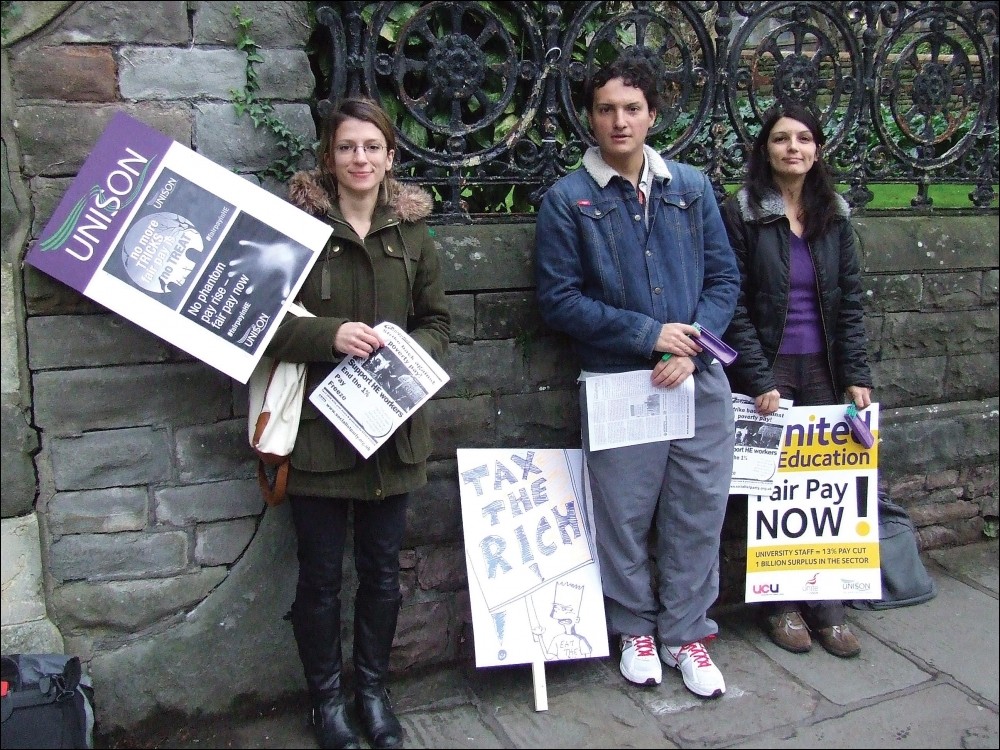
On 3 December university and college workers will be taking action. This strike day involves UCU, Unison and Unite members working in universities who struck on 31 October, now joined by further education (FE) members of UCU in England and higher education (HE) members of EIS in Scotland.

In HE, the employers' organisation UCEA returned to negotiations with the unions, but did not improve on the initial pay offer of 1% that triggered the dispute. Rattled by the 31 October strike, they have asked the individual employers to impose 1%. University workers are fully aware, however, that their employers have multi-million-pound surpluses and reserves while staff incomes have fallen by 13% in real terms since 2008.

FE staff have similarly experienced a 15% real-terms pay cut in the last four years, and have just rejected their employers' offer of a 0.7% increase - that is, another below-inflation rise - with over 70% voting tostrike. This doubtless reflects the anger union members feel when research shows that over half the lecturers in FE work ten hours' unpaid overtime during an average week, for dwindling pay.

Many student unions and the NUS nationally have passed resolutions in favour of the action, with Socialist Students and other campaigning groups building support. Ultimately our interests are all the same - for a public, fully-funded education system, free at the point of use and democratically run.

This background makes the coordinated national strike action particularly positive - the more unions that can be brought out together, the greater chance of success. At the same time, it is important for each dispute to have a strategy and to keep its own momentum.

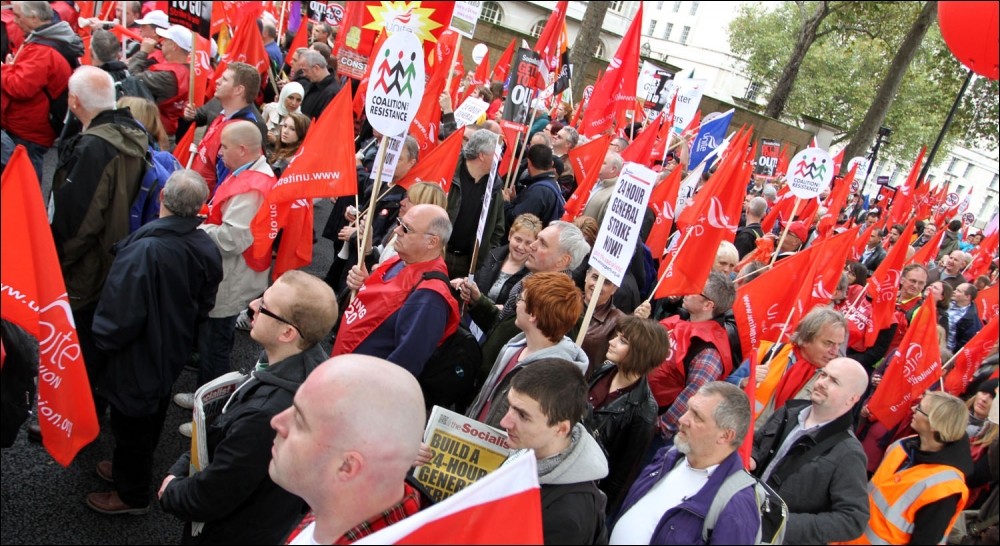
Industrially, we need to work to build for a 24-hour general strike against austerity; and politically, trade unionists and students need to consider the question of an alternative to the three parties of austerity. Education is been under attack - we need to fight to defend it!

Monday, 25 November 2013

Stop Ferguson's Cuts Onslaught


Mayor George Ferguson is due to announce a further £90 million per year of cuts to Bristol City Council which, if passed, will destroy most of the public services we enjoy but that it would not be illegal for them to cut! An estimated 1,000 more workers will lose their jobs (800 FTE) and Bristol will never be the same again!

BADACA along with the unions and other campaigners will be protesting outside and intervening in various meetings over the coming weeks to build the campaign against this savage attack on the people of Bristol by the mayor & his cabinet.

Monday 18th November - demo from 5.30pm - meeting (booking required) 6pm: It has been trailed that the cuts will be announced at this event in Great Hall of Wills Memorial Building, University of Bristol, Queens Road, Bristol BS8 1RJ To book:https://www.eventbrite.co.uk/event/7715199369

http://www.bristol.ac.uk/pace/public-events/mayor-debate.html

The mayor will also be personally attending these four public consultation meetings on the budget:

Tuesday 26th November - demo outside from 5.45pm - meeting (booking required) 6.30pm to 7.30pm - Henbury School, Station Road, Henbury, Bristol, BS10 7QH To book: https://budgetnorth.eventbrite.com/

Wednesday 27th November - demo outside from 5.45pm - meeting (booking required) 6.30pm to 7.30pm - The Park Centre, Daventry Road, Filwood, Bristol BS4 1DQ To book: https://budgetsouth.eventbrite.com/

Thursday 28th November - demo outside from 6.15pm - meeting (booking required) 7pm to 8pm - City Hall (Council House), College Green, Bristol BS1 5TR To book:https://budgetcentral.eventbrite.com/

Friday 29th November - demo outside from 6.15pm - meeting (booking required) 7pm to 8pm - Bristol Brunel Academy, Speedwell Road, Speedwell, Bristol BS15 1NU To book: https://budgeteast.eventbrite.com/

http://www.bristol.gov.uk/page/council-and-democracy/budget-consultation-meetings

Then on Tuesday 3rd December is another of Ferguson's "aimed at residents rather than political or pressure groups" Question Times this time at Great Hall of Wills Memorial Building, University of Bristol, Queens Road, Bristol BS8 1RJ - demo outside from 6.15pm - meeting (booking required) 7pm To book: https://mayorqtdec.eventbrite.co.uk/

http://www.bristol.ac.uk/pace/public-events/mayor-qt.html

And finally there is Cabinet Meeting on Thursday 5th December at 6.30pm (venue TBC)

See also our Facebook event page for our lobby of the full council meeting on 17th December when there will also be a full Bedroom Tax debate in the council in response to our petition exceeding 3,500 signatures: https://www.facebook.com/events/223992244443413/

Sunday, 11 August 2013

Socialist Party meetings this week - Why the pharmaceutical industry should be nationalised

Under capitalism, essential medication is privately produced and distributed for profit. In the developing world, HIV drugs are withheld from people that need them most as they are marketed first in the West, and even in the US many cannot afford the huge costs. Michael Wright explains why drug companies should be nationalised.

Tuesday 13 August: 7.45pm, Cheltenham Rd Library, Bristol BS6 5QX
Wednesday 14 August: 7.30pm Hydra Books, 34 Old Market Street, Bristol, BS2 0EZ

Find out more: http://www.socialistparty.org.uk/articles/16981

Wednesday, 31 July 2013

Report from recent Tolpuddle march and festival


This year's Tolpuddle martyrs festival in Dorset took place in the extreme heat but that didn't dampen the spirits of those who attended.

Around 1,000 people turned up for the weekend to celebrate trade unionism and the memory of the Tolpuddle martyrs, which was a significant step up from last year. Many more then joined us for the Sunday.

Over 130 copies of the Socialist were sold and several thousand NSSN (National Shop Stewards Network) leaflets were distributed demanding that the TUC call a 24-hour general strike.

Many people signed the NSSN petition and said that they would attend the lobby of the September TUC congress in Bournemouth.

There was also a lot of interest in the Trade Unionist and Socialist Coalition (TUSC) which shows that many trade unionists no longer see Labour as the electoral alternative.

With recent pronouncements by Ed Miliband and Ed Balls accepting Tory austerity policies and questioning Labour's link with the trade unions, many activists are having to accept for the first time that Labour no longer represents workers' interests in any way.

This potentially opens up the possibility of major unions ending their affiliation with Labour and looking for new ways to achieve political representation.
Speeches

After the traditional march through the village of Tolpuddle on the Sunday afternoon, we heard various speeches including from Labour MP Sadiq Kahn who struggled to raise any applause.

The new TUC general secretary (and first ever woman in the job), Frances O'Grady, said that the TUC would support workers who wanted to take industrial action, "up to and including coordinated action" but she stopped short of calling for a general strike against austerity.

Finally, we heard from veteran former Labour MP, Tony Benn, now 88 years old. He said that he was against protests which just register our disagreement with government policy - workers should instead demand that the policies be changed.

With the horrendous policies of Cameron and Clegg causing untold suffering for millions of ordinary people in Britain, the labour movement is starting to come to life after years of relative passivity.

At a traditional trade union event like the Tolpuddle festival, you can really feel the solidarity and everyone goes home feeling re-energised and ready to continue the struggle.

By Kyle Williamson (East London Socialist Party) and Matt Carey (Bristol South Socialist Party)

Tuesday, 25 June 2013

Bristol council opposes bedroom tax evictions

By Mike Luff, Bristol Socialist Party
'No eviction' for bedroom tax victims is now the official policy of Bristol City Council.

All four parties - Labour, Greens, Tories and Lib Dems - and the Mayor gave full support to a 'no eviction' resolution at Bristol council's full meeting on Tuesday 18th June.

All the councillors also called on mayor Ferguson to review the definition of a bedroom, reclassify box rooms, downstairs rooms and small bedrooms - which he agreed.

We have had two demonstrations and local meetings across the city, building opposition to the bedroom tax.

There will now be a working group of councillors who will look at the details of the new policy, so our campaign will continue.

Tom Baldwin (mayoral candidate last year for TUSC - the Trade Unionist and Socialist Coalition) spoke at the council meeting on behalf of the Bristol and District AntiCuts Alliance.

His call to stop any evictions whether by the council or social housing organisations and for a house building programme, was supported by the full public gallery.

The mayor and councillors also supported the resolution calling for the building of social and affordable homes.

This could be paid for by the government lifting the borrowing restrictions on the housing revenue account.

However, their only weapon to change the government's mind was in having a directly elected mayor! While the councillors are keen to promote 'localism', there was no mention of building a city-wide mass campaign to fight for more housing and against the cuts.

They seemed to be suffering from mass amnesia, forgetting that it is their parties' policies which introduced and maintained these financial restrictions that have decimated council housing.

We can't trust councillors who have shown no opposition to other cuts, with over 300 local authority job losses as part of a 9% budget cut, including the eviction of old people from their residential homes.

There is the prospect of similar cuts for the coming year. We will be vigilant, hold them to their promise, organise to prevent evictions if they happen, and we will keep up the fight against all cuts.

Thursday, 6 June 2013

Stop unmanned drone attacks!

By Matt Gordon, Bristol East Socialist Party
"To say a military tactic is legal, or even effective, is not to say it is wise or moral in every instance," said US president Obama in a major speech recently where he promised to scale back the use of unmanned drones to attack targets in Afghanistan, Pakistan and elsewhere.

But pious hand-wringing will not bring back the lives of the civilians indiscriminately bombed in their homes by Obama's killer robots.

Nor does one speech change the tactics of the US Military and the CIA on the ground. On 29 May a drone strike in the North Waziristan, on the border between Pakistan and Afghanistan, killed at least four people, including Wali Ur-Rehman, second-in-command of the Pakstani Taliban.

However these attacks are rarely as accurate as that. One source estimates that only 2% of drone attacks kill targets as high profile as Wali Ur-Rehman.

It is also common practice for the Taliban to name a commander as killed only for them to later resurface elsewhere alive and well.

Obama and the US government have consistently downplayed the use of drones and the havoc they cause, but in truth their use has grown exponentially during his presidency. It is yet to be seen if Obama's most recent speech is any more genuine.

Afghanistan is undoubtedly the epicentre of unmanned drone attacks, with 506 incidents in 2012 and no way to verify the number of civilian casualties accurately.

In Pakistan there have been 369 since 2004, and the Bureau of Investigative Journalism estimates that between 2,541 and 3,540 people have been killed, and that between 411 and 884 of those have been civilians.

On receiving the Nobel Prize for Peace, Obama declared that America, "must remain a standard bearer in the conduct of war".

But unmanned drones are not used because they are more 'surgical' or less deadly than traditional weapons, they are used because they save the lives of American troops in the short term and so are more politically and financially expedient back home.

For those on the receiving end, a hellfire missile is just as deadly and indiscriminate whether it is fired by a drone or by a piloted aircraft.

The reality is that the war in Afghanistan is an expensive and bloody failure. Obama tripled the number of troops in Afghanistan, making it the mightiest and most technologically advanced military occupation in the world, but still failed to make any real gains against the Taliban insurgency, which is likely to become apparent when combat troops leave at the end of 2014. Replacing human troops with robots will not change this.

Drones terrorise entire populations. This will leave thousands if not millions of people psychologically traumatised and deeply opposed to the United States, and will also continue to fuel anger.

The billions spent on war could instead be used for schools, hospitals and creating jobs - both in America and in Afghanistan. The war and use of drones must be ended now.

Tuesday, 28 May 2013

Large turnout at South West Socialist Party conference


"It was amazing to learn from some brilliant and thinking people yesterday. I've buried my head in the sand for too long and it was inspiring. Capitalism must end and I'd like to learn a lot more about how I can go about bringing about that change".

That was the verdict from Chris, one of three young people who joined the Socialist Party at the end of its largest South West regional conference for a number of years.

On Saturday 25 May Socialist Party members and supporters from 19 different towns and cities packed into a room in Bristol to hear Socialist Party deputy secretary Hannah Sell deliver a thorough analysis of the volatile situation unfolding in Britain and Europe.

Over 20 members followed this up with contributions that dealt with attacks in the workplaces and how we are helping to organise the fightback; a programme for opposing the far-right; lessons from struggles in Greece and Spain and the over-arching question of capitalism's chronic inability to take humankind forward in the 21st century; and why therefore a socialist alternative is imperative.

Workshops on women, youth, and building in the workplaces followed. Each resulted in practical initiatives keenly being agreed, including the organising of a regional women's meeting early in July, the stepping up of the 'Sick of your Boss' campaign from Cornwall to Cheltenham, and a trade union meeting in Exeter in September where the building of the National Shop Stewards Network will be one of our priorities.

Recruitment and finance

Robin Clapp, South West regional secretary, introduced a closing session on the progress made in the last 12 months. The rate of recruitment in the region is up by 50% over 2012 and every area has enthusiastic new people eager to take on a role in helping us to build.

It was agreed we would set up a branch in Somerset where we'll trigger fast progress by organising a Saturday 'super stall' in June with the aim of selling 75 papers and getting new members.

This follows on from the highly successful initiative in Poole where we sold 82 papers in four hours, 10 'join' cards were filled in and £46 was raised in Fighting Fund.

Conference committed itself to smashing through the new paper sales targets. This shouldn't be too difficult, given that every branch has already exceeded these targets on at least one occasion since March.

Mid-week stalls are now the norm in Plymouth and Bristol, workplace sales take place at council offices in Gloucester, and sales outside Bristol Temple Meads rail station have yielded 10-12 sales in a single session.

At the beginning of the conference, Plymouth and Gloucester branches had each recruited eight new members since January. By the end of the day, the Devonians were ahead having signed up somebody in the meeting. They have three more knocking on the door, Bristol has five who have agreed to join and this welcome infection is spreading rapidly across every branch in the region.

The viciousness of the Con-Dem attacks is polarising society, making many of those who have previously spent their evenings screaming at the television decide it's time to stand up and seek out a party that is serious about fighting for change.

The mood of optimism suffusing through the conference was expressed concretely by a magnificent collection which yielded £1,125 for our party funds.

The excellent Gloucester branch 'catering company' raised £70 towards our funds from selling their delicious food and Bev Anderson's fairy cakes went down a treat and gave us another £20.

The last word must go to Matt Stabb from Trowbridge who is new to our ranks but a veteran in the struggles of disabled workers:

"Cheers for a brilliant South West congress yesterday, comrades! Thank you for making me so welcome. It was so good to meet other comrades and feel part of the good work that is going on".

Monday, 11 March 2013

No more austerity and cuts! Fight for our future! Demo on Wednesday 13th 6pm

Wednesday 13th March, 18.00
The Fountains, Bristol City Centre

The current global crisis has affected workers, unemployed, students and pensioners all over Europe. The crisis has social, economic and political impacts: firm closures lead to millions of redundancies; more people are living below the poverty line deepening in such a way the gap between rich and poor. Rising poverty and unemployment and the socio-political developments of the last 30 years under neo-liberalism are likely to intensify divisions based on racial or ethnic difference within society and push down the legitimacy of the political institutions.

In order to confront the crisis, to restore the profit rate, to service the total debt and to rescue the banks (by huge bailouts) the governments in Europe applied certain policies. The European banks were extremely exposed to the national debts of the periphery. The bailout of the banks by the member states was important since the states switched the holding of sovereign bonds from the European banks to the European tax payers having as their main argument financial discipline and paying off the debt.

Especially in the periphery of the European Union the austerity measures and the budget cuts, under the guidelines of the ECB and the IMF deteriorated the situation and deepened the division between the core and periphery. Austerity measures, budget cuts, house evictions pushing down the salaries and the pensions, privatisations, raising the taxation for the poor, inflation and increasing the flexibility of the workers, led to more than 10,000 suicides in the last three years. 11% unemployment in the Euro zone, more than 25% of the people live below the poverty line and thousands of homeless people reflect the situation in Europe. This is the real character of the murderous EU!

However, this situation is also visible in the core of the EU transferred due to the characteristics of the EU and the character of the austerity policies. The conservative and liberal government coalition has already applied, in England, the 5 year Government Austerity Program (in order to reduce the national deficit) which aims at destroying the welfare state: huge education cuts and increase of tuition fees, huge cuts in the health and care system (the NHS is under huge attack), companies more interested in avoiding taxation than recruiting new people. That means no new jobs, no income increase and that the gap in society in terms of income is rising dramatically. In addition, in Bristol, the new mayor, the independent neo-liberal Ferguson applies more than 100 million pounds cuts of housing, transport and local care services.

On the 13th of March people all over Europe will mobilize against this situation. We should fight united against the austerity measures and paying off the debt in order to reduce inequalities, defend our social and economic rights and achieve social justice. In this struggle the unions should be on the front line by mobilizing the workers with strikes.

Against EU policies! Against police repression!
Against paying off the debt! Against austerity!
For our lives. For our future!
People over profits! We will not pay for your crisis!


http://www.facebook.com/events/333307433457480/

Wednesday, 6 March 2013

George Ferguson imposes £35m of cuts on Bristol...with a little help from his friends

By Tom Baldwin, Trade Unionists & Socialists Coalition mayoral candidate 2012

The opposition to £35m of cuts in Bristol took on a vocal and vibrant expression last week as about 70 people turned out to lobby the council and George Ferguson, the city's 'independent' mayor. Banners and flags from all of the local authority trade unions, the Bristol and District Anti-Cuts Alliance and the Disability Equality Forum represented the broad spectrum of opposition to these attacks.

Unfortunately the mood of protesters outside the council chamber found no echo inside. Those who braved the public gallery were treated to a game of spot the difference as the mayor and Tory, LibDem, Labour and Green councillors all made indistinguishable speeches. One after another they got up to say how much they hated the cuts, only to claim there was choice but to pass them on. There's a word for people who say one thing and do another - hypocrites. Whether they’re made reluctantly or with enthusiasm, these cuts will hurt just the same.

Labour are the only party not to have joined the mayor’s cabinet, despite most of their Bristol councillors wanting to. When it was her turn speak the Labour leader rose like Spartacus and announced her group were so disgusted they were going to… abstain from the vote. They claimed this was in the spirit of a new, consensual age of politics in Bristol, ushered in by the election of an independent mayor. What’s new about the butchery of our public services and attacks on working-class people? Speaking to anti-cuts protesters one councillor tried to justify this collaboration with the hope it would win Labour 5 more seats in May’s elections. What good are 5 more abstentions when the Tories and their stooges are trying to obliterate our living standards? In the end only one Labour councillor voted against the cuts budget and it’s not even clear that was on purpose!

The mayor, Ferguson said he'd lost sleep thinking about the impact of these cuts but as a millionaire businessman he's unlikely to feel the impact. The 330 council workers due to lose their jobs will though, along with users of children’s centres and countless others. We won’t get very far on sympathy and abstentions. What we need is a mass campaign to stop the cutters in their tracks, whatever their political allegiance. Lobbies and demos will form a part of that but it’s strike action that will hit them the hardest. With the vast majority of people’s lives being made harder we’re strongest when we stand together. A one-day general strike would be a turning point in the fight against austerity. That struggle would also be stronger if it had a voice on the council benches, standing up against all cuts to our living standards no matter who makes them. That’s why Trade Unionist and Socialist Coalition candidates will be standing across Bristol in May to give a real alternative to the cutters.

Tuesday, 15 January 2013

BADACA: Fightback Against Ferguson's Cuts

BADACA Circular:

A rare additional email from BADACA because we need your help to build the fightback against Ferguson's Cuts - £35 million of cuts including up to 100 compulsory redundancies.

We want you to join in:

Lobby Of Cabinet Meeting - Thursday 24th January. Meet outside the Council House from 5pm. Cabinet meeting starts at 6pm. Bring banners, placards & friends. Facebook here.

Stalls – we plan to run street stalls in as many parts of city as possible. If you can help with this please email admin@bristolanticutsalliance.org.uk as soon as possible and let us know where and when you could help.

We have only a few weeks to build a fightback against these cuts. Please do help if you can. Please pass this information on to anyone else you know who may be interested.

The full details of the proposed cuts are on the BADACA website here. These include:

  • access to Children Centres drastically reduced with the loss of 55 jobs
  • funding of community transport to be slashed
  • the new East Bristol swimming pool to be scrapped
  • the programme of closure of care homes and day centres for the elderly and vulnerable endorsed
  • In the words of the Evening Post, it is planned to 'squeeze better value out of commercial contracts for home care provision'. The council's own service was privatised resulting in a lowering of standards. It is now likely to deteriorate further.
  • And the Green Party's reward for giving their support to these cuts is – the scrapping of Hartcliffe’s proposed new recycling centre!
And of course Council Tax will be increased by 2% at exactly the time when many people, in and out of work, will find their benefits cut.

If you want more information about any of the above, email admin@bristolanticutsalliance.org.uk

Saturday, 5 January 2013

Unite the Union general secretary election

Unite the Union general secretary election
Socialist Party statement


Unite general secretary Len McCluskey has decided to bring forward the next election for general secretary by almost three years.

Because of his age, realistically he would otherwise be a 'one-term' general secretary.

This move has been agreed after wide consultation on the left, including ourselves. Peter Taaffe and Rob Williams had a two-hour meeting with Len McCluskeywhere he asked for our party's endorsement of the steps he was preparing to take.

The Socialist Party has agreed to give him critical support. This is despite some political disagreement such as on Unite's continued support for New Labour.

This does not mean we will automatically endorse all decisions and actions of Len McCluskey and Unite's leadership.

We will argue for the need for Unite to break the link with New Labour, which has clearly indicated that, if it wins the next general election, will continue the present government's cuts.

Some, like Jerry Hicks, who has now declared that he will stand, and the Socialist Workers Party, have tried to argue that the early election is undemocratic and smacks of past sharp practice by right-wing ex-Amicus [one of the unions which merged to become Unite] general secretaries.

Some other activists, particularly from the ex-Amicus wing will have genuine concerns as well. But we have to frankly explain that it's not just a case of what is done but who does it and for what reasons.

Unlike with right-wing union leaders in the past or in the future, this election is not being brought forward in order to push Unite to the right but to consolidate the union for the left.

Providing the rank and file is strengthened, we believe that a victory for Len McCluskey can achieve this.

Ultimately the essential considerations are: what are the interests of Unite members, the left and the wider working-class?

Len McCluskey's leadership since 2010

The election of Len McCluskey in 2010 as the first general secretary of the merged union was a victory for the left in Unite and the wider trade union movement.

The Socialist Party supported his candidature rather than that of Jerry Hicks because we believed that Len was best placed to defeat the right wing.

A victory for the 'Simpsonite' [Derek Simpson, the previous Amicus general secretary] candidate Les Bayliss would have been a major setback for the left.

It would have meant Unite lining up with the other big unions, Unison and the GMB, along with the TUC bureaucracy against the smaller left unions.

Instead, Unite voted in favour of Resolution 5 at the 2012 TUC congress, supporting the idea of moving towards a general strike against austerity.

At the post-congress general council executive, Len McCluskey lined up with the likes of RMT general secretary Bob Crow to defeat the TUC leadership's attempt to effectively stop all talk of a general strike.
Unite flags - 2012 Oct 20th TUC demo, photo by Senan (Click to enlarge)

In apocalyptic words in 2010, Jerry Hicks warned that if he wasn't elected, it would be a disaster for the union and that it would never recover.

Actually, the huge potential of Unite has started to be realised under McCluskey's leadership. It is far from perfect.

In just two years in a union of up to 1.5 million members across 23 industrial sectors, with the history of the ex-Amicus unions, some of them right-wing, it would be an extremely difficult task under the best stewardship.

Unite is in some ways a mini TUC. It is four to five times the size of PCS. When this is considered, Jerry's words lacked a sense of proportion and perspective.

Despite Unite's weaknesses, there have been clear steps forward. There have been innumerable strikes by Unite members and some notable victories, even if partial and/or short-lived.

The Sparks, London bus workers, Paddy Brennan in Honda Swindon, and now the Doncaster Tesco drivers have all won some gains.

Many others from Unilever, Crown, Remploy and Amnesty, as well as public sector members in the pensions dispute have also engaged in action.

Len has emphasised that not once has he issued a repudiation letter to any Unite members taking unofficial action since becoming general secretary.

He repeated this in the national United Left meeting. He also immediately doubled strike pay to £30 per day.

In the public sector pensions dispute, Unite refused to sign up to the government's 'heads of agreement' and the union's members in the MOD and civil service sector took part in the 10 May strike alongside PCS and others, including Unite health workers.

However, this was under huge pressure from the health national sector committee. But this did show again that under McCluskey's leadership, the union can be pushed into taking action.

In local government, it has followed behind Unison and GMB as it regards itself as a minority union, which it is.

Therefore, unfortunately it didn't see its role as giving a lead and putting pressure on Unison in particular.

Left programme


We believe it is correct to give support to McCluskey, while we raise criticisms where necessary when we think the union hasn't gone far enough.

We will raise our programme during the election, for instance about making Unite a more democratic union, including the election of officers.

We must continue to place demands on Len McCluskey, particularly about the Labour Party and the need for a 24-hour general strike or at least mass coordinated strike action against the Con-Dem austerity onslaught.

On the Labour Party, we disagree with McCluskey's view that the party can be reclaimed. We instead pose the need for Unite to disaffiliate and work with other unions to create a new party for working class people.

At the national United Left meeting, Len said Unite would support Labour councillors expelled for opposing cuts.

He said he would be prepared to put to the union's executive before the next council elections that they give Labour leader Miliband an ultimatum that Labour doesn't stand against them.

He was well aware that this could change the whole relationship between Unite and Labour.

We also need to use the general secretary election to push Unite to lead the call for mass coordinated strike action, up to and including a 24-hour general strike.

This approach has helped prompt Len to state that Unite will ballot and take action alongside PCS on pay, which he says is the next focus for the struggle against the cuts.

Unite could put pressure on Unison and the GMB if it seriously links up with left unions such as PCS.

Unite's United Left has many weaknesses - it is still too much influenced by full-time officials and hasn't been able to attract enough fresh forces - but we still think that it represents the most forces of the organised left. We will continue to strive to build it and make it more democratic and accountable.

Under Len McCluskey's leadership it has been possible to open up the union and push back the forces of the right.

But we shouldn't write off the potential for the right to reassert itself if the union's leadership disappoints.

Instead of following our advice and coming into the United Left after the last general secretary election, Jerry Hicks has continued with his own 'Grassroots Left'.

But we don't believe that Jerry has proved capable of building the broad left alliance that would be essential to drive the union to the left, combat the bureaucracy and build across the wider trade union movement.

The re-election of Len McCluskey is an important step to consolidate the real gains that have been made, which can be the foundation for the union to move forward.