Showing posts with label Education Cuts. Show all posts

Wednesday, 24 May 2017

Thousands March in Bristol to Defend Education


On Saturday 20th May around 5000 people took to the streets of Bristol to oppose devastating education cuts.

The demonstration, organised by the National Union of Teachers brought in people from across the local area. Tory spending plans will see 98% of schools worse off by 2020. In Bristol that means schools will lose more than £32m, the equivalent of 1000 teachers.
Pupils, parents and teachers alike were chanting “No ifs, no buts, no education cuts!” Anger toward Tory cuts is rising as some schools in the area are now sending out letters warning what the impact will be. Increasing class sizes, shortening the school day, cutting subjects from the curriculum, cutting support for children with additional needs and firing teachers and other staff are all being considered to cover the huge shortfall schools will face.

This government are willing to cause this damage the future of a whole generation of children just to pay for tax cuts for their super-rich friends. It’s no wonder that most people at the protest saw the need to kick the Tories out of power in order to protect education. The Socialist Party’s message was very well received on the demonstration and we sold over 100 copies of the Socialist newspaper. 

See below for pictures of the demonstration. See our Facebook page for more photos.  


How the Bristol Post covered the demonstration. 

Thursday, 6 October 2016

BADACA meeting - Stop the 1000 job cuts at Bristol City Council!

From the Bristol and District Anti-Cuts Alliance (BADACA):


BADACA public meeting
Report back of meeting between BADACA and Mayor Rees
7.30pm, Monday 17th October
Tony Benn House, 92 Victoria St, BS1 6AY


Bristol Mayor Marvin Rees addresses a lobby opposing huge cuts to council jobs. 

Bristol Labour Mayor Marvin Rees has agreed to meet a delegation from Bristol & District Anti-Cuts Alliance (BADACA) to discuss our concerns about the cuts programme that he has already embarked on, 1,000 extra redundancies this financial year, and cuts planned in the budget for future years. The delegation will be lead by two-time anti-austerity mayoral candidate, Tom Baldwin. (Tom stood for mayor in 2012 & 2016 for the Trade Unionist & Socialist Coalition (TUSC) )


BADACA has always opposed all cuts and will be calling on the mayor to refuse to implement the cuts and to join with the Local Government unions, the anti-austerity movement & Labour authorities in other cities in fighting back. Reserves & prudential borrowing should be used to stop the cuts for now while the movement builds. Jeremy Corbyn has just been re-elected as Labour leader, with an increased mandate & on a clear anti-austerity programme. Labour has the power to start to push back on Tory austerity measures as they have successfully under Corbyn with disability benefits & tax credits. Local authorities can't take any more - we need to end austerity NOW!!!

With the Tories in disarray after the unexpected Brexit vote and the sudden political demise of Cameron, Osborne, Iain Duncan-Smith & Michael Gove, we can push them back. Replacement chancellor, Philip Hammond has already abandoned Osborne's austerity targets... the alternative to fighting is the end of council services as we know them in Bristol!!

Come & join us at Tony Benn House at 7.30pm on Monday 17th October for a report-back on the meeting with the mayor and a discussion on where the campign needs to go from here. All welcome!!


The meeting will hear from a member of the Save Hanham Library campaign about the cuts to libraries in South Gloucestershire and a teacher about the attacks on education from the Tory government, including the proposals for new grammar schools. 


This meeting follows our successful meeting in September which was attended by about 15 people and agreed to continue to get BADACA meetings going again. At this meeting we are hoping to set a date for an AGM so new officers can be elected. More info in an email bulletin shortly. If you're not on our mailing list and would like to be, please message matthewcarey@mykolab.com with your name & email address.

Friday, 20 May 2016

Bristol's New Labour Mayor Puts Tory In Charge of City's Education

Marvin Rees, Bristol's new Labour mayor has announced his cabinet today. Despite a resounding win in the mayoral election and Labour taking a majority of Bristol's council seats they've allowed the hated Tory party a seat on their cross-party cabinet.

Conservative councillor Claire Hiscott has been given the education brief. This is despite her party in government cutting education funding and pursuing the destructive policy of academisation.

Trade Unionist and Socialist Coalition (TUSC) former mayoral candidate  and Bristol Socialist Party member Tom Baldwin said:

“Bristol needs a fundamental change from the cuts policies of the last few years. This cabinet does not reflect the change people that voted for just 2 weeks ago. Education is absolutely vital to Bristol’s future and to put it in the hands of a Tory will be a slap in the face for many Labour voters. Unfortunately this is already beginning to look like the approach taken by the previous mayor. The main parties will be ‘all in it together’ on the cabinet, implementing anti-working class austerity.

“Tory policies of taking from ordinary people and giving to the rich are playing havoc in Bristol and across the country. We need a mayor who will oppose that party, not bring them onto the top table and into the running of the city. TUSC will continue to stand alongside ordinary people and campaign for the jobs and services we need, regardless of who is threatening them.”

Monday, 13 January 2014

Pupils chase hated Gove around their school

By Chris Moore, Gloucestershire Socialist Party
http://www.socialistparty.org.uk/articles/17946/13-01-2014/pupils-chase-hated-gove-around-their-school

Education minister Michael Gove recently accused 'left wing academics' of using Blackadder Goes Forth as propaganda in the teaching of the First World War. On reflection, he may regret his decision to visit the schoolof a former pupil who played the part of one of the characters, Captain Darling.

Current Stroud school students angry at gormless Gove's education policies, chased him for over an hour around Marling, a Gloucestershire grammar school that recently benefitted from a £3.7 million refurbishment. "Education shouldn't be elitist, it should be for everyone, that's why I'm protesting" said Janneke Bax-Pratt.

Hundreds of students were waiting for one of the most despised members of the coalition cabinet. He was left cowering in a classroom with a few officials and the local Tory MP, while students circled the building chanting 'Gove out'.

A handful of teachers tried to hold back students from getting too close to Gove, but were brushed aside by a wave of young people determined to make their anger heard. Other teachers clapped or smiled as Gove was hounded. Several agreed with Socialist Party members who suggested building support with students for their next industrial action against attacks on pay and conditions.

Janneke spoke for many when she said: "Gove is pathetic and cowardly; he should have the guts to come out and speak to ordinary students. I'd like to know if he's making visits to any comprehensives in the area". Will, a sixth-former at Marling school, added: "why doesn't Gove take a cut out of his own salary instead of cutting education and our future".

The coalition government is continuing the dismantling of comprehensive education and replacing it with a tiered elitist system based on ever more testing. Education will be increasingly about teaching students to regurgitate facts for exams. Those in power see no point in spending resources on a decent education for all young people when there will not be enough decent jobs needing highly qualified people. Free Schools and Academies are a way of taking schools out of local authority control and for the private sector to further get their claws into the education system.

Teachers face attacks on pay through divisive performance-related pay and a squeeze on pensions, while workloads and stress increase. Further strike action this year by teachers could get wide support from students and could be part of coordinated industrial action with other trade unions, building to a 24-hour general strike.

Monday, 2 December 2013

End the pay freeze: A united fight in post-16 education, support the strike tomorrow

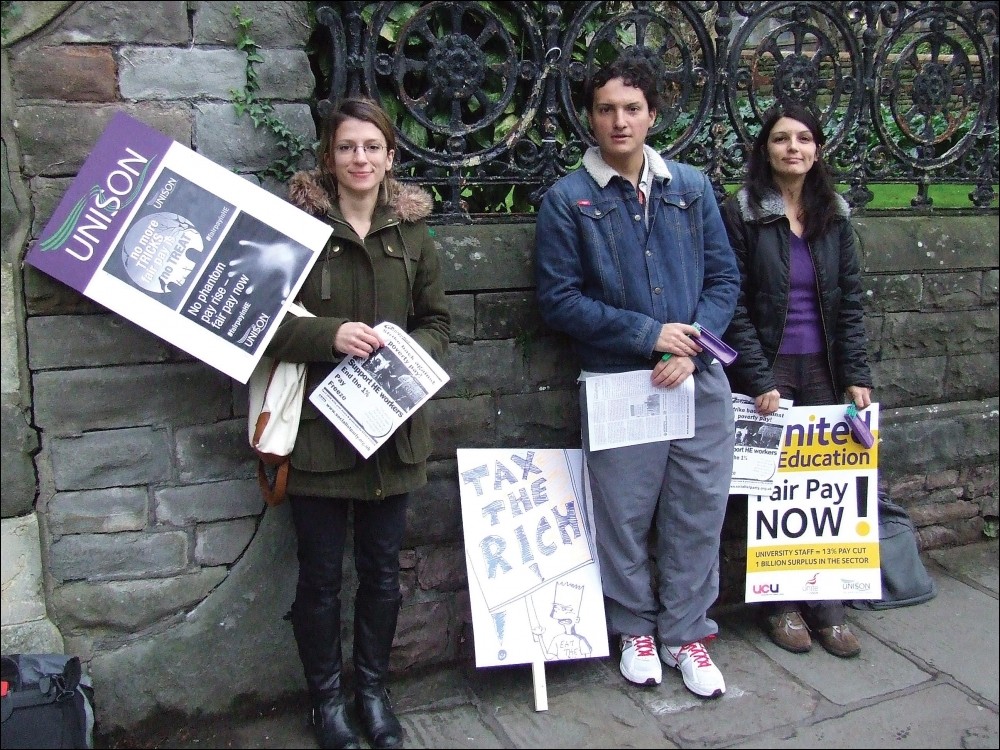
Bristol university workers on strike in October 2013

Bristol university workers on strike in October 2013


On 3 December university and college workers will be taking action. This strike day involves UCU, Unison and Unite members working in universities who struck on 31 October, now joined by further education (FE) members of UCU in England and higher education (HE) members of EIS in Scotland.

In HE, the employers' organisation UCEA returned to negotiations with the unions, but did not improve on the initial pay offer of 1% that triggered the dispute. Rattled by the 31 October strike, they have asked the individual employers to impose 1%. University workers are fully aware, however, that their employers have multi-million-pound surpluses and reserves while staff incomes have fallen by 13% in real terms since 2008.

FE staff have similarly experienced a 15% real-terms pay cut in the last four years, and have just rejected their employers' offer of a 0.7% increase - that is, another below-inflation rise - with over 70% voting tostrike. This doubtless reflects the anger union members feel when research shows that over half the lecturers in FE work ten hours' unpaid overtime during an average week, for dwindling pay.

Many student unions and the NUS nationally have passed resolutions in favour of the action, with Socialist Students and other campaigning groups building support. Ultimately our interests are all the same - for a public, fully-funded education system, free at the point of use and democratically run.

This background makes the coordinated national strike action particularly positive - the more unions that can be brought out together, the greater chance of success. At the same time, it is important for each dispute to have a strategy and to keep its own momentum.

Industrially, we need to work to build for a 24-hour general strike against austerity; and politically, trade unionists and students need to consider the question of an alternative to the three parties of austerity. Education is been under attack - we need to fight to defend it!

Monday, 18 March 2013

NUT and NASUWT call joint action

From: http://electmartin1.blogspot.co.uk/2013/03/nut-nasuwt-joint-action-proposals-fall.html


Plans for joint action announced – but firmer action needed to protect teachers and education 

The announcement at today’s joint NUT/NASUWT Press Conference that plans are being put in place for joint strike action between the two main teaching unions, the NUT and NASUWT, will be welcomed by teachers who have been waiting since Christmas for national action to be called to oppose Gove’s plans to impose performance-related pay. However, as the details become clearer, we think that many members will feel, as we do, that these plans have to be strengthened if we are to successfully oppose Gove’s attacks on our pay, pensions and conditions.

A school-term lost without action being called


It was in early December that Michael Gove made his announcement that, under legislation to be imposed after Easter, fixed incremental pay scales will be abolished and all future pay-rises would be tied to performance. In addition, teachers moving to new posts face the risk of huge pay cuts as their existing points on the pay scale will no longer be protected. This huge attack will leave teachers’ livelihoods dependent on arbitrary judgements of ‘performance’ and on the health - or otherwise - of an individual school’s budget. As the history performance-pay has always shown, it will also have a deadening and demoralising affect on education as a whole. All of this comes on top of the ongoing attacks on teachers’ pensions and the relentless workload still being imposed on staff.


Given the scale of the attack, and the speed at which these plans were being imposed, a minority on the NUT National Executive, including ourselves, have argued that national strike action should be called THIS term - in time to try and persuade Gove to back-down before legislation was enacted. Regrettably, and despite contrary evidence from elections, surveys and most Union meetings, we have been told that members weren’t ready to support strike action, and certainly not unless the NASUWT took joint strike action too. Strikes have not been called for this term and nor has a serious enough campaign begun to explain the threats facing teachers’ pay in order to build for that action.

Can we fight off these attacks school-by-school?


This term’s delay means that legislation will now become law before unions have taken action. As a consequence, all schools will be expected to adopt new pay policies that link pay rises with performance by the summer.


Regrettably, instead of starting with unifying national action, the battle will now be starting with school-by-school struggles to persuade governors to adopt pay policies that circumvent most of Gove’s plans. Given where we are now having to start from, the plans announced today for the NUT and NASUWT to publicise a joint pay policy are correct. However (and we have not yet seen the details of the policy ourselves), even the best policy will not be able to protect teachers moving to other schools where governors have refused to guarantee to protect existing pay points. Short of winning withdrawal of Gove’s legislation, unions will therefore need to mount a battle that can persuade the vast majority of schools to adopt an acceptable pay policy. How should that be done?


The NUT and NASUWT have also announced today that the ‘Action Short of Strike Action’ (ASOSA) campaign, launched jointly in September over workload, observation protocols and appraisal policies, be extended to cover pay policies too. The threat of non-strike action, escalating to strike action if required, has succeeded in making gains in well-organised schools groups and Local Associations. However, even then, compromises over the finer details of observation policies were sometimes made in order to reach agreement. The same may well happen over pay policies. 


The real weakness of such a school-by-school action approach is that, faced with intransigent management at a school and/or Local Authority level, some teachers will not feel confident in taking isolated action. In addition, even the best-organised Association will struggle to have the capacity to monitor and support members across all the individual schools in their area. The danger will be that less strongly unionised schools become isolated and only a minority adopt acceptable pay policies.


In order to overcome this isolation, action will need to be co-ordinated across as many schools as possible and, where Local Authorities refuse to recommend acceptable policies, across the whole Association. However, this requires that both unions adopt a far more urgent approach to warning teachers about these pay threats and in encouraging ‘ASOSA’ than has been seen up to now. But the best way to overcome isolation, and to show both teachers and governors that unions are serious about opposing these pay attacks, is to launch a vigorous campaign of national strike action. This should be combined with a bold public campaign to explain how Gove’s plans threaten education.

These plans are not strong enough to defend teachers


In our view, the plans announced today for joint action do not show Michael Gove, our members or Heads and Governors that we are taking this battle as seriously as we need to be. The plans suggest that there will be no national strike action in the summer term, just the beginning of rolling regional action in one area, on 27 June in the North-West of England. The indications are that this should be followed by further regional strikes in the Autumn – but with no national strike action being called until nearer Christmas.


As in March 2012, when Martin, as a NUT National Executive member for Inner London, went all-out to help build a regional strike called in the capital city alone, we will work hard to build action that is called. However, then and today, many teachers will have understandable doubts about this proposed plan of action. Yes, regional action spreads out the ‘pain’ of pay deductions but, as London teachers questioned a year ago, will such a slowly unfolding regional action have sufficient impact?


Teachers are practical people. They will be prepared to put up with pay deductions if unions can show that this temporary loss is likely to achieve a victory that means that the long-term pay losses from the permanent imposition of Gove’s pay and pension robbery plans can be avoided. But the plans announced today are not yet up to the job. Both NUT and NASUWT members need to tell their Unions to go back and strengthen the proposed plan of joint action.

Unions should call national strike action next term

If, despite bullying from Ofsted and budgetary pressures, we are going to successfully persuade schools not to apply Gove’s wishes, then the planned action needs to be stepped up. If, and this is the only real guarantee of success, we are going to mount sufficient pressure on Gove to withdraw this legislation before the new rules lead to teachers’ pay progression being blocked from September 2014, then, again, a far more vigorous plan of action is needed.
 
Both unions need to raise their sights and shake off their timidity. We should have confidence that, when the scale of these attacks are explained to teachers, they will respond to a firm call to take national strike action. 

The NUT and NASUWT are right to call on the Secretary of State to meet with unions to discuss our demands over pay, pensions and workload and to suspend any implementation of his divisive performance-pay proposals.  But what are unions bringing to the table that is going to make Gove think again? Instead of starting with regional action, teaching unions should be calling national strike action next term, perhaps escalating from a one-day strike up to 48-hour strike action. That’s a program that would show that unions were deadly serious about defeating these attacks.

Defeating Gove or just influencing the General Election?


The problem facing teachers is that some of their union leaders, in both the NASUWT and NUT, are not confident about making a bold call to action. Some Executive members seem to be looking at the timescales for action in a very different way to us. We fear that some have wrongly concluded that unions cannot defeat the Coalition, and so think our campaign should be restricted essentially to localised campaigns over pay policies. In this scenario, wider strike action isn’t then really aimed at defeating Gove but, over a longer timescale, at influencing the outcome of the next General Election.


Firstly, that approach will leave many of our members suffering pay and pension losses, and ever greater bullying and workload thanks to performance-pay, before any General Election is called. Secondly, it’s clear that, whatever the result of that Election, we can’t rely on any of the main political parties to adopt policies that oppose the pro-cuts, pro-privatisation agenda that demands the imposition of performance-related pay. It’s a strategy that just postpones launching a serious battle, demobilising and demoralising our members – and risks serious defeat. Instead, that serious national struggle needs to be waged – and soon, before we run into a quagmire of local disputes.


This Government is not as strong as it seems. Instead of just hoping for the best from a future Labour Government, unions should be co-ordinating action now, rebuilding the momentum that has been lost since the co-ordinated national strikes of 2011, including building for a 24-hour General Strike that could really start to shake this Government off its present disastrous course.

NUT and NASUWT Conferences must call for a strengthened program of action


Teachers in both the NUT and NASUWT will be asking questions about the strengths and weaknesses of the plans announced today. There will be relief that a concrete plan of joint action has now been announced. However, we think many will fear, as we do, that the potential advantages of united action across both unions could be wasted if the joint program of action that is agreed upon is too weak to adequately defend members of either union.


Today’s Press Conference announced that joint rallies are being planned for April and May in a number of cities. Classroom teachers of both unions – and parents and trade unionists that might also be attending - need to be calling for a more vigorous campaign of action to defend teachers and education. But, in reality, it will be hard to change these plans unless delegates at the two unions’ Annual Conferences meeting this Easter have already voted to improve the plan announced today.


Of course, delegates will be urged to back the agreed plan and, particularly at the NASUWT Conference, that call to back the leadership will be influential. However, NUT Conference delegates need to make sure that a plan of action is agreed that is up to the task of defeating these attacks. If the NASUWT feel unable to call national strike action earlier than, say, November, then that must not stop the NUT Conference from deciding on additional actions besides those jointly agreed. 


There are other unions also calling for co-ordinated action at an earlier date. For example, at the TUC’s pre-Budget rally last week,PCS General Secretary Mark Serwotka publicly called for unions to take co-ordinated national strike action jointly with the PCS on June 26. As a minimum, surely that is a request that the NUT should support - and call on the NASUWT to do the same?


After months when calls for ‘confidentiality’ about talks between the two unions have prevented full and open debate within the NUT about the action that needs to be taken, today’s announcement needs to be the start of an urgent discussion leading up to NUT Conference, not a plan that is just presented as one that delegates are expected to rubber-stamp over the Easter weekend.


The Local Associations National Action Campaign (LANAC) will be seeking to aid that debate and bring together delegates who wish to propose a strengthening amendment to these plans. A fringe meeting on the Saturday evening of Conference in Liverpool (March 30) will be held to see if delegates can agree a common proposal to put to a Priority Motion expected to be tabled after this week’s meeting of the NUT National Executive.


Teachers should urgently discuss today’s announcements and let their NUT Conference delegates know what they think Conference needs to agree if we are to defeat Gove’s poisonous pay plans.

Martin Powell-Davies, NUT National Executive member for Inner London

Peter Glover, NUT National Executive member for Cheshire / Merseyside


Sunday, 17 June 2012

‘Local Associations for National Action Conference’ to defend pensions, pay and conditions for teachers

From 'Martin Powell Davies - member of NUT Executive' blog:
http://electmartin1.blogspot.co.uk/2012/06/lanac-delegates-unanimously-call-for.html


Over 100 delegates representing over 30 NUT Local Associations gathered at the ‘Local Associations for National Action Conference’ in Liverpool on June 16 to discuss how to build national action to defend pensions, pay and conditions.

At the conclusion of a day of democratic debate and discussion, the following amended statement was agreed unanimously, formally setting up the 'Local Associations Network':

This conference agrees to maintain and build a network of local associations and school reps that will enable teacher trade unionists to exchange information, debate and discuss strategy to defeat the serious attacks we face, call on our National Unions to implement such a strategy, and organise solidarity between local and national struggles with the following aims:

1. Continue to work at every level in the NUT for the earliest possible return to collective industrial action in opposition to the attacks on pensions and for a calendar of action that can secure further concessions from this weakened Government. This must involve an escalating program of national action, starting from as early as possible in the autumn term, and continuing beyond, including strike action of more than one day's duration. The NUT should call on other teaching and non-teaching unions to join with us in setting that calendar of joint action.

2. Develop a fightback on workload, capability and abuse of classroom observations at school, local and national level based on collective action by members, including both strike and non-strike sanctions, non-cooperation, defined limits to workload demands and spreading success.

3. Identify, develop and spread the best examples of effective, confident organisation in the workplace which can deliver action, involve members and breakdown divisions between school unions, and build solidarity with associations, school groups and other unions taking action.

4. Welcome and seek to maximise the potential of the national joint declaration of intent between the NUT and NASUWT on action to defend pensions & jobs, and to fight excessive workload, local and performance pay, starting by making every effort to win the national NUT ballot this term with as large a majority and turnout as possible. Establish association campaign committees. Organise as many school meetings as possible, preferably with the NASUWT, to build for the ballot and endorse the Agreement.

5. Work to ensure that the joint NUT/NASUWT initiative:

(a) includes joint national strike action

(b) clearly and explicitly addresses the issue of pensions and demands the re-opening of talks with government

(c) leads to the development of rank and file links between the NUT and NASUWT including across schools.

(d) is not used to justify further unnecessary delay in taking action alongside other trade unions seeking to build co-ordinated strike action.

(e) includes far more effective sanctions than those in the existing NASUWT ‘action-short-of-strike-action’

6. Congratulate London associations on organising the lobby of the DfE on 10th May. Commit ourselves to organise similar actions in our areas, if possible with local NASUWT branches. Build the joint NUT/NASUWT demonstrations in Sheffield and Oxford on July 14.

7. Fight to have these priorities endorsed and prioritised by the national union and every NUT association.

From this Conference, we propose that:

a. We agree to set up a ‘Local Associations Network’ from today’s Conference that:

i) Hosts a website to publicise the network’s aims, to share materials that can be used in schools and associations to build local and national campaigns, and to inform teacher trade unionists about the latest developments in union campaigns, decisions and debates on the National Executive, and about actions being taken by teacher trade unionists and other public sector unions.

ii) is co-ordinated by a Steering Committee elected at today’s Conference. In electing the committee, the conference must ensure that the steering group is not dominated by any particular geographical area or political viewpoint but is inclusive to the range of associations supporting the aims of the network (* see footnote).

iii) produces a report of the discussion and decisions at today’s Conference to be distributed as widely as possible and certainly by associations sponsoring the Conference.

b. We publicise the concrete actions suggested at today’s Conference including:

iv) Sharing and circulating model materials urging NUT members to vote YES in the new ballot.

v) Calling on school groups and associations to lobby their NUT Executive members by sending letters and motions calling on them to vote for national strike action to be held as soon as possible next term, such strikes to be co-ordinated with unions who are willing to take action, such as PCS and the NASUWT, wherever possible but not tied to such joint actions alone.

vi) Inviting Executive members to Association and school group meetings to explain the position they have taken and to listen to the views of members in schools.

c. We convene a further Local Associations Conference next term to review progress made in both revitalising the pensions campaign - and in building effective action to tackle the other attacks facing teachers and education - and to discuss our next steps.

* It was agreed that this proposal would best be met by agreeing that each Association that agrees to affiliate to the Local Associations Network and supports the Network's aims is entitled to one representative on the Steering Committee, to be decided by that Local Association, and that the first meeting of the Committee should be in early September.

As agreed unanimously (with amendments) by LANAC Conference on June 16 2012. 

Thursday, 15 March 2012

Reports of student protests across the country

Wednesday, March 14th saw hundreds of students protesting against cuts, tuition fees and privatisation across the country. This day was part of an NUS called ‘walkout’. But in reality the vast majority of actions were organised and built by Socialist Students members and anti-cuts activists. Despite little to no support for action from most students unions locally and NUS nationally, the series of successful demonstrations and college walkouts which took place showed the huge anger on our campuses. Students and young people are not willing to simply accept Con-Dems brutal onslaught on our education and our future – we are determined to fight back!

http://socialiststudents.org.uk/wp/?p=325


London, Claire Laker-Mansfield

In London around 500 students joined a march from the University of London Union to the Department for Business innovation and skills. The demonstration displayed an enormously angry mood which was directed at the government and in particular the universities minister, David Willetts. The protest had clear demands, against tuition fees, cuts privatisation and for the immediate reinstatement of EMA. Outside Downing Street, a short sit down protest took place. Unfortunately no rally was organised at the end of the education which could have played an important role in giving a way forwards for the movement. Socialist Students says what’s needed now is to go back to our campuses and continue to organise. We need local campaigns linked on a regional and national level, united with workers struggles with a strategy for victory. March 14th is just the start!

West Lancashire College, Phil Rawsthorne

The students, both in Skelmersdale and nationwide, were protesting against the vicious cuts inflicted to public services by the multi-millionaires of the Conservative led government. Specifically, the students demanded an end to ‘hidden’ university fees and the return of the E.M.A. payments, ruthlessly stolen by the Tories from working-class students nationwide. Also on the agenda was a desire to stop the Tory plans to privatise the NHS, and a demand to end slave-labour ‘workfare’ schemes that force the unemployed to work for £1.67-an-hour.During our march, we recieved excellent support from the Skelmersdale public, who showed a genuine interest in the issues we raised, as well as genuine worries regarding the reckless slashing of public services inflicted by this unpopular and uncaring government.

As the vast majority of the marchers are regular Champion readers, we would be delighted if you could publish any coverage of our march, and feel very much that it is of great public interest to the people of Skelmersdale.

Sheffield, Wylie Hume
Students from both the University of Sheffield and Sheffield Hallam University walked out of lectures in protest of rising tuition fees, the scrapping of EMA and all the cuts to education. This was part of the NUS called national walkout. Sheffield Socialist Students put pressure on the Student Unions at both universities but was unsuccessful in getting them to support for the walkout. However, Socialist Students along with other groups organised a demonstration of 50 people inSheffield city centre regardless of the lack of support from the student union executives who were unwilling to fight for the living, studying and working conditions of students. Students marched through the city centre to the City Hall were a rally took place with speakers from Socialist Students, Unite and the NUS. The students also passed McDonalds where they paused on their march to protest against the company’s shameful participation in the ConDem government’s Workfare scheme which forces young people to work for their benefits. The March gave a real presence in the city centre and many people expressed their support for students in their fight back against the government’s attempts to make students and workers to pay for the crisis of the rich. During the march many students showed interest in joining Sheffield Socialist Students and joining the fight that will continue against education cuts and putting pressure on the NUS to call further action.

Nottingham – by Helen Pattison

Socialist Students called a small demo at 11 which attracted a lot of attention, including from the campus security who tried to tell students it was against the law for them to hand out leaflets. Because it was an open day there were not only lots of students taking leaflets, but lots of future students who would be paying the fees who welcomed the action. The walkout got a good response and showed that the students were keen to keep up the pressure against the fees and cuts being proposed to universities. But there was also a lot of anger and the lack of support from both the NUS and the SU who were disappointed that they hadn’t heard about the action and it hadn’t been built for more widely.
Leicester – by Rebecca Christiensen

Around 20-30 engaged activists gathered at the steps outside Leicester Student Union protesting against privatisation of the university, education’s fees and also the cuts in general. We handed out a large amount of leaflets and got quite a few new contacts. Of course, a protest is not enough for Leicester Socialist Students so we are following up with a public meeting about the education cuts and privatisation to provide the political alternative and how we can fight it. Hopefully some of our new contacts will come along so that we can build a stronger Leicester Socialist Students.

Lincoln – by Alex Moore

40 students marched noisily around the campus of the University of Lincoln in protest against the rising of tuition fees and the cuts to education. After the rally which featured speakers from Socialist Students Lincoln, Youth Fight for Jobs Lincoln and Lincoln and District Trades Council, a teach-in was held in the university. Students listened to and discussed different topics such as Housing, Black Panther movement, Attacks on Public Sector pensions, and young people and politics. Socialist students organised and built for the demonstration and teach-in and was able to push the Student’s Union into helping organise the demonstration. This shows the key role active socialist students can have on campus.

Manchester, Hugh Caffrey

A good contingent of students marched from Manchester Uni to MMU against cuts fees, privatisation and for EMA. Socialist Students were to the fore in building for the demonstration and on the demonstration itself, it was our leaflets and our posters that provided the vast majority of publicity for the day and on the day. A Socialist Students public meeting in the evening in Salford attracted several students including 5 for whom this was a first ever Socialist Students meeting.

Thursday, 24 November 2011

Bring Back EMA!

Youth Fight for Jobs (YFJ) is campaigning for the reinstatement of the EMA. This is a small grant of £30 a week for 16-19 year olds in further education. It allows students to pay for their bus fare to school or college and for books and other equipment.

The government says it cannot afford to pay this small amount of money. Yet the banks that were bailed out with billions of public money are still giving their chief executives millions in bonuses. The number of billionaires is increasing as young people are being denied the right to go to education. There has been an estimated 49% drop in the number of students going to college this year as a result of this cut. But this is not the only attack. Those wanting to go to university are being told they will have to pay £9,000 a year. There are now over 1 million young people unemployed. Instead of creating jobs, the government is just going to force people to work for their dole money. We didn’t cause this crisis and so shouldn’t be made to pay for it! YFJ says: we won't be a lost generation!

Southwark Council in London is going to continue to pay EMA to people living in that area. We demand that our local councils do the same. But we don't think that they should just cut other services to pay for it. They should launch a campaign to demand that the government gives them the money!

We are collecting signatures on a petition to give into the council. If we get enough, they will be forced to debate the issue in a full council meeting. We want to organise lobbies and protests of the council to make our voices heard and make them bring back EMA!

***WHAT CAN YOU DO?***

SIGN OUR PETITIONS:

NOTTINGHAM - need 5,000 signatures for the city council to debate

http://www.ipetitions.com/petition/...

LINCOLN - need 3,500 signatures for the county council to debate

http://www.ipetitions.com/petition/...

DERBY - need 8,500 signatures for the city council to debate

http://www.ipetitions.com/petition/...

LEICESTER - need 1,500 signatures for the city council to debate

http://www.ipetitions.com/petition/...

COME TO OUR ORGANISING MEETINGS:

NOTTINGHAM

Saturday 10th December
3pm
ICC (YMCA) 61B Mansfield Road, Nottingham, NG1 3FN

LINCOLN

Saturday 10th December
3pm
Community Centre, Croft Street, Lincoln, LN2 5AX

DERBY

Saturday 3rd December
3pm
Lonny Wilsoncroft Community Centre, Stepping Lane, Derby, DE1 1GL

LEICESTER

Saturday 3rd December
3pm
Room 216, Attenborough Building, University of Leicester, University Road, Leicester, LE1 7RH

JOIN YOUTH FIGHT FOR JOBS!

- Visit www.youthfightforjobs.com
- Message admins for more info
- Invite your friends to join this group and sign the petitions
- Organise a Youth Fight for Jobs in your local area!

Wednesday, 9 November 2011

Support today's two national demos - Construction workers and students

There are two important demonstrations in London tomorrow, the first is a national construction worker's protest and the second is a nationally organised student demo against cuts and fees, the police are trying to scare people away by threatening to use rubber bullets. If your going to one, you should be able to make the other, and Socialist Party members will be intervening on both including members from the South West. Hope to see you there.

Construction workers' national demonstration
Wednesday 9th November 2011
7am
The Pinnacle building site, Bishopsgate, London


National student demonstration
Wednesday 9th November 2011
Assemble 12 noon
University of London Union, Malet Street, London

Saturday, 22 October 2011

Jarrow March 2011 Events - Marchers visiting Bristol this weekend

As has been covered on this blog, Youth Fight for Jobs have organised a recreation of the Jarrow Crusade of 75 years ago, marching from Tyneside to London to highlight the issues of youth unemployment and education cuts, including the removal of the EMA and the trebling of university tuition fees. This march has got a lot of national press coverage, including an endorsement from The Fonz on the One Show (available to watch here).
 
Jarrow marchers are visiting Bristol this weekend and there are several events organised while they are here. Please come along to show your support for an event that is making the ConDem government squirm by proving that youth unemployment cannot be ignored. We won't have a lost generation!
 
Fundraising Gig
Sunday 23rd Oct, 8pm. Grain Barge, Mardyke Wharf, Hotwells, BS8 4RU. Entry £5.
 
Public Meeting
Monday 24th October, 7pm. City of Bristol College (College Green campus), St George's Road, BS1 5UA
 
National Demonstration
The end of the Jarrow march will be marked by a national demonstration in London on Saturday 5th November. Coaches will be going from Bristol, leaving 8.30am from Anchor Road (opposite @Bristol). Contact Tom Baldwin on 07986951527 to book a place.

Wednesday, 13 April 2011

TUC: Education cuts, 9k tuition fees, and now loans go up...

Using RPI to set student loans will cost graduates up to £5,000 more, says TUC

The government's refusal to change the interest rate on student loans from the retail prices index (RPI) to the consumer prices index (CPI) - despite already doing so for key benefits, tax thresholds and public sector pensions - will leave graduates thousands of pounds deeper in debt, the TUC warns today (Tuesday).
The RPI inflation figure for March, published later today, is crucial for many graduates as it is used to set the interest rate on student loans from the following September.
While some graduates are currently paying back their student loans at 1.5 per cent due to historically low Bank of England interest rates, RPI is the most common method for calculating the interest rate on student loans - and the only method for those taking out loans before 1998.
A TUC analysis has found that a graduate with a student loan of £25,000 and on the average graduate salary will pay an extra £4,800 and take two years longer to pay off their student loan if it is uprated by RPI rather than CPI.
Graduates with higher levels of debt, lower earnings growth or broken career patterns, for example if they stop working full-time to look after children, will pay an even greater amount, says the TUC...

Wednesday, 30 March 2011

BADACA: Report on recent UCU strike

Taken from: http://www.bristolanticutsalliance.org.uk/2011/03/30/university-lecturers-strike/
There have been two days of strike action called by the University and College Lecturers Union against attacks on pensions, pay and job losses. The action on Tuesday 22 March affected Bristol University and on Thursday 24 March lecturers at Bristol University, UWE and the City of Bristol College came out. On Tuesday there was a march to a rally outside the Wills Memorial Building and on both days the picket lines were supported by students. A poll of students overwhelmingly supported their lecturers’ action.
The pensions issue affects hundreds of thousands of public service workers. The Hutton Report is recommending the ending of final salary pensions and a later retirement age, eventually increasing to 68. This is the one issue on which there can be a general strike of public service workers without breaking the anti-trade union laws. Amongst the unions, the PCS and NUT are preparing for just such action.
Congratulations to the university lecturers for leading the way.