Showing posts with label Marxist Theory. Show all posts

Friday, 24 January 2014

Lenin's revolutionary legacy

Lenin's revolutionary legacy

A review of "Lenin", by Lars T Lih

In an attempt to answer the description of Lenin by capitalist historians as a brutal dictator, some on the left turn to Lars T Lih. He has tried to reinvent the leader of the Russian revolution as some kind of woolly liberal. In so doing, Peter Taaffe writes in the February 2014 issue of Socialism Today, the understanding of how to build a movement capable of transforming society is in danger of being lost.
In the recent 'revolution' in Ukraine - aimed against Vladimir Putin's attempts to blackmail the Ukrainian government to keep within Russia's sphere of influence - a crowd demolished the last remaining statue of Lenin in the capital, Kiev. Statues like this were erected in the past in the former 'Soviet Union' by the privileged Stalinist bureaucratic elites, who wished to screen themselves from the anger of the masses by basking in the political authority of Lenin. In reality, they were separated by a colossal gulf from Lenin's real ideas about socialism and workers' democracy.
In the capitalist West there were few if any statues of Lenin to be toppled. So capitalist historians and academics, particularly after the collapse of Stalinism - and with this, unfortunately, the planned economies in Russia and Eastern Europe - did the next best thing. They vilified Lenin, and his co-leader of the Russian revolution, Leon Trotsky, in an attempt to systematically discredit the ideas of socialism and genuine Marxism.
In a series of weighty tomes a small army of modern 'historians', like Richard Pipes, Orlando Figes, and not forgetting the inimitable Robert Service, undertook a colossal rewriting of history. Figes was publicly exposed as criticising other historians' works while secretly writing laudatory reviews of his own books! Service's 'biography' of Trotsky, which we answered as soon as it was published, has now been discredited even by non-Marxist historians as lacking any objectivity.
Today, however, a new, more 'subtle' approach is required given the protracted crisis of capitalism, which has seen a renewed interest in socialism and Marxism. There is already a revolt in academia against the previous concentration on pro-market, capitalisteconomic teaching. There are increasing demands by students and lecturers that they be familiarised with the ideas of Karl Marx, as well as the more 'radical' of the capitalist Keynesian economists. In this can be perceived an element of the reappearance of the 1960s within the hallowed institutions of learning. The enormous radicalisation of students and academics which developed then was a reflection and, to some extent, precursor to the mass movements of workers in the 1960s and 1970s.
This book by Lars T Lih - first published in the 'Critical Lives' series in 2011 - is a response to this new situation. In it, and in his other writings, he is more sympathetic to Lenin than those historians mentioned above. But the claim on the jacket that the book "presents a striking new interpretation of Lenin's political outlook" is overblown, to say the least. Lars himself admits: "My view of Lenin is not particularly original and chimes in closely with most observers of Lenin and his time". Unfortunately, 'most observers' are still not 'sympathetic' to Lenin's views. This is particularly the case when it comes to the character of the kind of party the working class will need for a successful struggle against capitalism and for socialism.

Workers and peasants

Trotsky, who barely gets a mention in this book, gives a much richer account of the real history of Bolshevism in its initial phase in his unfinished biography of Stalin, albeit in a sketchy fashion. He also outlines clearly the views of Lenin on the crucial issues of the character ofrevolutionary party needed, and on the structures and practices of such a party, including democratic centralism and its origins.
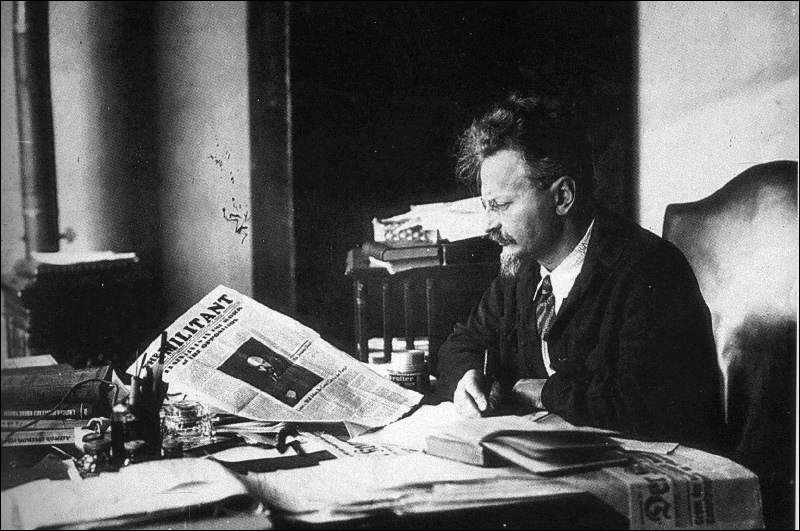
Leon Trotsky reading The Militant newspaper in 1931
Leon Trotsky reading The Militant newspaper in 1931   (Click to enlarge)
Lars on the other hand, writes in a misleading, cloudy and abstruse fashion: "Lenin had a romantic view of leadership within the class. He sought to inspire the rank-and-file activists... with an exalted idea of what their own leadership could accomplish". In the same vein the book is irritatingly peppered throughout with phrases like Lenin's "heroic scenario". Then there are crude assertions on relations between the working class and the peasantry in Russia: "His insistence on the peasant as follower did not exclude an exalted, even romantic view of the peasants in the revolution. Heroic leaders required heroic followers".
Of course Lenin, like most Marxists, could be enthusiastic. In turn, they could be enthused by the spectacle of workers in struggle, especially when it reached a high point of revolution. Marxism is saturated with the spirit of optimism. At the same time, Lenin is deadly realistic about the prospects of the class struggle in general and all the issues involving the fate of the working class. His view of leadership, as with the need for the party, was not 'exalted' but practical and flowed from what was necessary.
Then again, what are we to make of Lars's conclusions at the end of the book when he writes: "Old Bolshevism was defined by its wager on the revolutionary qualities of the peasantry. Yet less than a decade after his death, the regime founded by Lenin was waging war on the peasants and imposing a revolution from above during the collectivisation campaign, contributing to a devastating famine". (p202)
Firstly, Bolshevism never put a 'wager' on the peasantry, but recognised that it could never play an independent role. Therefore, the issue was who would lead them in the revolution - who would satisfy their demand for the land - the working class or the bourgeoisie? History attested to the fact that the working class satisfied the peasantry in action, after the bourgeois and its parties had demonstrated that they would never give the land, as well as peace and bread, to the masses, including the peasant masses. Secondly, it is ludicrous to identify "the regime founded by Lenin", as Lars does, with that presided over by Stalin, already, ten years after Lenin's death, one dominated by a privileged bureaucratic elite. Indeed, Lenin's widow, Nadezhda Krupskaya, famously stated in 1926 that if Lenin had lived, he would have been imprisoned under the Stalinist regime.

The revolutionary party

There are many misleading, and consequently erroneous, statements like this in the book and it cannot therefore be fully embraced as a correct account of Lenin's role in history. But it has been taken up by some on the left, even in certain quasi-Marxist circles. This is because Lars's presentation, particularly in relation to democratic centralism, chimes with a layer who rejects this idea, the 'hard' Lenin, in favour of an allegedly 'more open' one. It is not the first time we have confronted this phenomenon. In the 1960s and 1970s, journals like New Left Review would 'discover' woolly 'ground-breaking new theoreticians' who would then invariably disappear almost as quickly as they had appeared.
Lars's ideas have become the current fashion for those who are fleeing from genuine Marxism and the real traditions of Lenin and Trotsky. Vital in this respect is the need for a revolutionary party based upon the traditions of democratic centralism. This in no way contradicts the broader task of organising a mass workers' party at this stage. Of necessity, this will be required to organise on a much looser basis, involving a form of federation and in Britain, of course, rooted in the trade unions. The maintenance of a clear Marxist core within such broader formations is absolutely necessary. Without this, there will be no long-lasting gains for the working class.
History, including recent history, reinforces this point. For instance, the main forces behind the formation of the Scottish Socialist Party (SSP) in 1998 came from our party. The leadership of Militant supported the formation of such a broad party; in fact, we were the first to advance this idea. But the leaders of Scottish Militant Labour (SML) proposed and carried out, at the same time as forming the SSP, the effective winding up of SML into this party. This, in turn, led to their separation from the Committee for a Workers' International (CWI) in Scotland and internationally. They were not expelled but voluntarily departed from our ranks.
We warned at the time that not only would this mean the tragic weakening of a distinct revolutionary organisation and tradition in Scotland but, at a certain stage, the complete disintegration of the SSP as well. Unfortunately, this was borne out. A similar process happened in Italy, where different Marxist organisations joined Rifondazione Comunista (RC) when it was formed in 1991, but were incapable over time of winning the ranks of this party to a clear Marxist position. The RC has now effectively disintegrated.
Compare this to the achievements of Militant, both when it was in the Labour Party - in 1964, we had no more than 40 supporters - and during our expulsion in the late 1980s. The conclusion to draw from this is that in the case of both Scotland and Italy there was not a sufficiently organised and politically trained Marxist core capable of either winning a majority in the party or at least gaining more significant numbers, which could then form the basis of a new organisation or party.

The class, party and leadership

These mistakes flow from an incorrect understanding on the part of some Marxist forces of the relationship between the class, a party and its leadership. 'Democratic centralism' - the term itself - was not an invention of Lenin, but was first used in the Russian workers' movement by the Mensheviks within the Russian Social Democratic Labour Party (RSDLP). However, the conception of a party, its methods of organisation, and how discussion and internal debates should be conducted, have a long pedigree, beginning with Marx and Engels themselves.
This is shown, for instance, in the rules of the Communist League of 1847, of which Marx and Engels were members. Even before the term 'democratic centralism' was used, the concept was adopted within this, the first distinct international party of the working class.
In its statutes the Communist League states the conditions of membership: "Subordination to the decisions of the League... The circle [comprising a number of 'branches' as we would understand it today] authority is the executive organ for all the communities of the circle... The various circles of a country or province are subordinated to a leading circle... The Central Authority is the executive organ of the whole of the League and as such is responsible to the Congress... The Congress is the legislative authority of the whole League. All proposals for changes in the rules are sent to the Central Authority through the leading circles and submitted by them to the Congress... Whoever violates the conditions of membership... is according to the circumstances removed from the League and expelled".
Lenin took these and other examples from the historical experience of the workers' movement, including the German social democracy, and attempted to apply them to the specific conditions of Russia. Lenin's famous book, What is to be Done?, written in 1901, was devoted to the need for a centralised party in Russia. Lars deals, not very adequately, with some parts of the history. He touches on the disagreements over the formulas of Lenin in answer to the 'Economist school', who believed in concentrating on the purely day-to-day struggles. Lenin "bent the stick" too far, in his own words, in his description of how socialist consciousness arises in the working-class movement.
Lenin's assertion that socialist consciousness could only be brought to the working class from the outside by the revolutionary intelligentsia was wrong. He borrowed this also from the German social democratic leader and Marxist at the time, Karl Kautsky. Although Lenin corrected this later, it has been used to justify the haughty approach of self-appointed 'leaders', usually by tiny organisations, proclaiming to be 'the' leadership of the working class.
Trotsky paid tribute to Lenin's stubborn and painstaking work in laying the basis through the struggle of theBolsheviks for the mass party approach. Nevertheless, he emphasised that it was the 'steam', the working class, which is the driving force in the revolution. The party, if it acts correctly, plays the same role as a 'piston box' in harnessing this to a revolution.
Lenin emphasised the same point in opposition to the 'committeemen' who took shape in the underground. They were suspicious of the initiatives of workers. Trotsky had warned of the dangers of the emergence of such figures in his 1904 pamphlet, Political Problems. He pointed out that these types of committeemen have "forgone the need to rely upon the workers as they had found support in the principles of 'centralism'." Lenin recognised the dangers of a one-sided interpretation of what he was trying to build when he wrote: "I could not contain myself when I heard it said that there were no working men fit for the committee membership". Trotsky remarks: "Lenin understood better than anyone else the need for a centralised organisation; but he saw in it, above all, a lever for enhancing the activity of the advanced working man. The idea of making a fetish of the political machine was not only alien but repugnant to his nature". (Stalin, p103, Panther edition)

Democratic centralism

Lars T makes sweeping, incorrect comments about democratic centralism. He writes that there was no "exposition of the meaning of the term - Lenin used it in passing to make particular points". He also states: "Lenin's points would have been: 'Democratic centralism is not possible in underground conditions. Genuine interparty democracy is mandatory when possible and dispensable when not'."
But he is completely wrong in asserting, with no basis in the actual practice of Bolshevism, that democratic centralism was practised at one stage and then withdrawn in a completely arbitrary fashion at another. The Bolsheviks, as with all genuinely revolutionary organisations, based themselves at all times on the general principles of democratic centralism: maximum discussion until a decision is arrived at and then a united effort by the whole party, group or organisation to implement the decision. Even then, it is totally false to imply that all discussion and debate ended after the decision was taken. The history of the genuine workers' movement showed that vital discussion on unresolved issues continued in the form of internal bulletins, debates, etc, outside of the framework of the national congress of the party.
The different sides of this question might be difficult for isolated intellectuals to grasp but it is an idea that the working class readily understands, particularly its more advanced, guiding layers. It flows from the very position of the working class under capitalism.
Never in history has capitalism been more centralised than today. Never have the means of coercion - witness the revelations of Wikileaks, the massive surveillance by capitalist governments of their own populations, as well as other governments - been so concentrated in the hands of the capitalist state. It is inconceivable therefore that a loose network would be capable of mobilising to defeat this colossal power. Without a centralised mass party capable of unifying working people and then acting in a decisive fashion when the time requires it, it is impossible to carry through the socialist transformation of society, the greatest change in human history.
The working class instinctively understands the need for a centralised party and the discipline that goes with it. This is shown in every serious struggle, particularly strikes, involving the working class. When shop stewards, for instance, are called to discuss and debate an issue, and sometimes heatedly, they will usually strive to adopt one voice when putting the issue to a mass meeting. There will, of course, be occasions when a minority of stewards and workers will disagree with a recommendation, and in that situation Marxists would argue for a full debate to take place.
These methods, which involve elements of democratic centralism, are instinctively understood by working people. This is demonstrated by the recent statement of the National Union of Metalworkers of South Africa (Numsa). When they announced a break from the ANC and supported the idea of a new mass workers' party, they declared: "Numsa is a revolutionary union and as such plays a leading role in the defeat of capitalism and the exploitation that is associated with it. We are democratic centralist - we believe in robust, vigorous and democratic debate leading to a united decision and action".

Discussion and decision

What is then posed is the balance between democracy, full debates and discussions and upholding the rights of all members to participate in the formulation of policy, and centralism, the need to act in a unified fashion, at each stage. This cannot be decided a priori - through general principles applicable at all times irrespective of the concrete circumstances. Organisation, even in the mass revolutionary party, is not an independent factor for a Marxist. It is an inference from policy. It is politics, perspectives and programme, as well as the concrete circumstances, which determine what forms of organisation should be applied at each stage. But it is not true, as Lars T suggests, that democratic centralism is applied only in some circumstances, and not in others. For Marxists, democratic centralism means a 'mobile balance' between democracy and centralism, with emphasis being given to democracy or centralism depending upon the concrete circumstances.
In underground conditions, centralist methods tend to dominate over the full expression of democratic discussion, rights and principles. But this does not in any way mean complete centralism with little democracy. On the contrary, while struggling against the brutal tsarist regime and its police, the Russian revolutionaries, including the Bolsheviks, debated and fought with each other over programme and policy. This was a necessary means of sharpening the political and theoretical weapons in preparation for the revolution. There were even regular congresses, both in the underground and during the civil war.
There was full freedom of discussion and debate. But this did not mean for the Bolsheviks, particularly Lenin and Trotsky, that the revolutionary party should become a debating club. To those who characterise this method as inherently 'unhealthy', Trotsky had a word of advice. Faced with the disarray in the ranks of his followers in France in the 1930s, he commented: "An organisation smaller but unanimous can have enormous success with a clear policy, while an organisation which is torn by internal strife is condemned to rot". There are some organisations in Britain and internationally today to whom Trotsky's words are very apt.
Lars T tries to present a softer Lenin, more 'open' and 'democratic' than the 'centralist', if not authoritarian, figure that is usually invoked by bourgeois and most 'Marxist' historians alike. This 'new' Lenin is almost a 'liberal' in his alleged acceptance of open, public, unrestricted discussion in a revolutionary party.
This new approach towards Lenin distorts his real views. There were times when Lenin and Trotsky advocated the most open kind of discussion, even in public forums and at difficult times, which to some extent took place outside of the party. Nikolai Bukharin and the so-called 'Left Communists', who supported him in his advocacy of a 'revolutionary war' at the time of the Brest-Litovsk controversy of 1918, had a daily newspaper which argued against the ideas of Lenin and Trotsky.
The mass communist parties in France and Italy argued in their daily papers against the idea of the united front. But after two years they were compelled to implement the decision of the Communist International.
There are many other such examples, including Trotsky's initial support for the minority within the American SWP in the 1930s for a public discussion on the class character of the Soviet Union. However, he withdrew his proposal when his American co-thinkers pointed out that this minority was appealing in the main to the petty bourgeois milieu outside the party who had moved from support of the Soviet Union under the pressure of 'democratic' public opinion. This did not prevent a vigorous discussion within the ranks of the SWP on this issue.

Anti-party mood

Part of the capitalists' campaign in the aftermath of the collapse of Stalinism was to feed the popular mood, particularly among the new generation, against 'parties' and the model of Lenin's supposedly closed, authoritarian type of party. We argued against this but also recognised that anything that appeared to be tainted with the mark of Stalinism would repel the new generation looking for a political alternative.
This 'anti-politics' and 'anti-party' mood represented, in reality, a deep hostility towards all 'official', 'traditional' parties; in other words, the capitalist parties, including the social democrats and even the Communist Party who were identified with the old order.
Moreover, this mood lasted for a considerable period of time and is still an important factor in the political situation in many countries today. We have had the phenomenon of the 'indignatos' in Spain, with similar trends in other countries. In Spain, it reflected the entirely justified hatred of the so-called 'Socialist Party', PSOE. This was a factor in the formation of the indignatos in the first place. But this hostility was also often directed against Marxist groups, although the most active promoters of this within the indignato movement were themselves members of small political organisations. They were, in effect, 'anti-group groups'.
But what was the net result of this abstention from politics? In Spain, the disastrous election of the present right-wing PP government, which has presided over a devastating crisis, with youth unemployment levels well over 50%. Therefore, there has been a reassessment by this new generation who are once more returning to the idea of building a political alternative.
A similar mood was present in the Occupy movement, which developed on a world scale following initiatives in the US. Subsequent experience demonstrated that an amorphous movement, albeit fuelled by youthful energy and idealism but which lacked clear direction and organisation, represented little danger to the highly centralised and organised forces of capitalism. A new road was sought and a significant layer of workers and youth found this road in the spectacular election campaigns in Seattle and Minneapolis.
The election of a socialist to the Seattle council for the first time in 100 years represents a real leap forward in the possibility for political struggles not just in the US, but worldwide. Socialist Alternative took the initiative in this case, but similar radical political movements were expressed elsewhere: in New York with the election of Bill de Blasio, and his invocation of a 'tale of two cities', with 73% of the vote, and the election of 24 independent Labor candidates in Lorain County, Ohio.
A similar process has unfolded in Argentina, where a Trotskyist electoral front received 1.2 million votes in the recent elections. This arose from the completely changed situation compared, for instance, to 2001. Then, despite a catastrophic economic situation, parties were discredited; Marxist parties, in particular, made little headway.
These elections indicate that the situation has completely changed with the more conscious workers now aware of the need for organisation and parties. A layer has consequently transferred their hopes to this 'left front', which is in a particularly favourable situation to grow if it employs the correct tactics and openness to the new layers of the working class who will be looking for a mass party of their own in the battles to come. This is likely to involve the maintenance of a revolutionary core - in a distinct and separate organisation - seeking a wider base in a larger mass formation. There have been other opportunities in the past which have been lost because this open approach has not been adopted.

Look at Lenin in the round

Millions of workers are looking for a new way forward. This can be provided for them by the building of new mass parties of the working class. Because of the period that we have passed through, these are unlikely in most countries to immediately adopt a clear revolutionary, Marxist programme. But a Marxist organisation, working in an honest and open fashion, will be welcomed into the ranks by the best workers looking for a way forward.
Unfortunately, books like this of Lars T - and particularly those who uncritically praise his ideas - will not be able to prepare working people for the stormy but exciting period ahead. It does not present the ideas of Lenin clearly. It scandalously ignores the contribution made by Trotsky, in particular.
Our criticisms are not restricted just to the organisational plane. The author does not adequately explain Lenin's ideas in relation to the perspectives for the Russian revolution. The central idea of Lenin of the 'democratic dictatorship of the proletariat and peasantry' was different to the ideas of the Mensheviks, who saw Russia developing in a capitalist direction with socialism relegated to the mists of the future. Lenin completely rejected the idea that the weak Russian capitalists could carry through the tasks of the democratic capitalist revolution: of land reform, solution of the national question, the introduction of democracy, etc. Only an alliance of the workers and peasants, the overwhelming majority of the population of Russia, was capable of carrying through these tasks.
The weak point in Lenin's scenario, that Lars T in no way fully explores, is who would be the dominant force in the alliance between the proletariat and the peasantry. The whole of history attests to the fact that the peasantry has never played an independent political role because of its heterogeneity. Its upper layers tend to merge with the capitalists, its lower layers tend to sink into the ranks of the working class.
This is where Trotsky's famous theory of the permanent revolution comes in, which correctly anticipated how the Russian revolution would develop. Although a minority, the working class, because of its social position in society and its special features, dynamic and organised in big industry, would be able to lead the mass of the peasantry in revolution to overthrow the autocracy. Having come to power, it would then pass over to the tasks of the socialist revolution in Russia and the world. In Lenin's Letters From Afar, as well as his April Theses, he completely concurs with these ideas of Trotsky. This is not even mentioned in this book.
Lars T Lih's book undoubtedly presents an advance over the malicious distortions of Lenin and Trotsky's ideas. But at the same time, unless filled out and corrected, it will introduce further confusion as to what Lenin and Trotsky really stood for.

Lenin, by Lars T Lih, published by Reaktion Books, 2011, £10.95


Sunday, 11 August 2013

Socialist Party meetings this week - Why the pharmaceutical industry should be nationalised

Under capitalism, essential medication is privately produced and distributed for profit. In the developing world, HIV drugs are withheld from people that need them most as they are marketed first in the West, and even in the US many cannot afford the huge costs. Michael Wright explains why drug companies should be nationalised.

Tuesday 13 August: 7.45pm, Cheltenham Rd Library, Bristol BS6 5QX
Wednesday 14 August: 7.30pm Hydra Books, 34 Old Market Street, Bristol, BS2 0EZ

Find out more: http://www.socialistparty.org.uk/articles/16981

Tuesday, 28 May 2013

Large turnout at South West Socialist Party conference


"It was amazing to learn from some brilliant and thinking people yesterday. I've buried my head in the sand for too long and it was inspiring. Capitalism must end and I'd like to learn a lot more about how I can go about bringing about that change".

That was the verdict from Chris, one of three young people who joined the Socialist Party at the end of its largest South West regional conference for a number of years.

On Saturday 25 May Socialist Party members and supporters from 19 different towns and cities packed into a room in Bristol to hear Socialist Party deputy secretary Hannah Sell deliver a thorough analysis of the volatile situation unfolding in Britain and Europe.

Over 20 members followed this up with contributions that dealt with attacks in the workplaces and how we are helping to organise the fightback; a programme for opposing the far-right; lessons from struggles in Greece and Spain and the over-arching question of capitalism's chronic inability to take humankind forward in the 21st century; and why therefore a socialist alternative is imperative.

Workshops on women, youth, and building in the workplaces followed. Each resulted in practical initiatives keenly being agreed, including the organising of a regional women's meeting early in July, the stepping up of the 'Sick of your Boss' campaign from Cornwall to Cheltenham, and a trade union meeting in Exeter in September where the building of the National Shop Stewards Network will be one of our priorities.

Recruitment and finance

Robin Clapp, South West regional secretary, introduced a closing session on the progress made in the last 12 months. The rate of recruitment in the region is up by 50% over 2012 and every area has enthusiastic new people eager to take on a role in helping us to build.

It was agreed we would set up a branch in Somerset where we'll trigger fast progress by organising a Saturday 'super stall' in June with the aim of selling 75 papers and getting new members.

This follows on from the highly successful initiative in Poole where we sold 82 papers in four hours, 10 'join' cards were filled in and £46 was raised in Fighting Fund.

Conference committed itself to smashing through the new paper sales targets. This shouldn't be too difficult, given that every branch has already exceeded these targets on at least one occasion since March.

Mid-week stalls are now the norm in Plymouth and Bristol, workplace sales take place at council offices in Gloucester, and sales outside Bristol Temple Meads rail station have yielded 10-12 sales in a single session.

At the beginning of the conference, Plymouth and Gloucester branches had each recruited eight new members since January. By the end of the day, the Devonians were ahead having signed up somebody in the meeting. They have three more knocking on the door, Bristol has five who have agreed to join and this welcome infection is spreading rapidly across every branch in the region.

The viciousness of the Con-Dem attacks is polarising society, making many of those who have previously spent their evenings screaming at the television decide it's time to stand up and seek out a party that is serious about fighting for change.

The mood of optimism suffusing through the conference was expressed concretely by a magnificent collection which yielded £1,125 for our party funds.

The excellent Gloucester branch 'catering company' raised £70 towards our funds from selling their delicious food and Bev Anderson's fairy cakes went down a treat and gave us another £20.

The last word must go to Matt Stabb from Trowbridge who is new to our ranks but a veteran in the struggles of disabled workers:

"Cheers for a brilliant South West congress yesterday, comrades! Thank you for making me so welcome. It was so good to meet other comrades and feel part of the good work that is going on".

Saturday, 23 February 2013

Credit rating downgrading proves that austerity isn't working - Socialists call for mass movement to stop the cuts

Press release from the Socialist Party

http://www.socialistparty.org.uk/articles/16213/23-02-2013/credit-rating-downgrading-proves-that-austerity-isnt-working-socialists-call-for-mass-movement-to-stop-the-cuts

Hannah Sell, Socialist Party deputy general secretary says: "The government has justified brutal austerity by saying that it would reduce the deficit and protect Britain's AAA credit rating.

"As we warned the opposite has happened. The deadline for cutting the deficit has now been moved back to 2018. And today's news that Moody's has cut the credit rating compounds that failure.

"There is no justification for the misery the governmentis inflicting on working class people. This crisis is a crisis of capitalism; caused by big business and in particular the bankers.

"Ordinary people should not be paying for it with our jobs and services. We are part of building a mass movement against the cuts.

"We support the campaign by trade unionists for the calling of a 24-hour general strike as the next step in the fight against austerity.

"We also believe the anti-cuts movement needs a political voice. We are part of the Trade Unionist and Socialist Coalition (TUSC) which brings together socialists and trade unionists, including the RMT, to stand candidates against cuts and privatisation."

Monday, 14 January 2013

Crisis in the SWP: Socialist Party material

http://www.socialistparty.org.uk/keyword/Left_and_radical/SWP

http://www.socialistparty.org.uk/books_pamphlets/Socialism_and_Left_Unity_-_A_critique_of_the_Socialist_Workers_Party/1

Please see the above links for Socialist Party material on the current and previous crises inside the Socialist Workers Party of Britain including critiques of popular frontism, state-capitalism, a history of their method and ideas and chapters from Peter Taaffe's 2008 booklet - Socialism and Left Unity: A critique of the Socialist Workers Party

Saturday, 5 January 2013

Democratic Centralism: The need for a party

In the light of ongoing events on the left, we link here to some material on the questions of organisation, party democracy and left unity that readers of our blog may find interesting, and we welcome debate around these issues.

Democratic Centralism by Peter Taaffe, 1996 - http://marxist.net/namechange/nameframe.htm

Published in Militant Labour Members Bulletin No.16, 'A discussion on Democratic centralism', 18 March 1996.

This discussion took place in the UK section of the Committee for a Workers' International (CWI), which at that time went by the name Militant Labour. This discussion on democratic centralism was followed immediately by the discussion on the name of the party, which dominated the following four members' bulletins (17 - 20) during 1996. It led to the decision to change the name from Militant Labour to Socialist Party in early 1997.
The Class, The Party and the Leadership by Leon Trotsky, 1940 - http://marxist.net/trotsky/cpl/index.html

This article is an unfinished work written by Trotsky and first published in 1940. It nevertheless forms a very valuable text.

Wednesday, 19 December 2012

Prepare to resist austerity in 2013

Editorial of the Socialist


Millionaire Tory Chancellor Osborne began his Autumn Statement speech with excuses for economic predictions reduced from 0.8% 'growth', to -0.1%, a contraction, and lower forecasts for years. Two days later the Guardian reported: "The City has put the UK on triple-dip recession alert after news that falling factory and North Sea production have sent the output of industry plunging to its lowest level in 20 years."

In reality the truth is the capitalist class in Britain, as elsewhere, have no solution to the deep-going crisis of capitalism they face. We've quoted Einstein's definition of insanity before, "doing the same thing over and over again and expecting different results", but it is certainly apt.

Osborne later pledged that a further cut in the rate of corporation tax to 21% from April 2014 - already among the lowest of the world's main economies - would bring us growth and jobs. But there is no evidence to show that previous reductions have had that effect - the opposite has happened.

On the one hand you have Amazon, Starbucks and co, corporate tax-dodging. On the other hand you have £800 billion lying idle in the bank vaults of the big corporations as they see no easy profit in spending it.

A government serious about improving the lives of millions would make a 50% levy on that stashed cash and use it to put money where it will make a difference - in working class and middle class people's pockets, through a massive programme of socially useful public works, through wage and benefit increases and real job creation not workfare, so we can actually spend money, raising 'consumption'. But they refuse to consider tapping their super-rich big business pals. In the same vein, Osborne decided against a mansion tax.
Blame game
Disgracefully but characteristically Osborne directed us to blame our neighbours for the cuts he announced, and talked about: "being fair to the person who leaves home every morning to go out to work and sees their neighbour still asleep, living a life on benefits ... we have to have a welfare system that is fair to the working people who pay for it."

The government's big lie, that we are divided into 'shirkers' and 'workers', must be smashed. They want us to blame each other for the poverty conditions we face - but it is them and the capitalist system they defend that are to blame. This budget limits most working-age benefits to a 1% rise for three years, breaking the link with inflation and meaning misery for millions.

Look at the figures: on average there are more than five job seekers for every vacancy. And the majority of new claimants for housing benefit are working people - with an estimated six million stuck in precarious, low-paid work. The real shirkers are the millionaires and billionaires whose wealth is continuing to pile up - whether they work or not - while we are being put on rations.

Infrastructure

Again we heard about Osborne's fantasy infrastructure plans - this time £5 billion to go into roads, broadband, science, etc. We'd all like to see investment in socially useful and planned infrastructure, bringing jobs and improved travel and living standards but his inadequate measures will be paid for by fresh cuts across most government departments.

The Ernst and Young Item Club said that this amount would have "minor, almost negligible impact", and Guardian research shows that of commitments made in the 2011 Autumn Statement very few of the projects announced have progressed. This year the Chancellor pledged £1 billion for roads but the Guardian reports that of the 18 road schemes in last November's budget work has not begun on one!

That the gas strategy is to include consultation on incentives for fracking represents major threats to health and safety and to the environment.

Teachers will face the prospect of performance-related pay, a bully's charter in effect. Already the number of teachers who quit their jobs in English state schools has risen by almost a fifth in one year. See page 4 for more on this.

Education spending shows a blatant transfer of wealth and partial control from ordinary people to the rich vultures preying on our public services.

A smug Tory education minister Michael Gove will be given £1 billion, 'saved' from government departments to spend on expanding his pet academy and free school project - in effect privatising schools, eroding education workers' rights and democratic accountability and transferring land from the public to the private sector.
Fail, fail, fail

Labour MPs made speeches attempting to show that the Con-Dems are "failing, failing, failing", as Ed Balls, shadow chancellor, put it. But Labour is also failing - failing to put up any alternative to austerity.

Osborne has promised austerity into the next parliament. If Labour announced that they would cancel all these measures if they won the next election they would be enormously popular.

Local government is to have a year's 'respite' from the massacre of its budget, notwithstanding previously decided enormous cuts coming down the line in April. But the year after there will be a 2% reduction in spending. What does this mean? No let up from the Tories handing the axe down to local councillors.

If Labour councillors cannot find the courage, as the few rebel councillors in Southampton and Hull have done, to vote against this annihilation of local services, they must step aside or face a challenge from people who will - and that means trade unionists and anti-cuts campaigners standing as 'no cuts' candidates.
Action needed

The case for building a new mass workers' party that would actually oppose cuts is clear. The Trade Unionist and Socialist Coalition, involving the RMT transport union and other leading trade unionists, is an important step in that direction.

The best way to show the mass opposition to austerity is to support the call for a 24-hour general strike. There is no question the mood is there. See the workplace reports on page 4, largely unreported elsewhere.

In Scotland Unison delegates representing union members in local government, health, education, etc, unanimously supported a motion calling for a coordinated industrial action strategy, beginning with a one-day strike across Scotland and coordination with unions across the UK for a one-day strike.

The PCS union has announced a ballot for strike action in the New Year - that will provide the basis for other unions to join the action. Such action would terrify this posh-boy government - look at the measures they take to try to weaken the unions. Strike action would also massively build the confidence of working class people that we can defeat the Con-Dems.

Socialist alternative needed


With all this comes a questioning of what kind of a society we live in that sees children malnourished, pensioners dying in the cold, and hospitals closing - while there is no shortage of wealth. It's unsurprising that, with a comparable situation in the US, a Gallup poll has found 39% of Americans now have a "positive image" of socialism, 53% among Democrat voters.

The 30% vote for a Socialist Alternative (CWI) candidate in Seattle in November's US elections is further evidence of the search for an alternative to rotten capitalism - in the belly of the beast itself. The times are changing and this is not limited to the US.

In 2013, linked to making a 24-hour general strike our rallying call, the case for democratic socialism, based on planning to meet the needs of the '99%', the overwhelming majority, as an alternative to bankrupt, rotten capitalism must be made at every opportunity.

Thursday, 15 November 2012

Che Guevara - Symbol of fashion or symbol of struggle?

By Tom Baldwin, Mayoral Candidate for Bristol, Trade Unionists & Socialists Against Cuts
Che Guevara, photo Alberto Korda
Ernesto 'Che' Guevara is perhaps the most recognisable revolutionary icon, his image having graced countless posters and t-shirts.
For some it is just a fashion statement, but many are drawn to him as a symbol of the struggle against capitalism and the fight for a better world.
Films such as the Motorcycle Diaries and the two-part biopic 'Che' reflect his enduring popularity and give a glimpse of how his political ideas developed.
Revolutionaries do not fall ready-made from the sky, but are formed by conditions and events. In 1950 the asthmatic Guevara began his series of travels around Latin America as a 22 year old middle class medical student, seeking only youthful adventure.
But these experiences were to shape the rest of his life. On these journeys he witnessed the enormous class divide that existed between the "luxurious façade" and the real "soul" of the continent, the poor and downtrodden.
Seeing the struggles of workers and the poor everywhere he went, Guevara's attitude evolved from sympathy, through support, to active participation.
It was also on these travels that he was given the nickname Che, due to his Argentinian accent.

26 July Movement

It was in Mexico in 1955 that Che first met Fidel Castro and joined his 26 July movement. At the time Cuba was under the dictatorship of Fulgencio Batista, who had come to power through a military coup.
Its economy was completely dominated by US big business and wealthy Americans frequented the many Havana brothels and casinos.
Castro wanted a modern capitalist state in Cuba with some reforms for the poor. He envisaged a guerrilla struggle to overthrow only the dictatorship, not capitalism.
Even after returning to Cuba he told a journalist: "we have no animosity towards the United States... we are fighting for a democratic Cuba and an end to dictatorship".
Che himself was, by this point, an avowed socialist but joined the movement as a way to get active in the struggle.
He had previously criticised the Stalinist 'popular front' policy, promoted by the Cuban Communist Party.
This was the idea that in Latin American countries the working class was not ready to take power and establish a socialist society and instead had to make alliances with the 'progressive' sections of the national capitalist class in order to defeat imperialism.
He had seen first-hand how these so-called progressive capitalists were prepared to use bloody repression against the workers to defend their own interests.
However, while correctly criticising this approach, Che did not propose an alternative. He had not absorbed the lessons of the Russian Revolution nor the writings of its leaders, Vladimir Lenin and Leon Trotsky, particularly on the role of the revolutionary party and Trotsky's theory of the permanent revolution.

Trotsky's theory

Trotsky explained that the capitalist class in countries with developing capitalist economies such as Cuba was dominated by imperialism and unable to play the independent role that it had in the capitalist revolutions such as in Britain.
It was therefore incapable of carrying out its historical role and the tasks of land reform, establishing capitalist democracy and creating an independent nation state.
Trotsky argued that these steps could only be achieved through socialist revolution: nationalising industry, taking its ownership and control out of the hands of the capitalists and establishing a planned economy under democratic workers' control.
Trotsky said that the working class, even when in a minority, must lead the struggle against capitalism.
The decisive role of the working class arises from its role in production and the collective consciousness which develops in the workplace and lays the basis for the collective democratic control and management of society.
Because of isolation in rural areas and an individualistic outlook, the peasantry cannot lead such a transformation, but can still play in important role in the struggle.
This theory was borne out in the course of the 1917 Russian Revolution when the working class, in the period immediately after 1917, established the most democratic state in history.
But Che was not an active member of any organisation that understood the lessons of 1917. He instead saw the peasantry as the most revolutionary class and the methods of guerrilla struggle as the most effective.
He was influenced by many factors, including his own class background, the abandonment of an independent working class approach by communist parties and the victory of Mao's peasant army in the Chinese revolution.

Cuban revolution

It was December 1956 when a small band of fighters, Che and Castro among them, landed in Cuba. The landing was plagued with errors and accidents and two days later, when the scattered guerrillas managed to regroup, they were reduced in number from 82 to just 20. But just over two years later they had forced Batista to flee the island.
Che thought the guerrilla struggle would ignite a revolutionary movement, especially among the peasantry.
But while the guerrillas drew support, the mass of the population - especially the urban working class - were not active participants in the struggle.
Che gained a reputation as a courageous fighter and leader. He also organised political discussions among those under him and argued for socialist ideas within the 26 July Movement.
The guerrilla forces grew as they were seen as the only force consistently opposing the Batista dictatorship.
In marked contrast to the brutal treatment they received at the hands of the regime, the guerrillas did not execute the soldiers they captured.
Instead they discussed politics with them and let them go, winning an increasing number of defectors from the army.
On 1 January 1959, with his regime crumbling and the guerrillas approaching the cities, Batista fled the country.
The only successful general strike since Che's arrival on the island was called for the following day, which greeted the guerrillas as they marched into the major cities.
Despite Che arguing for it, Castro's intention had never been the overthrow of capitalism. It was over a year later when he first described the revolution in Cuba as 'socialist'.
He was pushed to take measures of nationalisation by the pressure of the masses combined with the reaction of American imperialism.
As the US recoiled, Cuba developed greater trade and political links with the Soviet Union. The 26 July movement merged with the Communist Party and became the organ of one party rule.

Capitalism overthrown

The Cuban revolution broadly bears out the theory of the permanent revolution. Castro's vision of an independent, democratic, capitalist Cuba was impossible; the Cuban revolution overthrew capitalism.
But workers did not play an active role in the revolution, so their role in the subsequent running of society was also passive.
From the outset the planned economy in Cuba was controlled not by workers' democracy, but by a bureaucratic elite, reflecting Stalinism in the USSR.
Despite this, the revolution still brought huge improvements to the lives of ordinary Cubans. Illiteracy was eradicated in just two years and by the late 1970s life expectancy was 74, comparable to Britain and much higher than other Latin American countries, Bolivia's was just 45.
Showing the same spirit of self-sacrifice that had marked him out as a fighter, Che rejected completely the privileges of the bureaucracy.
For this he must be saluted and it is one of the reasons he's still so admired today. Despite his growing disillusionment and revulsion at the bureaucracy, unlike Leon Trotsky he did not propose nor fight consistently for an alternative.
Instead he left Cuba in order to try and spread revolution abroad. This devotion to internationalism was another of Che's best characteristics.
The methods of guerrilla struggle, which succeeded in the specific conditions of Cuba, did not have the same effect elsewhere.
In 1965, Che left for the Congo but his efforts were unsuccessful and he had to make a clandestine return to Cuba.
In 1967 he appeared with a band of guerrillas in Bolivia. Sadly the failure to ignite revolution and resulting defeat of that struggle were to prove fatal to Che.
Che was captured and executed by the Bolivian army, backed by the CIA, at the age of just 39. Throughout his life, the injustices that Che saw motivated him to continue struggling for a better world.
At the same time, the development of his political ideas never stopped. Works by Trotsky were found on him when he was captured.
Che Guevara's position as an icon of struggle is completely justified. But we would not be doing his life justice if we did not examine it 'warts and all'.
His life is an inspiration for all those seeking to fight oppression and change society.

Monday, 5 November 2012

Report from Socialism 2012

Socialism 2012 Rally - photo by Senan


Socialism 2012 An inspirational weekend of socialist rallies, discussion and debate took place in London over the weekend 3-4 November, organised by the Socialist Party. Despite the fact that Socialist Party members and supporters were out in force just two weeks before for the national TUC 20th October anti-austerity demonstration, Socialism 2012 was very well attended. Rally at Socialism 2012, 3-4 November , photo Paul Mattsson (Click to enlarge) Two large rallies took place in Friends Meeting House, Euston, on the Saturday evening and Sunday afternoon and there were three sets of smaller sessions giving an opportunity for everyone present to discuss and express points of view. Bob Crow speaking during the Socialism 2012 Saturday rally, photo by Senan (Click to enlarge) The first rally welcomed transport union RMT general secretary Bob Crow onto the platform, who opened the event with a rousing speech against the Con-Dem government and in favour of a one-day general strike against its attacks. He was followed by excellent speeches from: Assistant general secretary of the Prison Officers Association Joe Simpson; Socialist Students organiser Claire Laker-Mansfield; Participant in the recent South African miners' strike movement in South Africa Alec Thraves; and General secretary of the Socialist Party Peter Taaffe. Socialism 2012 rally, photo Paul Mattsson (Click to enlarge) Addressing the second rally, were: General secretary of the Fire Brigades Union Matt Wrack; Assistant general secretary of the RMT Steve Hedley; Chair of the National Shop Stewards Network Rob Williams; President of the DWP group in the Public and Commercial Services union Fran Heathcote; and Deputy general secretary of the Socialist Party Hannah Sell. Over £17,000 was raised in the financial appeal made by Alec Thraves during the Saturday rally. If you weren't present, you can still add your donation to this important appeal; see www.socialistparty.org.uk/articles/15611/ and click on 'donate' below. A fuller report of the weekend will be posted soon.

From: 
http://www.socialistparty.org.uk/articles/15625/05-11-2012/socialism-2012

Thursday, 4 October 2012

Labour Party conference: Can Labour give a lead in the fight against austerity?

Lead article from this weeks The Socialist, by Peter Taaffe, Socialist Party general secretary


Owen Jones will debate these questions with Clive Heemskerk, deputy editor of Socialism Today, at:Socialism 2012, a weekend of discussion and debate.

The Labour Party conference takes place at a crucial time. Working people are crying out for a lead in a mass movement which can force elections and topple the hated Con-Dem government.

The TUC has responded, under the pressure of left trade unions and radical fighting forces such as the National Shop Stewards Network, by passing a motion calling for a 24-hour general strike.

The battle is on to make sure that, in the run-up to the 20 October TUC demonstration and afterwards, the General Council names the date for a one-day general strike.

No such bold initiative can be expected at the Labour Party conference. On the contrary, Ed Miliband and Ed Balls make it quite clear that they are opposed to strikes.

Yet the right to strike is the ultimate weapon, the last resort which working people possess to confront the bosses and their government.

And these rights are already severely restricted through Thatcher's anti-union laws. Laws, which New Labour in power, both under Blair and Brown, did nothing to repeal.

'Wait for Labour'

The Eds' mantra is 'wait for the Labour government'. It is also the real policy of right-wing trade union leaders who are incapable or afraid of mounting effective resistance which can mobilise the full potential of the labour movement to defeat the anti-working class measures of the government.

But what will such a government look like if it is successful in being elected? Ed Balls spelt this out in the most explicit terms at the TUC Congress.

Delegates were outraged to hear a possible future Labour chancellor openly admitting that if New Labour was in power now it too would be carrying through cuts and holding down wages.

This at a time when a UNCTAD report has pointed out that the share of GDP taken by wages declined from 70% in 1970 to less than 63% in 2010!

In other words, the only policy the New Labour leadership has is continued impoverishment of the working class.

Ah, but these would be different to Tory cuts! It would be like the ill-fated 'social contract' of the Labour government of 1974-79, which was supposed to be a trade-off for limited wage rises in order to create jobs.

The social contract collapsed when the trade union movement concluded that it was a device for holding down wages while prices increased, resulting in deteriorating living standards and little benefit in terms of new jobs.
Economic crisis

It didn't work then nor will it work today, particularly when capitalism demands unprecedented cuts in living standards as the price for maintaining the system.

There is not the slightest perception among the New Labour tops of the grave, deep-going crisis, which will hold any government in an economic vice, severely restrict its room for manoeuvre and remorselessly force it to bend the knee to capital unless it has a programme to break the stranglehold of capitalism.

Witness the retreats already, within months of being elected, of French president Francois Hollande. Forced by the pressure of the 'market', he has promised that his already weak and ineffective wealth tax will last no more than two years and even that timescale could be in doubt.

Moreover, he has proposed a €30 billion cuts package in state expenditure. The consequence of this is a plummeting in his standing in the polls and, incredibly, a rise in the standing of the recently ousted right-wing Sarkozy.

The Bank of International Settlements shows that on the basis of capitalism, the scenario for the working people of Britain and Europe is dire.

The Financial Times commented on its findings: "In most advanced economies, the fiscal budget excluding interest payments would need 20 consecutive years of surpluses exceeding 2% of gross domestic product just to bring the debt-to-GDP ratio back to its pre-crisis levels." [22 August.] The British capitalist economy has no chance of achieving a 'surplus'.

In fact, despite all the pain associated with cuts, the budget deficit will not be eliminated by the next election.

Capitalism is going through its biggest crisis since the 1930s. The failure of this system is there for all to see in the more than 200 million unemployed worldwide, including 100 million young people, and the colossal growth of inequality and poverty.

Europe is convulsed - particularly southern Europe - by mass movements protesting against the dead end of capitalism, which offers nothing for the future but endless austerity.

Greece, Spain, Portugal and Ireland are experiencing a soul-destroying depression. The level of unemployment in Greece for instance is the same - 24% - as afflicted the US in the deepest days of the 1930s Great Depression.

The youth with no future have scattered to the four corners of Europe and the world, or are returning to the villages from which their families came, in a desperate but largely fruitless search for a job, any job, even one paying slave wages. The wheel of history is being turned back before our eyes!

And Britain, facing the onslaught of decayed British capitalism and its brutal agents, Cameron, Osborne and Clegg, is not far behind; it is Greece in slow motion! Unless the present economic decline is arrested and a massive programme of growth, generating millions of jobs, is put in place, the conditions of southern Europe will surely come to Britain.

There are already elements of Greece present in the social decay of Britain flowing from economic decline, revealed already in the growing ranks of youth unemployment and the 'solution' of overseer Boris Johnson for them of work with no pay.

Even the knights of capitalism - professional economists - desperately casting around for an alternative have turned to Marx's ideas, according to the BBC economics editor Stephanie Flanders.

She has produced a TV programme in which capitalist economists praise Marx and his ideas.

For instance, George Magnus is a senior economic adviser to the Swiss bank UBS and a frequent guest on Newsnight who "decided that Marx's warnings about the internal contradictions of capitalism were becoming more and more relevant."

It's reported that Magnus wrote an article headlined 'Give Marx a chance to save the world economy'. He received more emails in response to this than anything else he had written: "Some of the emails were pretty vicious"! The capitalist economist Nouriel Roubini simply stated in the Wall Street Journal: "Karl Marx had it right."

Miliband

Yet Ed Miliband chooses this moment, just before the Labour Party conference, when capitalism is coming apart at the seams and the props of the system are enormously weakened, to ride to the defence of capitalism.

An interview with Miliband by Charles Moore, the former editor of the right-wing Daily Telegraph, in that paper has the headline: "I want to save the capitalism my father hated." [15 September].

His father, Ralph, was a well-known Marxist opposed to the system and its apologists on the right wing of the Labour Party.

The son, however, "wants to save capitalism from itself". When Charles Moore questioned his support for "responsible capitalism", which Moore correctly says is a "contradiction in terms", he doesn't even deny this! He just falls back on the moth-eaten arguments of Winston Churchill, famous for his hatred of the labour movement, socialism and particularly Marxism: "Yes! But I believe capitalism is the least-worst system we've got. I believe in the creativity of BlackBerry (picking up his)."

How do we know that it is "the least worst system"? A real democratic socialist plan of production has not been tried, at least in an advanced industrial country, up to today.

Miliband seems to equate "inventiveness" - his BlackBerry - to capitalism and the market. Yet it remains a fact that all the big innovations, from space travel and its spin-offs, health research, the worldwide web and aerospace were not developed by private capitalism for profit but were initiatives reliant on state backing.

Imagine the colossal advantages if instead of the isolated islands of innovation in the state sector this was translated to a national and international scale.

Capitalism is an enormous brake not just on the productive forces, but on inventiveness, imagination and talent.

'Good capitalism'

Miliband has also served up 'pre-distribution' as a winning idea. This has been described by an academic from Yale as "to focus on market reforms that encourage a more equal distribution of economic power and rewards even before government collects taxes or pays out benefits".

In other words, it is an extension of Miliband's "good capitalism" (markets). "Equal" and "market" are diametrically opposed to each other.

The system demands the highest possible profit - and the easiest and best way for the capitalists to achieve this is by cutting wages and slashing services.

There is nothing 'modern' in Miliband's arguments. In fact, they predate the formation of the Labour Party itself, a return to the ideas of liberal capitalism, of a programme of limited reforms within the framework of the system.

There was at least an objective basis for such ideas in the 19th century when capitalism was a relatively progressive system.

Despite the horrors of the Industrial Revolution, the slave trade, etc, capitalism was at least able to develop the productive forces, science, technique and the organisation of labour, thus furnishing the possibility on the basis of socialism to abolish want and privation for the first time in history.

However, this system broke down at the end of the 19th century, accentuated in the first decades of the 20th century, when capitalism was no longer capable of providing reforms, through the Liberal Party in particular, to the working class.

This in turn laid the basis for the rejection of the Liberals and the rise of the Labour Party, which adopted a specifically socialist clause in 1918 - the famous Clause IV Part 4 of the Labour Party constitution.

When the labour movement embraced the aim of socialism it was because capitalism had palpably demonstrated, as it does today, its inability to take society forward.

In the former Soviet Union a bureaucratic caste betrayed the ideals of the Russian revolution. Although the planned economy was still maintained - and therefore the system which remained was still relatively progressive compared to capitalism - a one-party totalitarian regime was gradually established.

Socialist opposition

But today, it would not be Stalinism but democratic socialism based upon workers' democracy which would be the model in Britain.

The check and control of all leaders and representatives at every level through workers' control and management of the economy and society would ensure this. This could open up a future of undreamed of plenty.

The other perspective, chosen by Ed Miliband, is of a Labour government operating within the framework of a diseased system of capitalism, with the capitalists threatening blackmail at every step and defeat whenever even a slightly radical measure is proposed.

Even Miliband perhaps has an inkling of this history when he says: "While there's capitalism, there'll be socialism, because there is always a response to injustice." Precisely! Capitalism will always provoke opposition from the suffering working class and, ultimately, also big sections of the middle class.

It will engender a mood of looking for an alternative which will lead to a rediscovery of socialism.

Why not then return to some of the roots of the Labour Party of the past which at least rested on the working class and the labour movement, although the right-wing Labour leadership always had one foot in the camp of capitalism? Miliband will not do this and is therefore preparing disaster for his party and the working class in the event of coming to power.

Some on the left who remain within New Labour, including some left trade union leaders, vainly hope that they can 'reclaim' the party for the working class.

Some, like the left-wing celebrity and writer, Owen Jones, together with trade union leaders like Len McCluskey of Unite, have set up a think tank, the Centre for Labour and Social Studies (Class) to further this aim.

Yet some of the panel members of this new organisation cannot be remotely described as 'left'.

It includes, for instance, Polly Toynbee of the Guardian - in the past, a champion of the right-wing Social Democratic Party split from Labour.

She is, at best, a liberal critic of the present government. Jack Dromey, a former right-wing trade union leader and another stalwart of Class, was a hammer for Neil Kinnock and the right wing in the Labour Party against the immortal Liverpool councillors in the 1980s who confronted and defeated Thatcher.

Moreover, this campaign has set itself very limited aims: to "transform the debate within the Labour Party".

When pressed if and when this project fails, under what circumstances will Class's supporters conclude that the task of transforming New Labour is redundant? Owen Jones has argued: "When the trade union leaders have come to that conclusion."

This worshipper of accomplished facts only proposes to change history when he is guaranteed overwhelming support supplied by the trade union leadership.

With this approach, the Labour Party itself would never been founded in the first place.

It was the heroic minority, those like Keir Hardie, as well as the advanced trade unions, which fought for the project of a new party, which through struggle and events eventually found a majority.

The same task is being fulfilled today by those left trade unions such as the RMT transport union and the left within the PCS and the FBU, as well as the Socialist Party, who are fighting for the same project in modern conditions: a new mass workers' party.

In the teeth of New Labour-dominated councils inflicting savage cuts across the board, such as Knowsley near Liverpool or in Southampton, where two Labour councillors have been suspended for fighting against the closure of a swimming pool and other cuts, what do Owen Jones and his allies on the left do in practice to counter them? Hold out the prospect that, in the mists of time, somehow New Labour will be transformed. This will have as much effect as a drop of water on a hot stove.

But if a mass workers' party, even a small one at the beginning, was in existence then right-wing Labour councillors - more like a privileged caste today rather than genuine representatives of the working class - will be looking over their shoulders at an electoral challenge from such a party.

This would at least hold out the chance of staying their hand and preventing the cuts.

New Labour's party conference, we can be sure, will be long on flowery rhetoric but short on a practical fighting programme to defeat the Con-Dem government.

It is to the idea of a new mass workers' party, with a fighting socialist programme, that increasing numbers of workers will turn in the stormy period opening up in Britain.

Sunday, 24 June 2012

'What's Socialism Got to Do With It?' Socialist Party public meeting tomorrow


There is an Alternative
‘What’s Socialism Got To Do With It?

Monday 25th June 7:30pm
St. George’s Library, Church Road,
St. George, Bristol, BS5 8AL

Matt Gordon will look at why the capitalist system is in crisis and explain there is an alternative to ordinary people paying the costs through cuts and job losses

Sunday, 17 June 2012

Greece: Syriza preparing for power

Paul Murphy MEP is in Greece this week, campaigning with Syriza in the run-up to Sunday's election. He'll be writing daily reports of his experiences for Politico. The second of these is below, and you can find the first one here.
http://politico.ie/world-politics/8627-syriza-preparing-for-power-.html

Day two of my visit began with a press conference of international guests to support Syriza. Political representatives from the Left Bloc in Portugal, Izquierda Unida in Spain, a left group in Argentina, the ambassador from Venezuela to Greece and a member of Occupy Wall Street addressed the press, together with myself and members of Syriza. The emphasis of all of the speeches were on the centrality of the struggle in Greece for working people all across Europe and the impact that a Syriza victory could have.

From the questions of the press afterwards to Syriza, the pressure from the media against their representatives was evident. One journalist recounted the fact that the leader of Syriza, Alexis Tsipras, had declared to Bloomberg that the euro is not a fetish and asked for justification of this! Because of the fear of people of leaving the euro, there is an attempt to make the election a referendum on the drachma or the euro, just as was attempted in Ireland in the Austerity Treaty referendum.On a stroll to find suncream, I met two young members of the Greek Communist Party (KKE), handing out their election manifesto and a flyer advertising their final rally, due to take place last night. I engaged one of them, who had good English, like nearly all Greek young people. The conversation encapsulated the essence of what I think is mistaken about their approach.

The KKE is a huge organisation, with many thousands of active members, a large apparatus and deep support in sections of the industrial working class. Later on, I passed their headquarters, which is absolutely massive. It is the equivalent of about three or four Liberty Halls put together. Their position on these elections is summed up inan article published by the Morning Star newspaper in Britain.

The KKE activist made many criticisms of Syriza, with which I was able to agree – that they have not prepared people for the struggle for power, that a revolutionary break with the capitalist system is needed, that people's power is needed rather than governments managing capitalism. Together with those criticisms, he also made the kind of statements that are contained in the article: that Syriza is the enemy, and that Syriza is in favour of the continuation of capitalism and the imperialist European Union. These go beyond the bounds of comradely criticism and amount to a sectarian misrepresentation and reflect an approach reminiscent of 'Third Period' Stalinism.

The main problem, however, is that the KKE do not make any attempt to really connect with those who are attracted to Syriza and the idea of a left government by joining in a united front with Syriza and engaging in criticism of the Syriza programme while fighting together for power. Instead, in the context of this massive crisis of capitalism, where Greece is the weakest link in the chain, they simply stand back and make denunciations of Syriza. They make abstract propaganda for 'people's power' without proposing demands and measures that connect the need for 'people's power' with people's day to day struggles and consciousness.

In effect, they say that 'the people are not ready for socialism', and instead of engaging in struggle to raise consciousness and awareness about the fundamental change that is needed, they retreat from that struggle. In many respects, sections of Syriza have the opposite approach to that, in that they also accept that 'people are not ready for socialism', and therefore to some extent prepare to manage a better capitalism.

This emerged at a Syriza rally I attended and spoke at in Neo Ionia in Athens last night. Neo Ionia is historically a left-wing area, where in the last elections Syriza came first and the KKE came second. It has a left-controlled Council and was the birthplace of the movement of mass boycott against the Greek equivalent of the household tax.

This was one of many outdoor local Syriza election rallies taking place. There was a mix of people present, from pre-existing political activists from Syriza and Xekinima to others who came to hear what was being advocated. When I spoke, I was very warmly welcomed.

I explained that in Ireland we had also experienced a campaign of terror and bullying during the referendum campaign and that the lesson from Ireland was not to vote in fear. I also exposed the lies that are peddled about Ireland in order to bully the Greek people – that austerity is working and that people accept austerity in Ireland. I detailed how the domestic economy continues to shrink, as do people's incomes, while unemployment and emigration go up. My description of the mass revolt against the household tax and mass non-payment got a warm response, because of their experience with a similar tax and movement.

I also took the opportunity to put forward the need for a revolutionary break with capitalism and a struggle for socialist policies. When I explained that if they put Syriza in first place on Sunday and elected a left government, that they would not be alone but would have tens of millions of allies across Europe, there was spontaneous appluse. Just like in Ireland, the propaganda of being isolated in Europe if you stand up to austerity is used to intimidate people. That underlines the importance of international solidarity that demonstrates the common nature of the struggle we are involved in across Europe.

After I spoke, the next two speakers illustrated the differences in approach and tensions within Syriza. The first was from 'International Workers Left' (DEA), which is a split from the group linked with the Socialist Workers Party in Ireland. He put forward a left position – calling for nationalisation of the banks and the key enterprises under public control and declaring that a government of the left would cancel a large portion of the debt and impose a moratorium on the repayment of the rest, until the state was in a position to pay it. In contrast to the right-wing, he said that the payment of public services would come before the repayment of bondholders. He also emphasised the need for the working class and left across Europe to struggle together for a fundamental change in Europe.

The next speaker was from Synaspismos (the biggest grouping in Syriza, a euro-communist split from the KKE formed in 1991). While excoriating the right wing parties and the political leaders of Europe, the content of his speech was more tame. He emphasised that the time was not yet right for socialism in Greece, but that there were many 'bourgeois democratic' reforms that could be made, such as a reform of the electoral system and increases in taxation for the rich. In effect, he put forward a 'stageist' view, whereby firstly Greece would develop as a proper developed capitalist European country, before a later struggle for socialism.

Such a gradualist perspective seems to be totally at odds of the reality of what will happen if Syriza is the biggest party. On Monday morning, the markets in Greece and all across Europe will go haywire. Capitalism, in the form of the bankers and bondholders of the markets, as well as their political representatives in Germany and elsewhere, will go on the attack. The question of ownership and control of the financial sector in particular, together with the key sections of the economy, will have to be posed immediately if Syriza is to avoid a flood of money out of the country.

Immediately afterwards, I spoke to the speaker from DEA. He said it was now neck and neck between New Democracy and Syriza in the private polls that are circulating. In the papers, there are some reports of New Democracy pulling ahead by 1-2%, but he argued that in the latest polls it was back to even, as people had switched from the KKE and Democratic Left to Syriza to stop New Democracy winning..

I asked what he thought would happen if Syriza was elected. He confessed that he felt that Syriza was entirely unprepared for this eventuality. The members of Xekinima, the sister party of the Socialist Party, agree with that assessment. In the taverna afterwards, the Syriza member who had translated for me argued that they were in fact prepared and detailed a series of measures that would need to be taken in the 100 days after Syriza comes to power. However, I feel that a plan for 100 days is optimistic; there are many emergency measures that would need to be taken extremely quickly in order to stabilise the situation.

If Syriza wins on Sunday and if there is the possibility for a left government, the question will be quickly answered. One of the questions I will try to focus on in tomorrow's blog is about how 'preparing for power' should not just be about preparing to be in government, but in preparing for socialist change and a workers' government. That will require not just a victory for Left parties in the election on Sunday, but a fundamental struggle in the workplaces and streets to take economic and political power away from the capitalist establishment which currently holds it.

Paul Murphy is Socialist Party MEP for Dublin