Showing posts with label Peter Taaffe. Show all posts

Thursday, 5 January 2017

2017: Upheaval and fightback will continue

By Peter Taaffe, Socialist Party general secretary


2016 was the year when the pent-up anger of the masses worldwide finally spilled over in a series of political earthquakes - a delayed reaction to the devastating world economic crisis of 2007-08. And tremors are still being felt, with serious aftershocks - if not new earthquakes - expected in 2017.


The changed situation was dramatically illustrated by Brexit, with repercussions not just in Europe but worldwide. At bottom, this reflected a working class revolt against the austerity programme both of the British Tory government and the predatory capitalist EU.


The Socialist Party has consistently opposed the capitalist, imperialist EU from its origins and therefore called for a Leave vote in the referendum, along with the transport workers' union the RMT and many others.


Moreover, it was striking that those who had suffered under the iron heel of the EU - the Greek, Spanish, Portuguese and Italian workers - hailed Brexit, which they saw as striking a decisive blow against their mortal enemies, the gang of EU robber capitalists.


Fight the right


We also fought against the corrosive nationalism of Ukip and other reactionary forces who attempted to seize hold of Brexit as a means of dividing workers against one another. We will stay implacably opposed to the neoliberal EU while at the same time proposing a class and socialist alternative: no to the EU, yes to a socialist confederation of Europe.


It is no exaggeration to say that the leave vote resounded throughout the world. How dare the ignorant untutored masses defy their rulers, reasoned an army of capitalist comentators!


The leave vote upended the Tory cabinet and Cameron was soon consigned to history. Absolute turmoil has ensued, which continues into 2017, plunging the Tory party under Theresa May into an endemic crisis. The capitalist media constantly harps on the split within Labour but from the medium and long-term perspectives, the divisions within the Tory party are much more serious.


A schism within the Tory party, like that over the Corn Laws in the first half of the nineteenth century, is entirely possible. This saw the Tory party out of power for generations.


In Italy, Renzi has followed Cameron, after a stunning 60% to 40% rejection of his own undemocratic referendum, which sought to consolidate his austerity regime.


But the far right in Europe is still on the march, having been given a lift by the victory of Trump in the US presidential elections. Although the Austrian far right failed to win the re-run presidential election.


It is not even excluded that at a certain stage some countries - Austria, France, the Netherlands and possibly also Italy - could repeat the successes of the far right in Eastern Europe, participating in right-wing coalition governments.


Failure


It is the transparent failure of right-wing social democracy in Spain, Greece, Portugal and Britain - trapped within the framework of diseased capitalism and consequently presiding over savage cuts, eye watering poverty, mass unemployment etc - which has provided this opportunity for the right to emerge and threaten past conquests of the working class.


They believe that they have been given a huge comfort blanket by the victory of Donald Trump in the US elections. There are even some on the left who believe that a 'festival of reaction' will follow.

Nothing of the kind is likely or possible. Without in any way minimising the threat from the right - which should be fought - the relationship of class forces is still decisively in favour of the working class and its organisations, although weakened. The fascists could not successfully use today the methods of Hitler or Mussolini, the mobilisation of mass middle class forces to terrorise and atomise the working class.


Coming to power - even partially sharing power in a right-wing, conservative government - would act like a crack of thunder to awaken the working class and particularly the youth into ferocious resistance to such governments and the measures that they would undertake.


Witness the marvellous resistance of Polish women to the attempt to restrict abortion rights. Other powerful mass women's movements have developed in Ireland against strict abortion laws, in Argentina against vile attacks on women, and in Turkey against attempts to legitimise rape.


Look also at the mass resistance that erupted against Trump's fraudulent victory in cities in the US, in some cases led by our co-thinkers in Socialist Alternative. It is expected that mass demonstrations in the US and worldwide will take place on 20 January at Trump's inauguration. This is just a little payment on account for the mass working class resistance he is likely to encounter in the next years.

Moreover, such right-wing governments with far-right participation would pave the way for a massive swing towards the left among the working class, which would be reflected in the labour movement. This will act to further discredit the right-wing social democrats, who through their failure have paved the way for the right's re-emergence.


The truth is class radicalisation overwhelmingly predominates worldwide. This was shown in the 180 million Indian workers who demonstrated their power in a mighty general strike against the right-wing Modi regime in September 2016.


Unprecedented mass movements have also a broken out in South Korea, which are likely to force the president out on corruption charges.


Middle East


Of course, this has to be balanced against the horrific intractable crisis in the Middle East with its countless victims - a monument to the endless horrors to which humankind will suffer on the basis of outmoded capitalism.


The war in Syria has lasted longer than World War One, and moreover there is an element of that situation in the present conflict with its mutual slaughter. Leon Trotsky remarked in relation to the pre-1914 Balkan war: "Our descendants... will spread their hands in horror when they learn from history books about the methods by which capitalist peoples settled their disputes."


If nothing else, the Syrian war has demonstrated beyond all doubt that none of the capitalist powers - the US, Russia, the European Union - can provide a solution to the myriad national conflicts within the region.


Indeed, imperialism in all its guises - British, French, US - is the author of the present divisive patchwork divide-and-rule tactics on a massive scale, undemocratically stitched together when these imperialist powers were forced to retreat from direct domination of the region in the post-1945 situation.


A representative of the British spy agency MI6 recently appeared on British television and had the effrontery to quote from the Roman historian Tacitus - "You create a desolation and call it peace" - while attacking Putin's Russia! If so, then Putin learnt well in the school of the British ruling class and MI6. They were the first to pursue a bloody divide-and-rule policy, to carve out their empire upon which the 'sun would never set'.


Only the decisive intervention of the working class and poor in the Middle East region through a programme of class unity and socialism on the basis of a democratic confederation can put an end to this horror once and for all. The first step towards this would be the development of an independent political voice for the masses.


But in the meantime the catastrophic situation which has beset all countries in the Middle East will continue. The attempted coup in Turkey has led to an even bigger and more effective right-wing counter-coup led by Turkish President Erdoğan himself. Over 100,000 public sector workers have been dismissed; there has been a clampdown on the media and suppression of democratic rights.

Only by determined struggle, and a vision of a new humane, socialist society, will the forces of the right be pushed back.


Donald Trump


Nowhere is that more necessary than in the US following the victory of the right-wing demagogic populist Donald Trump, who lied and cheated his way to power by pretending to champion the 'working class'. Nothing could be further from the truth.


He lacks any real 'legitimacy' for his right-wing programme. While he won the Electoral College, he was decisively beaten in the 'popular vote' by 2.6 million, receiving fewer votes even than the last defeated Republican presidential candidates Romney and McCain, and George W Bush when he won.


Within a matter of weeks - and without being installed yet as president - he has shredded most of his promises. His proposed government, true to form, is stuffed with billionaires, representative not of 'Main Street' but of Wall Street, which he denounced during the election campaign.


He is recruiting heavily from Goldman Sachs, which after the crash of 2007-08 was described by Rolling Stone magazine as "a great vampire squid wrapped around the face of humanity". Its tentacles are poised to try and further strangle working people in the cause of Trump's pro-big business agenda.


The trade unions face a massive challenge as he seeks to emulate Ronald Reagan in rolling out so-called 'right to work' legislation to weaken them. He will seek to reward Wall Street sharks who supported him by ruthless measures like privatisation and sackings, particularly of public sector workers.


Infrastructure and jobs


He hopes to soften the blatant pro-billionaire agenda by borrowing from capitalist economist Keynes with a promise to increase government spending of at least $1 trillion on the US's collapsing infrastructure.


However, as welcome as any new jobs would be in restoring the confidence of the US working class to fight back against the bosses and providing the unemployed with work, nevertheless these would not replace the high paid secure jobs which have been lost in the massive deindustrialisation of the US.


An estimated 70,000 factories in the US disappeared during this process, never to return on the basis of capitalism. Since 2010 something like 15 million new jobs were generated in the US but these have been overwhelmingly low paid and insecure, many the equivalent of the hated zero-hour contracts in Britain.


Moreover, the US is already saddled with colossal debt - government, corporate and personal - which is the main reason why enfeebled US and world capitalism has been able to still stagger on.

But will even a Republican congress ratify big increases in public spending, without any overall economic growth and ratcheting up even more debt? Top US tax expert and Congressman Ken Brady has declared: "The greatest threat to our prosperity long term is our growing national debt."


On the basis of capitalism, particularly the parasitic kind which Trump represents, a return to a 'golden age' when today appeared to be better than yesterday, and tomorrow would certainly be better, is over. The 60% of the US population who now consider themselves worse off than before signifies this.


Bernie Sanders


Hence the explosive developments in the US with the rise of the Bernie Sanders movement. Sanders' call for a political revolution drew mass support from discontented workers and young people and in turn terrified the pro-capitalist Democratic Party establishment.


When he was denied victory in the primaries by the manoeuvres of the pro-Clinton Democratic establishment, Bernie made a big mistake in not taking to the open road and establishing a new party. He had successfully appealed to the same impoverished and discontented layers of workers and young people to whom Trump was also pitching his message.


If he had stood for the presidency, then if not beating Trump, he would have at least attracted sufficient support to have allowed for the possibility of Hillary Clinton coming to power. This would have been the ideal scenario for the prospects of the further political awakening of the American working class and the youth.


A Clinton Democrat administration, which would have been tested to destruction - much as the Liberal Party in Britain was at the turn of the 20th century - could have created the base for the emergence of a new mass workers' party. Given the economic catastrophe of US capitalism and the desperation of the masses for an alternative, a new mass movement for socialism would have taken shape.


The election of Trump - the whip of counter-revolution - will not halt but ultimately spur on this process. There are features present in the current situation reminiscent of the explosive years in the 1960s and 70s. Socialism is an idea which has already captured the imagination of the new generation of workers and young people.


Socialism in the US


'Trotsky in New York 1917' - part of the avalanche of new books in preparation for the hundredth anniversary of the Russian Revolution this year - while inaccurate about Trotsky's real political views, nevertheless provides valuable insights about the powerful attraction for the American masses of socialism and its leading international figures then.


We are informed that "at least six New York newspapers with more than half a million readers would announce Trotsky's arrival in the city. Three put the story on the front page." There was a vibrant socialist movement and Eugene Debs had stood as a Socialist Party candidate in every presidential election since 1900, receiving over one million votes in 1912, the equivalent of six million today.


Those traditions will be revived, alongside those of the monumental class battles of the 1930s. American capitalism's colossal wealth and power allowed it to soften class relations in the post-1945 situation. Its relative economic decline has now sharpened these divisions, which will be further deepened by Trump.


And this will develop with American speed and elan. The success of our US co-thinkers, with the spectacular growth of Socialist Alternative and the election of the first socialist councillor in 100 years in Seattle - Kshama Sawant - is a measure of the changes wrought in the heartland of world capitalism.


As is the success of the school student union in Spain, which chalked up a big national victory against the PP government - the first in five years - when it successfully mobilised two million school students in a national strike which compelled the government to withdraw its attacks on education.


The political force behind this victory, the Spanish Marxist organisation Izquierda Revolucionaria, is in the process of linking up with the Committee for a Workers' International (CWI), which represents a great strengthening of the genuine forces of Marxism internationally. This will undoubtedly act as a magnet for other Marxist forces to come together with us to confront capitalism and its agents within the workers' movement.


Warnings


Never has this been more necessary. Even the representatives of the capitalist system, like Mark Carney, governor of the Bank of England, have warned the class they represent of the inherent dangers arising from the current crisis. Carney warned of the worst crisis for over 100 years with the UK "suffering its first lost decade since the 1860s", when Karl Marx was alive.


He repeatedly referred to the sense of insecurity and frustrations with global trade and technology, which has favoured "the superstar and the lucky... But what of the frustrated and frightened?" He denounced "inequality" as well as the banks who had been, according to him working in a "heads I win, tails you lose bubble".


Its intent was to warn the bosses who Carney represents of the incendiary economic and social situation in Britain which threatens to blow the system apart. And the examples which he uses are damning indictments of British capitalism, as well as an indication of further seismic events to come.


More than a fifth of the UK's population - almost 14 million people - is below the official yardstick for calculating poverty, according to the Joseph Rowntree Foundation. That includes 4.8 million adults and 2.6 million children in poverty despite living in a working family. The numbers in this category grew by over a million in the last decade, symbolising the inexorable impoverishment of broad swathes of the British people.


Stories now creep into the press of how those who come from the middle class can now rapidly sink into a desperate situation. From having a job, to no job, therefore no income, then being incapable of paying the rent and ultimately ending up on the streets. The wheel of progress has gone into rapid reverse towards barbarism, with some homeless people now found to be living in caves in Wales!


Jeremy Corbyn and Labour


It was these conditions - arising from the complete failure of traditional 'social democracy' trapped within the framework of outmoded capitalism to provide an answer - which lit the flame of populist revolt symbolised in Britain through the mass movement gathered around Jeremy Corbyn. And yet 18 months after this - and with the crushing defeat of two right-wing Blairite coups - his campaign has now stalled. Jeremy himself seems to be missing in action. Why?


Because a policy of 'peaceful coexistence' during a civil war, which has existed in the Labour Party and the labour movement from the very first day that Jeremy was elected, has been adopted by his closest supporters in the leadership of Momentum. It is potentially fatal for his leadership prospects and the mass anti-austerity movement around him. This has been successfully urged on him by his closest advisers in Momentum.


There is an element of dual power in the Labour Party at the moment. The right controls the Parliamentary Labour Party - mainly the unreconstructed Blairite right, who display their opposition and contempt for Corbyn and his allies on a daily basis.


These 'Labour' MPs are unmistakably in the camp of the bosses. This was illustrated by Chris Evans, MP for Islwyn - one of the poorest constituencies in South Wales - seeing himself as the 'voice' of the parasitic hedge funds rather than the working class, and proposing a parliamentary liaison committee with these City of London creatures.


This right-wing MP is prepared to get into bed with the financial spivs, who create nothing and who treat factories and workplaces as 'assets' that can be gambled away on the stock exchange. They are the sworn enemy of working people and yet this alleged representative of the workers of South Wales seeks the participation of corrupt, parasitic swindlers who are shunned by even 'respectable' capitalists.


This shows just how politically corrupt large swathes of the Parliamentary Labour Party are - the sooner they are driven out the better. The Labour right have played for time, while the left has dithered and refused to conduct a real struggle, therefore playing into the hands of the right.


This is particularly the role of the leaders of Momentum. They refused to consistently support the one measure that would have mobilised hundreds of thousands of left-leaning workers and youth who joined the Labour Party in great enthusiasm to complete the Corbyn revolution: namely, subjecting right-wing MPs to reselection.


The Socialist Party has offered to further this process, to join the Labour Party on the basis of a political and organisational reconfiguration, leading to a federal form of party. Jon Lansman, the leader of Momentum, unceremoniously refused to support this, while showing touching sensitivity to the right. His tactics have blown up in his face, with Momentum torn apart over forms of organisation.


There have been no systematic protests at the arbitrary and bureaucratic denial of access to its ranks or that of the Labour Party.


Our request for readmission of 75 supporters of the Socialist Party previously expelled has met a brick wall. This while the right have ruthlessly used their position on the National Executive Committee (NEC) of the Labour Party to consolidate their grip.


Unresolved civil war


The right have a clear plan to expel and marginalise all those on the left who pose a threat to their continued rule. The left under the baton of Momentum's leadership - organisationally and politically inept - have allowed the right to make a comeback.


All of this could have been avoided if clear direction had been given from the beginning to the hundreds of thousands who rallied enthusiastically to Corbyn's anti-austerity programme and clearly demonstrated the desire to drive the Blairite right out of the Labour Party. The response of Momentum's leadership was to rule out any such political 'confrontation' with the right.


The Labour Party is still composed of two incompatible parties in one. The right from the beginning showed they were absolutely unreconciled to Corbyn's leadership and would overthrow him at the first opportunity. That still remains their goal.


The civil war which has existed from the beginning of Corbyn's accession to the leadership remains unresolved. The right, having failed to remove him in an open coup and afraid of leaving the Labour Party in the hands of the left, have fallen back on a 'creeping coup'. The tactics consist of a war of attrition, constantly seeking to discredit Jeremy and John McDonnell, and marginalising and excluding their supporters.


Blind alley


There is nevertheless everything to play for in 2017. Capitalism is a blind alley, incapable of taking society substantially forward. All of those parties who accept the system will ultimately fall under the wheels of history.


The movement around Jeremy represents a determined attempt to throw off the outmoded shell of Blairite pro-market, pro-capitalist forces and take to a more radical, socialist road.

The Socialist Party, together with the CWI, will do everything in its power to assist workers and young people to attain the goal of a mass, socialist party fighting for a socialist society in Britain and the world.


Friday, 24 January 2014

Lenin's revolutionary legacy

Lenin's revolutionary legacy

A review of "Lenin", by Lars T Lih

In an attempt to answer the description of Lenin by capitalist historians as a brutal dictator, some on the left turn to Lars T Lih. He has tried to reinvent the leader of the Russian revolution as some kind of woolly liberal. In so doing, Peter Taaffe writes in the February 2014 issue of Socialism Today, the understanding of how to build a movement capable of transforming society is in danger of being lost.
In the recent 'revolution' in Ukraine - aimed against Vladimir Putin's attempts to blackmail the Ukrainian government to keep within Russia's sphere of influence - a crowd demolished the last remaining statue of Lenin in the capital, Kiev. Statues like this were erected in the past in the former 'Soviet Union' by the privileged Stalinist bureaucratic elites, who wished to screen themselves from the anger of the masses by basking in the political authority of Lenin. In reality, they were separated by a colossal gulf from Lenin's real ideas about socialism and workers' democracy.
In the capitalist West there were few if any statues of Lenin to be toppled. So capitalist historians and academics, particularly after the collapse of Stalinism - and with this, unfortunately, the planned economies in Russia and Eastern Europe - did the next best thing. They vilified Lenin, and his co-leader of the Russian revolution, Leon Trotsky, in an attempt to systematically discredit the ideas of socialism and genuine Marxism.
In a series of weighty tomes a small army of modern 'historians', like Richard Pipes, Orlando Figes, and not forgetting the inimitable Robert Service, undertook a colossal rewriting of history. Figes was publicly exposed as criticising other historians' works while secretly writing laudatory reviews of his own books! Service's 'biography' of Trotsky, which we answered as soon as it was published, has now been discredited even by non-Marxist historians as lacking any objectivity.
Today, however, a new, more 'subtle' approach is required given the protracted crisis of capitalism, which has seen a renewed interest in socialism and Marxism. There is already a revolt in academia against the previous concentration on pro-market, capitalisteconomic teaching. There are increasing demands by students and lecturers that they be familiarised with the ideas of Karl Marx, as well as the more 'radical' of the capitalist Keynesian economists. In this can be perceived an element of the reappearance of the 1960s within the hallowed institutions of learning. The enormous radicalisation of students and academics which developed then was a reflection and, to some extent, precursor to the mass movements of workers in the 1960s and 1970s.
This book by Lars T Lih - first published in the 'Critical Lives' series in 2011 - is a response to this new situation. In it, and in his other writings, he is more sympathetic to Lenin than those historians mentioned above. But the claim on the jacket that the book "presents a striking new interpretation of Lenin's political outlook" is overblown, to say the least. Lars himself admits: "My view of Lenin is not particularly original and chimes in closely with most observers of Lenin and his time". Unfortunately, 'most observers' are still not 'sympathetic' to Lenin's views. This is particularly the case when it comes to the character of the kind of party the working class will need for a successful struggle against capitalism and for socialism.

Workers and peasants

Trotsky, who barely gets a mention in this book, gives a much richer account of the real history of Bolshevism in its initial phase in his unfinished biography of Stalin, albeit in a sketchy fashion. He also outlines clearly the views of Lenin on the crucial issues of the character ofrevolutionary party needed, and on the structures and practices of such a party, including democratic centralism and its origins.
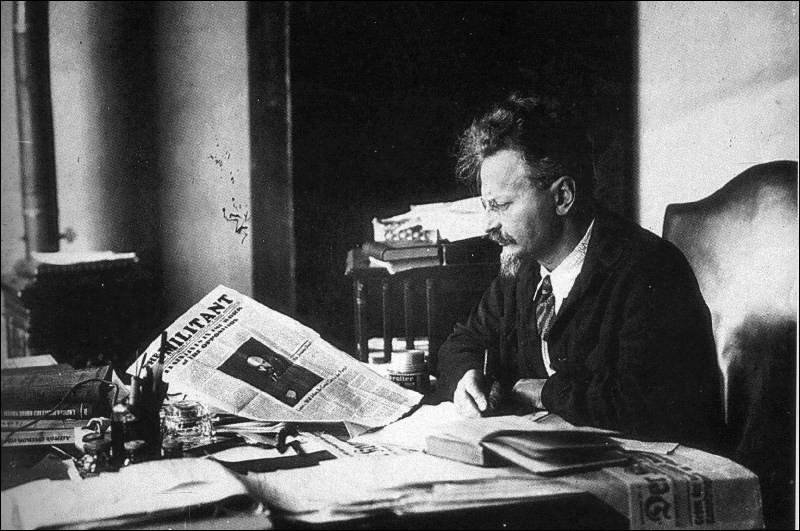
Leon Trotsky reading The Militant newspaper in 1931
Leon Trotsky reading The Militant newspaper in 1931   (Click to enlarge)
Lars on the other hand, writes in a misleading, cloudy and abstruse fashion: "Lenin had a romantic view of leadership within the class. He sought to inspire the rank-and-file activists... with an exalted idea of what their own leadership could accomplish". In the same vein the book is irritatingly peppered throughout with phrases like Lenin's "heroic scenario". Then there are crude assertions on relations between the working class and the peasantry in Russia: "His insistence on the peasant as follower did not exclude an exalted, even romantic view of the peasants in the revolution. Heroic leaders required heroic followers".
Of course Lenin, like most Marxists, could be enthusiastic. In turn, they could be enthused by the spectacle of workers in struggle, especially when it reached a high point of revolution. Marxism is saturated with the spirit of optimism. At the same time, Lenin is deadly realistic about the prospects of the class struggle in general and all the issues involving the fate of the working class. His view of leadership, as with the need for the party, was not 'exalted' but practical and flowed from what was necessary.
Then again, what are we to make of Lars's conclusions at the end of the book when he writes: "Old Bolshevism was defined by its wager on the revolutionary qualities of the peasantry. Yet less than a decade after his death, the regime founded by Lenin was waging war on the peasants and imposing a revolution from above during the collectivisation campaign, contributing to a devastating famine". (p202)
Firstly, Bolshevism never put a 'wager' on the peasantry, but recognised that it could never play an independent role. Therefore, the issue was who would lead them in the revolution - who would satisfy their demand for the land - the working class or the bourgeoisie? History attested to the fact that the working class satisfied the peasantry in action, after the bourgeois and its parties had demonstrated that they would never give the land, as well as peace and bread, to the masses, including the peasant masses. Secondly, it is ludicrous to identify "the regime founded by Lenin", as Lars does, with that presided over by Stalin, already, ten years after Lenin's death, one dominated by a privileged bureaucratic elite. Indeed, Lenin's widow, Nadezhda Krupskaya, famously stated in 1926 that if Lenin had lived, he would have been imprisoned under the Stalinist regime.

The revolutionary party

There are many misleading, and consequently erroneous, statements like this in the book and it cannot therefore be fully embraced as a correct account of Lenin's role in history. But it has been taken up by some on the left, even in certain quasi-Marxist circles. This is because Lars's presentation, particularly in relation to democratic centralism, chimes with a layer who rejects this idea, the 'hard' Lenin, in favour of an allegedly 'more open' one. It is not the first time we have confronted this phenomenon. In the 1960s and 1970s, journals like New Left Review would 'discover' woolly 'ground-breaking new theoreticians' who would then invariably disappear almost as quickly as they had appeared.
Lars's ideas have become the current fashion for those who are fleeing from genuine Marxism and the real traditions of Lenin and Trotsky. Vital in this respect is the need for a revolutionary party based upon the traditions of democratic centralism. This in no way contradicts the broader task of organising a mass workers' party at this stage. Of necessity, this will be required to organise on a much looser basis, involving a form of federation and in Britain, of course, rooted in the trade unions. The maintenance of a clear Marxist core within such broader formations is absolutely necessary. Without this, there will be no long-lasting gains for the working class.
History, including recent history, reinforces this point. For instance, the main forces behind the formation of the Scottish Socialist Party (SSP) in 1998 came from our party. The leadership of Militant supported the formation of such a broad party; in fact, we were the first to advance this idea. But the leaders of Scottish Militant Labour (SML) proposed and carried out, at the same time as forming the SSP, the effective winding up of SML into this party. This, in turn, led to their separation from the Committee for a Workers' International (CWI) in Scotland and internationally. They were not expelled but voluntarily departed from our ranks.
We warned at the time that not only would this mean the tragic weakening of a distinct revolutionary organisation and tradition in Scotland but, at a certain stage, the complete disintegration of the SSP as well. Unfortunately, this was borne out. A similar process happened in Italy, where different Marxist organisations joined Rifondazione Comunista (RC) when it was formed in 1991, but were incapable over time of winning the ranks of this party to a clear Marxist position. The RC has now effectively disintegrated.
Compare this to the achievements of Militant, both when it was in the Labour Party - in 1964, we had no more than 40 supporters - and during our expulsion in the late 1980s. The conclusion to draw from this is that in the case of both Scotland and Italy there was not a sufficiently organised and politically trained Marxist core capable of either winning a majority in the party or at least gaining more significant numbers, which could then form the basis of a new organisation or party.

The class, party and leadership

These mistakes flow from an incorrect understanding on the part of some Marxist forces of the relationship between the class, a party and its leadership. 'Democratic centralism' - the term itself - was not an invention of Lenin, but was first used in the Russian workers' movement by the Mensheviks within the Russian Social Democratic Labour Party (RSDLP). However, the conception of a party, its methods of organisation, and how discussion and internal debates should be conducted, have a long pedigree, beginning with Marx and Engels themselves.
This is shown, for instance, in the rules of the Communist League of 1847, of which Marx and Engels were members. Even before the term 'democratic centralism' was used, the concept was adopted within this, the first distinct international party of the working class.
In its statutes the Communist League states the conditions of membership: "Subordination to the decisions of the League... The circle [comprising a number of 'branches' as we would understand it today] authority is the executive organ for all the communities of the circle... The various circles of a country or province are subordinated to a leading circle... The Central Authority is the executive organ of the whole of the League and as such is responsible to the Congress... The Congress is the legislative authority of the whole League. All proposals for changes in the rules are sent to the Central Authority through the leading circles and submitted by them to the Congress... Whoever violates the conditions of membership... is according to the circumstances removed from the League and expelled".
Lenin took these and other examples from the historical experience of the workers' movement, including the German social democracy, and attempted to apply them to the specific conditions of Russia. Lenin's famous book, What is to be Done?, written in 1901, was devoted to the need for a centralised party in Russia. Lars deals, not very adequately, with some parts of the history. He touches on the disagreements over the formulas of Lenin in answer to the 'Economist school', who believed in concentrating on the purely day-to-day struggles. Lenin "bent the stick" too far, in his own words, in his description of how socialist consciousness arises in the working-class movement.
Lenin's assertion that socialist consciousness could only be brought to the working class from the outside by the revolutionary intelligentsia was wrong. He borrowed this also from the German social democratic leader and Marxist at the time, Karl Kautsky. Although Lenin corrected this later, it has been used to justify the haughty approach of self-appointed 'leaders', usually by tiny organisations, proclaiming to be 'the' leadership of the working class.
Trotsky paid tribute to Lenin's stubborn and painstaking work in laying the basis through the struggle of theBolsheviks for the mass party approach. Nevertheless, he emphasised that it was the 'steam', the working class, which is the driving force in the revolution. The party, if it acts correctly, plays the same role as a 'piston box' in harnessing this to a revolution.
Lenin emphasised the same point in opposition to the 'committeemen' who took shape in the underground. They were suspicious of the initiatives of workers. Trotsky had warned of the dangers of the emergence of such figures in his 1904 pamphlet, Political Problems. He pointed out that these types of committeemen have "forgone the need to rely upon the workers as they had found support in the principles of 'centralism'." Lenin recognised the dangers of a one-sided interpretation of what he was trying to build when he wrote: "I could not contain myself when I heard it said that there were no working men fit for the committee membership". Trotsky remarks: "Lenin understood better than anyone else the need for a centralised organisation; but he saw in it, above all, a lever for enhancing the activity of the advanced working man. The idea of making a fetish of the political machine was not only alien but repugnant to his nature". (Stalin, p103, Panther edition)

Democratic centralism

Lars T makes sweeping, incorrect comments about democratic centralism. He writes that there was no "exposition of the meaning of the term - Lenin used it in passing to make particular points". He also states: "Lenin's points would have been: 'Democratic centralism is not possible in underground conditions. Genuine interparty democracy is mandatory when possible and dispensable when not'."
But he is completely wrong in asserting, with no basis in the actual practice of Bolshevism, that democratic centralism was practised at one stage and then withdrawn in a completely arbitrary fashion at another. The Bolsheviks, as with all genuinely revolutionary organisations, based themselves at all times on the general principles of democratic centralism: maximum discussion until a decision is arrived at and then a united effort by the whole party, group or organisation to implement the decision. Even then, it is totally false to imply that all discussion and debate ended after the decision was taken. The history of the genuine workers' movement showed that vital discussion on unresolved issues continued in the form of internal bulletins, debates, etc, outside of the framework of the national congress of the party.
The different sides of this question might be difficult for isolated intellectuals to grasp but it is an idea that the working class readily understands, particularly its more advanced, guiding layers. It flows from the very position of the working class under capitalism.
Never in history has capitalism been more centralised than today. Never have the means of coercion - witness the revelations of Wikileaks, the massive surveillance by capitalist governments of their own populations, as well as other governments - been so concentrated in the hands of the capitalist state. It is inconceivable therefore that a loose network would be capable of mobilising to defeat this colossal power. Without a centralised mass party capable of unifying working people and then acting in a decisive fashion when the time requires it, it is impossible to carry through the socialist transformation of society, the greatest change in human history.
The working class instinctively understands the need for a centralised party and the discipline that goes with it. This is shown in every serious struggle, particularly strikes, involving the working class. When shop stewards, for instance, are called to discuss and debate an issue, and sometimes heatedly, they will usually strive to adopt one voice when putting the issue to a mass meeting. There will, of course, be occasions when a minority of stewards and workers will disagree with a recommendation, and in that situation Marxists would argue for a full debate to take place.
These methods, which involve elements of democratic centralism, are instinctively understood by working people. This is demonstrated by the recent statement of the National Union of Metalworkers of South Africa (Numsa). When they announced a break from the ANC and supported the idea of a new mass workers' party, they declared: "Numsa is a revolutionary union and as such plays a leading role in the defeat of capitalism and the exploitation that is associated with it. We are democratic centralist - we believe in robust, vigorous and democratic debate leading to a united decision and action".

Discussion and decision

What is then posed is the balance between democracy, full debates and discussions and upholding the rights of all members to participate in the formulation of policy, and centralism, the need to act in a unified fashion, at each stage. This cannot be decided a priori - through general principles applicable at all times irrespective of the concrete circumstances. Organisation, even in the mass revolutionary party, is not an independent factor for a Marxist. It is an inference from policy. It is politics, perspectives and programme, as well as the concrete circumstances, which determine what forms of organisation should be applied at each stage. But it is not true, as Lars T suggests, that democratic centralism is applied only in some circumstances, and not in others. For Marxists, democratic centralism means a 'mobile balance' between democracy and centralism, with emphasis being given to democracy or centralism depending upon the concrete circumstances.
In underground conditions, centralist methods tend to dominate over the full expression of democratic discussion, rights and principles. But this does not in any way mean complete centralism with little democracy. On the contrary, while struggling against the brutal tsarist regime and its police, the Russian revolutionaries, including the Bolsheviks, debated and fought with each other over programme and policy. This was a necessary means of sharpening the political and theoretical weapons in preparation for the revolution. There were even regular congresses, both in the underground and during the civil war.
There was full freedom of discussion and debate. But this did not mean for the Bolsheviks, particularly Lenin and Trotsky, that the revolutionary party should become a debating club. To those who characterise this method as inherently 'unhealthy', Trotsky had a word of advice. Faced with the disarray in the ranks of his followers in France in the 1930s, he commented: "An organisation smaller but unanimous can have enormous success with a clear policy, while an organisation which is torn by internal strife is condemned to rot". There are some organisations in Britain and internationally today to whom Trotsky's words are very apt.
Lars T tries to present a softer Lenin, more 'open' and 'democratic' than the 'centralist', if not authoritarian, figure that is usually invoked by bourgeois and most 'Marxist' historians alike. This 'new' Lenin is almost a 'liberal' in his alleged acceptance of open, public, unrestricted discussion in a revolutionary party.
This new approach towards Lenin distorts his real views. There were times when Lenin and Trotsky advocated the most open kind of discussion, even in public forums and at difficult times, which to some extent took place outside of the party. Nikolai Bukharin and the so-called 'Left Communists', who supported him in his advocacy of a 'revolutionary war' at the time of the Brest-Litovsk controversy of 1918, had a daily newspaper which argued against the ideas of Lenin and Trotsky.
The mass communist parties in France and Italy argued in their daily papers against the idea of the united front. But after two years they were compelled to implement the decision of the Communist International.
There are many other such examples, including Trotsky's initial support for the minority within the American SWP in the 1930s for a public discussion on the class character of the Soviet Union. However, he withdrew his proposal when his American co-thinkers pointed out that this minority was appealing in the main to the petty bourgeois milieu outside the party who had moved from support of the Soviet Union under the pressure of 'democratic' public opinion. This did not prevent a vigorous discussion within the ranks of the SWP on this issue.

Anti-party mood

Part of the capitalists' campaign in the aftermath of the collapse of Stalinism was to feed the popular mood, particularly among the new generation, against 'parties' and the model of Lenin's supposedly closed, authoritarian type of party. We argued against this but also recognised that anything that appeared to be tainted with the mark of Stalinism would repel the new generation looking for a political alternative.
This 'anti-politics' and 'anti-party' mood represented, in reality, a deep hostility towards all 'official', 'traditional' parties; in other words, the capitalist parties, including the social democrats and even the Communist Party who were identified with the old order.
Moreover, this mood lasted for a considerable period of time and is still an important factor in the political situation in many countries today. We have had the phenomenon of the 'indignatos' in Spain, with similar trends in other countries. In Spain, it reflected the entirely justified hatred of the so-called 'Socialist Party', PSOE. This was a factor in the formation of the indignatos in the first place. But this hostility was also often directed against Marxist groups, although the most active promoters of this within the indignato movement were themselves members of small political organisations. They were, in effect, 'anti-group groups'.
But what was the net result of this abstention from politics? In Spain, the disastrous election of the present right-wing PP government, which has presided over a devastating crisis, with youth unemployment levels well over 50%. Therefore, there has been a reassessment by this new generation who are once more returning to the idea of building a political alternative.
A similar mood was present in the Occupy movement, which developed on a world scale following initiatives in the US. Subsequent experience demonstrated that an amorphous movement, albeit fuelled by youthful energy and idealism but which lacked clear direction and organisation, represented little danger to the highly centralised and organised forces of capitalism. A new road was sought and a significant layer of workers and youth found this road in the spectacular election campaigns in Seattle and Minneapolis.
The election of a socialist to the Seattle council for the first time in 100 years represents a real leap forward in the possibility for political struggles not just in the US, but worldwide. Socialist Alternative took the initiative in this case, but similar radical political movements were expressed elsewhere: in New York with the election of Bill de Blasio, and his invocation of a 'tale of two cities', with 73% of the vote, and the election of 24 independent Labor candidates in Lorain County, Ohio.
A similar process has unfolded in Argentina, where a Trotskyist electoral front received 1.2 million votes in the recent elections. This arose from the completely changed situation compared, for instance, to 2001. Then, despite a catastrophic economic situation, parties were discredited; Marxist parties, in particular, made little headway.
These elections indicate that the situation has completely changed with the more conscious workers now aware of the need for organisation and parties. A layer has consequently transferred their hopes to this 'left front', which is in a particularly favourable situation to grow if it employs the correct tactics and openness to the new layers of the working class who will be looking for a mass party of their own in the battles to come. This is likely to involve the maintenance of a revolutionary core - in a distinct and separate organisation - seeking a wider base in a larger mass formation. There have been other opportunities in the past which have been lost because this open approach has not been adopted.

Look at Lenin in the round

Millions of workers are looking for a new way forward. This can be provided for them by the building of new mass parties of the working class. Because of the period that we have passed through, these are unlikely in most countries to immediately adopt a clear revolutionary, Marxist programme. But a Marxist organisation, working in an honest and open fashion, will be welcomed into the ranks by the best workers looking for a way forward.
Unfortunately, books like this of Lars T - and particularly those who uncritically praise his ideas - will not be able to prepare working people for the stormy but exciting period ahead. It does not present the ideas of Lenin clearly. It scandalously ignores the contribution made by Trotsky, in particular.
Our criticisms are not restricted just to the organisational plane. The author does not adequately explain Lenin's ideas in relation to the perspectives for the Russian revolution. The central idea of Lenin of the 'democratic dictatorship of the proletariat and peasantry' was different to the ideas of the Mensheviks, who saw Russia developing in a capitalist direction with socialism relegated to the mists of the future. Lenin completely rejected the idea that the weak Russian capitalists could carry through the tasks of the democratic capitalist revolution: of land reform, solution of the national question, the introduction of democracy, etc. Only an alliance of the workers and peasants, the overwhelming majority of the population of Russia, was capable of carrying through these tasks.
The weak point in Lenin's scenario, that Lars T in no way fully explores, is who would be the dominant force in the alliance between the proletariat and the peasantry. The whole of history attests to the fact that the peasantry has never played an independent political role because of its heterogeneity. Its upper layers tend to merge with the capitalists, its lower layers tend to sink into the ranks of the working class.
This is where Trotsky's famous theory of the permanent revolution comes in, which correctly anticipated how the Russian revolution would develop. Although a minority, the working class, because of its social position in society and its special features, dynamic and organised in big industry, would be able to lead the mass of the peasantry in revolution to overthrow the autocracy. Having come to power, it would then pass over to the tasks of the socialist revolution in Russia and the world. In Lenin's Letters From Afar, as well as his April Theses, he completely concurs with these ideas of Trotsky. This is not even mentioned in this book.
Lars T Lih's book undoubtedly presents an advance over the malicious distortions of Lenin and Trotsky's ideas. But at the same time, unless filled out and corrected, it will introduce further confusion as to what Lenin and Trotsky really stood for.

Lenin, by Lars T Lih, published by Reaktion Books, 2011, £10.95


Monday, 8 April 2013

Thatcher’s dead - Now let’s bury her policies


Peter Taaffe Socialist Party general secretary:

“It is a human response to be sad when somebody dies. But many working class people will be celebrating her death because of the absolutely destructive and long lasting effect she had on the lives of millions of working class and poor people. She is seen by many as a kind of modern day Genghis Khan. Elected into office in 1979 she unleashed a ferocious assault on the living standards and democratic rights of working class people. Trade unions were attacked in order to clear the way for the destruction of publically owned industries and the driving down of wages and conditions.

The Socialist Party’s forerunner the Militant Tendency was at the forefront of fighting her rotten policies. We led the famous struggle in Liverpool from 1983-87 as part of the labour council that refused to implement cuts. That council mobilised a mass campaign of trade unionists and working class people in support of the council’s needs budget. That campaign won £60million from the government which was spent on building thousands of new council homes and new facilities for working class communities. One commentator lamented that Militant had given Thatcher a “bloody nose”.

In the late 80s and 90s early we led the struggle against the hated poll tax. This tax would have seen a duke paying the same as a dustman. We initiated the All Britain Anti-Poll Tax Union which led the campaign that led to 18 million people not paying the tax. As a result the tax was revoked. Thatcher made it clear that she resigned as a result of the huge anti-poll tax demonstration on 31st March 1990, which was attended by 250,000.

Thatcher created a number of “mini Thatchers” not just in the Tory party but also in New Labour as well. Tony Blair was her heir just as Cameron and Clegg are now. They are carrying in her work and are in fact going even further than even she dared to go in the savaging of public sector jobs and services.”

Her true legacy is clear to see today in the policies of the ConDem government. They are today’s standard bearers of her neo-liberal ideas. On the day Thatcher has died the rich are about to receive a tax cut and working class people face a new assault in the form of the bedroom tax. At the same time we are seeing an unprecedented assault on jobs and services.”
Dave Nellist, Labour Party MP for Coventry South-West 1983-1992:

“The people I have sympathy for today are those working class people who’s lives have been blighted by her policies. The real tragedy is that while she may be dead herself her ideas are still alive and well in the form of the ConDem coalition and New Labour.

She was a determined fighter for her class, the 1% of very wealthy people at the top of society. The Socialist Party wants to build a movement that does the same for the 99%, working class people. We want to build a mass movement that will take the wealth from the super-rich and that dismantles the project she embarked upon. We want to use that wealth to provide jobs, services and a future for working class people.”

The Socialist Party of England and Wales (formerly known as Militant Tendency) is a campaigning, democratic organisation. We played a leading role on Liverpool Labour council in the 1980’s when it defied Thatcher and refused to implement cuts winning £60 million to spend on jobs and services in the city. We also led the struggle in the late 80’s and early 90s when 18 million people nationwide refused to pay the hated Poll Tax. We fight against all attacks on the rights and living standards of working class people.

Monday, 14 January 2013

Crisis in the SWP: Socialist Party material

http://www.socialistparty.org.uk/keyword/Left_and_radical/SWP

http://www.socialistparty.org.uk/books_pamphlets/Socialism_and_Left_Unity_-_A_critique_of_the_Socialist_Workers_Party/1

Please see the above links for Socialist Party material on the current and previous crises inside the Socialist Workers Party of Britain including critiques of popular frontism, state-capitalism, a history of their method and ideas and chapters from Peter Taaffe's 2008 booklet - Socialism and Left Unity: A critique of the Socialist Workers Party

Thursday, 4 October 2012

Labour Party conference: Can Labour give a lead in the fight against austerity?

Lead article from this weeks The Socialist, by Peter Taaffe, Socialist Party general secretary


Owen Jones will debate these questions with Clive Heemskerk, deputy editor of Socialism Today, at:Socialism 2012, a weekend of discussion and debate.

The Labour Party conference takes place at a crucial time. Working people are crying out for a lead in a mass movement which can force elections and topple the hated Con-Dem government.

The TUC has responded, under the pressure of left trade unions and radical fighting forces such as the National Shop Stewards Network, by passing a motion calling for a 24-hour general strike.

The battle is on to make sure that, in the run-up to the 20 October TUC demonstration and afterwards, the General Council names the date for a one-day general strike.

No such bold initiative can be expected at the Labour Party conference. On the contrary, Ed Miliband and Ed Balls make it quite clear that they are opposed to strikes.

Yet the right to strike is the ultimate weapon, the last resort which working people possess to confront the bosses and their government.

And these rights are already severely restricted through Thatcher's anti-union laws. Laws, which New Labour in power, both under Blair and Brown, did nothing to repeal.

'Wait for Labour'

The Eds' mantra is 'wait for the Labour government'. It is also the real policy of right-wing trade union leaders who are incapable or afraid of mounting effective resistance which can mobilise the full potential of the labour movement to defeat the anti-working class measures of the government.

But what will such a government look like if it is successful in being elected? Ed Balls spelt this out in the most explicit terms at the TUC Congress.

Delegates were outraged to hear a possible future Labour chancellor openly admitting that if New Labour was in power now it too would be carrying through cuts and holding down wages.

This at a time when a UNCTAD report has pointed out that the share of GDP taken by wages declined from 70% in 1970 to less than 63% in 2010!

In other words, the only policy the New Labour leadership has is continued impoverishment of the working class.

Ah, but these would be different to Tory cuts! It would be like the ill-fated 'social contract' of the Labour government of 1974-79, which was supposed to be a trade-off for limited wage rises in order to create jobs.

The social contract collapsed when the trade union movement concluded that it was a device for holding down wages while prices increased, resulting in deteriorating living standards and little benefit in terms of new jobs.
Economic crisis

It didn't work then nor will it work today, particularly when capitalism demands unprecedented cuts in living standards as the price for maintaining the system.

There is not the slightest perception among the New Labour tops of the grave, deep-going crisis, which will hold any government in an economic vice, severely restrict its room for manoeuvre and remorselessly force it to bend the knee to capital unless it has a programme to break the stranglehold of capitalism.

Witness the retreats already, within months of being elected, of French president Francois Hollande. Forced by the pressure of the 'market', he has promised that his already weak and ineffective wealth tax will last no more than two years and even that timescale could be in doubt.

Moreover, he has proposed a €30 billion cuts package in state expenditure. The consequence of this is a plummeting in his standing in the polls and, incredibly, a rise in the standing of the recently ousted right-wing Sarkozy.

The Bank of International Settlements shows that on the basis of capitalism, the scenario for the working people of Britain and Europe is dire.

The Financial Times commented on its findings: "In most advanced economies, the fiscal budget excluding interest payments would need 20 consecutive years of surpluses exceeding 2% of gross domestic product just to bring the debt-to-GDP ratio back to its pre-crisis levels." [22 August.] The British capitalist economy has no chance of achieving a 'surplus'.

In fact, despite all the pain associated with cuts, the budget deficit will not be eliminated by the next election.

Capitalism is going through its biggest crisis since the 1930s. The failure of this system is there for all to see in the more than 200 million unemployed worldwide, including 100 million young people, and the colossal growth of inequality and poverty.

Europe is convulsed - particularly southern Europe - by mass movements protesting against the dead end of capitalism, which offers nothing for the future but endless austerity.

Greece, Spain, Portugal and Ireland are experiencing a soul-destroying depression. The level of unemployment in Greece for instance is the same - 24% - as afflicted the US in the deepest days of the 1930s Great Depression.

The youth with no future have scattered to the four corners of Europe and the world, or are returning to the villages from which their families came, in a desperate but largely fruitless search for a job, any job, even one paying slave wages. The wheel of history is being turned back before our eyes!

And Britain, facing the onslaught of decayed British capitalism and its brutal agents, Cameron, Osborne and Clegg, is not far behind; it is Greece in slow motion! Unless the present economic decline is arrested and a massive programme of growth, generating millions of jobs, is put in place, the conditions of southern Europe will surely come to Britain.

There are already elements of Greece present in the social decay of Britain flowing from economic decline, revealed already in the growing ranks of youth unemployment and the 'solution' of overseer Boris Johnson for them of work with no pay.

Even the knights of capitalism - professional economists - desperately casting around for an alternative have turned to Marx's ideas, according to the BBC economics editor Stephanie Flanders.

She has produced a TV programme in which capitalist economists praise Marx and his ideas.

For instance, George Magnus is a senior economic adviser to the Swiss bank UBS and a frequent guest on Newsnight who "decided that Marx's warnings about the internal contradictions of capitalism were becoming more and more relevant."

It's reported that Magnus wrote an article headlined 'Give Marx a chance to save the world economy'. He received more emails in response to this than anything else he had written: "Some of the emails were pretty vicious"! The capitalist economist Nouriel Roubini simply stated in the Wall Street Journal: "Karl Marx had it right."

Miliband

Yet Ed Miliband chooses this moment, just before the Labour Party conference, when capitalism is coming apart at the seams and the props of the system are enormously weakened, to ride to the defence of capitalism.

An interview with Miliband by Charles Moore, the former editor of the right-wing Daily Telegraph, in that paper has the headline: "I want to save the capitalism my father hated." [15 September].

His father, Ralph, was a well-known Marxist opposed to the system and its apologists on the right wing of the Labour Party.

The son, however, "wants to save capitalism from itself". When Charles Moore questioned his support for "responsible capitalism", which Moore correctly says is a "contradiction in terms", he doesn't even deny this! He just falls back on the moth-eaten arguments of Winston Churchill, famous for his hatred of the labour movement, socialism and particularly Marxism: "Yes! But I believe capitalism is the least-worst system we've got. I believe in the creativity of BlackBerry (picking up his)."

How do we know that it is "the least worst system"? A real democratic socialist plan of production has not been tried, at least in an advanced industrial country, up to today.

Miliband seems to equate "inventiveness" - his BlackBerry - to capitalism and the market. Yet it remains a fact that all the big innovations, from space travel and its spin-offs, health research, the worldwide web and aerospace were not developed by private capitalism for profit but were initiatives reliant on state backing.

Imagine the colossal advantages if instead of the isolated islands of innovation in the state sector this was translated to a national and international scale.

Capitalism is an enormous brake not just on the productive forces, but on inventiveness, imagination and talent.

'Good capitalism'

Miliband has also served up 'pre-distribution' as a winning idea. This has been described by an academic from Yale as "to focus on market reforms that encourage a more equal distribution of economic power and rewards even before government collects taxes or pays out benefits".

In other words, it is an extension of Miliband's "good capitalism" (markets). "Equal" and "market" are diametrically opposed to each other.

The system demands the highest possible profit - and the easiest and best way for the capitalists to achieve this is by cutting wages and slashing services.

There is nothing 'modern' in Miliband's arguments. In fact, they predate the formation of the Labour Party itself, a return to the ideas of liberal capitalism, of a programme of limited reforms within the framework of the system.

There was at least an objective basis for such ideas in the 19th century when capitalism was a relatively progressive system.

Despite the horrors of the Industrial Revolution, the slave trade, etc, capitalism was at least able to develop the productive forces, science, technique and the organisation of labour, thus furnishing the possibility on the basis of socialism to abolish want and privation for the first time in history.

However, this system broke down at the end of the 19th century, accentuated in the first decades of the 20th century, when capitalism was no longer capable of providing reforms, through the Liberal Party in particular, to the working class.

This in turn laid the basis for the rejection of the Liberals and the rise of the Labour Party, which adopted a specifically socialist clause in 1918 - the famous Clause IV Part 4 of the Labour Party constitution.

When the labour movement embraced the aim of socialism it was because capitalism had palpably demonstrated, as it does today, its inability to take society forward.

In the former Soviet Union a bureaucratic caste betrayed the ideals of the Russian revolution. Although the planned economy was still maintained - and therefore the system which remained was still relatively progressive compared to capitalism - a one-party totalitarian regime was gradually established.

Socialist opposition

But today, it would not be Stalinism but democratic socialism based upon workers' democracy which would be the model in Britain.

The check and control of all leaders and representatives at every level through workers' control and management of the economy and society would ensure this. This could open up a future of undreamed of plenty.

The other perspective, chosen by Ed Miliband, is of a Labour government operating within the framework of a diseased system of capitalism, with the capitalists threatening blackmail at every step and defeat whenever even a slightly radical measure is proposed.

Even Miliband perhaps has an inkling of this history when he says: "While there's capitalism, there'll be socialism, because there is always a response to injustice." Precisely! Capitalism will always provoke opposition from the suffering working class and, ultimately, also big sections of the middle class.

It will engender a mood of looking for an alternative which will lead to a rediscovery of socialism.

Why not then return to some of the roots of the Labour Party of the past which at least rested on the working class and the labour movement, although the right-wing Labour leadership always had one foot in the camp of capitalism? Miliband will not do this and is therefore preparing disaster for his party and the working class in the event of coming to power.

Some on the left who remain within New Labour, including some left trade union leaders, vainly hope that they can 'reclaim' the party for the working class.

Some, like the left-wing celebrity and writer, Owen Jones, together with trade union leaders like Len McCluskey of Unite, have set up a think tank, the Centre for Labour and Social Studies (Class) to further this aim.

Yet some of the panel members of this new organisation cannot be remotely described as 'left'.

It includes, for instance, Polly Toynbee of the Guardian - in the past, a champion of the right-wing Social Democratic Party split from Labour.

She is, at best, a liberal critic of the present government. Jack Dromey, a former right-wing trade union leader and another stalwart of Class, was a hammer for Neil Kinnock and the right wing in the Labour Party against the immortal Liverpool councillors in the 1980s who confronted and defeated Thatcher.

Moreover, this campaign has set itself very limited aims: to "transform the debate within the Labour Party".

When pressed if and when this project fails, under what circumstances will Class's supporters conclude that the task of transforming New Labour is redundant? Owen Jones has argued: "When the trade union leaders have come to that conclusion."

This worshipper of accomplished facts only proposes to change history when he is guaranteed overwhelming support supplied by the trade union leadership.

With this approach, the Labour Party itself would never been founded in the first place.

It was the heroic minority, those like Keir Hardie, as well as the advanced trade unions, which fought for the project of a new party, which through struggle and events eventually found a majority.

The same task is being fulfilled today by those left trade unions such as the RMT transport union and the left within the PCS and the FBU, as well as the Socialist Party, who are fighting for the same project in modern conditions: a new mass workers' party.

In the teeth of New Labour-dominated councils inflicting savage cuts across the board, such as Knowsley near Liverpool or in Southampton, where two Labour councillors have been suspended for fighting against the closure of a swimming pool and other cuts, what do Owen Jones and his allies on the left do in practice to counter them? Hold out the prospect that, in the mists of time, somehow New Labour will be transformed. This will have as much effect as a drop of water on a hot stove.

But if a mass workers' party, even a small one at the beginning, was in existence then right-wing Labour councillors - more like a privileged caste today rather than genuine representatives of the working class - will be looking over their shoulders at an electoral challenge from such a party.

This would at least hold out the chance of staying their hand and preventing the cuts.

New Labour's party conference, we can be sure, will be long on flowery rhetoric but short on a practical fighting programme to defeat the Con-Dem government.

It is to the idea of a new mass workers' party, with a fighting socialist programme, that increasing numbers of workers will turn in the stormy period opening up in Britain.