Showing posts with label SWP. Show all posts

Saturday, 24 August 2013

A Trend in the Wrong Direction..in history..


A Trend in the Wrong Direction

(The case for defending an independently elected Party Control Commission was made by US revolutionary James P Cannon at a time when the Trotskyist party in the US, The Socialist Workers Party, was experiencing a growth of members as a result of the student radicalisation of the 1960's.
Posted for those interested in past discussions relating to organisation and cadre development in a Leninist Party.-Martyn Ahmet)


November 12, 1966
Copies to:
Ed Shaw, New York
Jean Simon, Cleveland
Reba Hansen
New York, N.Y
Dear Reba:
This answers your letter of November 2 with which you enclosed a copy of Jean Simon’s letter of October 12. I was surprised and concerned by Jean’s proposals to change the constitutional provisions providing for an independent Control Commission elected by the convention, and making it a mere subcommittee of the NC, which would mean in effect a subcommittee of the PC. This would be the de facto liquidation of the Control Commission as it was originally conceived.
As far as I can see all the new moves and proposals to monkey with the Constitution which has served the party so well in the past, with the aim of “tightening” centralization, represent a trend in the wrong direction at the present time. The party (and the YSA) is too “tight” already, and if we go much further along this line we can run the risk of strangling the party to death.
As I recall it, the proposal to establish a Control Commission, separately elected by the convention, originated at the Plenum and Active Workers’ Conference in the fall of 1940, following the assassination of the Old Man. The assassin, as you will recall, gained access to the household in Coyoacan through his relations with a party member.[6] The Political Committee was then, as it always will be if it functions properly, too busy with political and organizational problems to take time for investigations and security checks on individuals.
It was agreed that we need a special body to take care of this work, to investigate rumors and charges and present its findings and recommendations to the National Committee.
If party security was one side of the functions of the Control Commission, the other side - no less important - was to provide the maximum assurance that any individual party member, accused or rumored to be unworthy of party membership, could be assured of the fullest investigation and a fair hearing or trial. It was thought that this double purpose could best be served by a body separately elected by the convention, and composed of members of long standing, especially respected by the party for their fairness as well as their devotion.
I can recall instances where the Control Commission served the party well in both aspects of this dual function. In one case a member of the seamen’s fraction was expelled by the Los Angeles Branch after charges were brought against him by two members of the National Committee of that time. The expelled member appealed to the National Committee and the case was turned over to the Control Commission for investigation. The Control Commission, on which as I recall Dobbs was then the PC representative, investigated the whole case, found that the charges lacked substantial proof and recommended the reinstatement of the expelled member. This was done.
In another case, a rumor circulated by the Shachtmanites and others outside the party against the integrity of a National Office secretarial worker was thoroughly investigated by the Control Commission which, after taking stenographic testimony from all available sources, declared the rumors unfounded and cleared the accused party member to continue her work. There were other cases in which charges were found after investigation to be substantiated and appropriate action recommended.
All these experiences speak convincingly of the need for a separate Control Commission of highly respected comrades to make thorough investigations of every case, without being influenced by personal or partisan prejudice, or pressure from any source, and whose sole function is to examine each case from all sides fairly and justly and report its findings and recommendations. This is the best way, not only to protect the security of the party, but also to respect the rights of the accused in every case.
As far as I know, the only criticism that can properly be made of the Control Commission in recent times is that it has not always functioned in this way with all its members participating, either by presence or correspondence, in all proceedings - and convincing the party that its investigation was thorough and that its findings and recommendations were fair and just.

* * *

It should be pointed out also that the idea of a Control Commission separately constituted by the convention didn’t really originate with us. Like almost everything else we know about the party organizational principles and functions, it came from the Russian Bolsheviks. The Russian party had a separate Control Commission. It might also be pointed out that after the revolution the new government established courts. It provided also for independent trade unions which, as Lenin pointed out in one of the controversies, had the duty even to defend the rights of its members against the government. Of course, all that was changed later when all power was concentrated in the party secretariat, and all the presumably independent institutions were converted into rubber stamps. But we don’t want to move in that direction. The forms and methods of the Lenin-Trotsky time are a better guide for us.

* * *

I am particularly concerned about any possible proposal to weaken the constitutional provision about the absolute right of suspended or expelled members to appeal to the convention. That is clearly and plainly a provision to protect every party member against possible abuse of authority by the National Committee. It should not be abrogated or diluted just to show that we are so damn revolutionary that we make no concessions to “bourgeois concepts of checks and balances.” The well-known Bill of Rights is a check and balance which I hope will be incorporated, in large part at least, in the Constitution of the Workers Republic in this country. Our constitutional provision for the right of appeal is also a “check and balance.” It can help to recommend our party to revolutionary workers as a genuinely democratic organization which guarantees rights as well as imposing responsibilities, and thus make it more appealing to them.
I believe that these considerations have more weight now than ever before in the thirty-eight-year history of our party. In the present political climate and with the present changing composition of the party, democratic centralism must be applied flexibly. At least ninety percent of the emphasis should be placed on the democratic side and not on any crackpot schemes to “streamline” the party to the point where questions are unwelcomed and criticism and discussion stifled. That is a prescription to kill the party before it gets a chance to show how it can handle and assimilate an expanding membership of new young people, who don’t know it all to start with, but have to learn and grow in the course of explication and discussion in a free, democratic atmosphere.
Trotsky once remarked in a polemic against Stalinism that even in the period of the Civil War discussion in the party was “boiling like a spring.” Those words and others like it written by Trotsky, in his first attack against Stalinism in The New Course, ought to be explained now once again to the new young recruits in our party. And the best way to explain such decisive things is to practice what we preach.
Yours fraternally,
James P. Cannon

Monday, 14 January 2013

Crisis in the SWP: Socialist Party material

http://www.socialistparty.org.uk/keyword/Left_and_radical/SWP

http://www.socialistparty.org.uk/books_pamphlets/Socialism_and_Left_Unity_-_A_critique_of_the_Socialist_Workers_Party/1

Please see the above links for Socialist Party material on the current and previous crises inside the Socialist Workers Party of Britain including critiques of popular frontism, state-capitalism, a history of their method and ideas and chapters from Peter Taaffe's 2008 booklet - Socialism and Left Unity: A critique of the Socialist Workers Party

Saturday, 5 January 2013

Democratic Centralism: The need for a party

In the light of ongoing events on the left, we link here to some material on the questions of organisation, party democracy and left unity that readers of our blog may find interesting, and we welcome debate around these issues.

Democratic Centralism by Peter Taaffe, 1996 - http://marxist.net/namechange/nameframe.htm

Published in Militant Labour Members Bulletin No.16, 'A discussion on Democratic centralism', 18 March 1996.

This discussion took place in the UK section of the Committee for a Workers' International (CWI), which at that time went by the name Militant Labour. This discussion on democratic centralism was followed immediately by the discussion on the name of the party, which dominated the following four members' bulletins (17 - 20) during 1996. It led to the decision to change the name from Militant Labour to Socialist Party in early 1997.
The Class, The Party and the Leadership by Leon Trotsky, 1940 - http://marxist.net/trotsky/cpl/index.html

This article is an unfinished work written by Trotsky and first published in 1940. It nevertheless forms a very valuable text.

Unite the Union general secretary election

Unite the Union general secretary election
Socialist Party statement


Unite general secretary Len McCluskey has decided to bring forward the next election for general secretary by almost three years.

Because of his age, realistically he would otherwise be a 'one-term' general secretary.

This move has been agreed after wide consultation on the left, including ourselves. Peter Taaffe and Rob Williams had a two-hour meeting with Len McCluskeywhere he asked for our party's endorsement of the steps he was preparing to take.

The Socialist Party has agreed to give him critical support. This is despite some political disagreement such as on Unite's continued support for New Labour.

This does not mean we will automatically endorse all decisions and actions of Len McCluskey and Unite's leadership.

We will argue for the need for Unite to break the link with New Labour, which has clearly indicated that, if it wins the next general election, will continue the present government's cuts.

Some, like Jerry Hicks, who has now declared that he will stand, and the Socialist Workers Party, have tried to argue that the early election is undemocratic and smacks of past sharp practice by right-wing ex-Amicus [one of the unions which merged to become Unite] general secretaries.

Some other activists, particularly from the ex-Amicus wing will have genuine concerns as well. But we have to frankly explain that it's not just a case of what is done but who does it and for what reasons.

Unlike with right-wing union leaders in the past or in the future, this election is not being brought forward in order to push Unite to the right but to consolidate the union for the left.

Providing the rank and file is strengthened, we believe that a victory for Len McCluskey can achieve this.

Ultimately the essential considerations are: what are the interests of Unite members, the left and the wider working-class?

Len McCluskey's leadership since 2010

The election of Len McCluskey in 2010 as the first general secretary of the merged union was a victory for the left in Unite and the wider trade union movement.

The Socialist Party supported his candidature rather than that of Jerry Hicks because we believed that Len was best placed to defeat the right wing.

A victory for the 'Simpsonite' [Derek Simpson, the previous Amicus general secretary] candidate Les Bayliss would have been a major setback for the left.

It would have meant Unite lining up with the other big unions, Unison and the GMB, along with the TUC bureaucracy against the smaller left unions.

Instead, Unite voted in favour of Resolution 5 at the 2012 TUC congress, supporting the idea of moving towards a general strike against austerity.

At the post-congress general council executive, Len McCluskey lined up with the likes of RMT general secretary Bob Crow to defeat the TUC leadership's attempt to effectively stop all talk of a general strike.
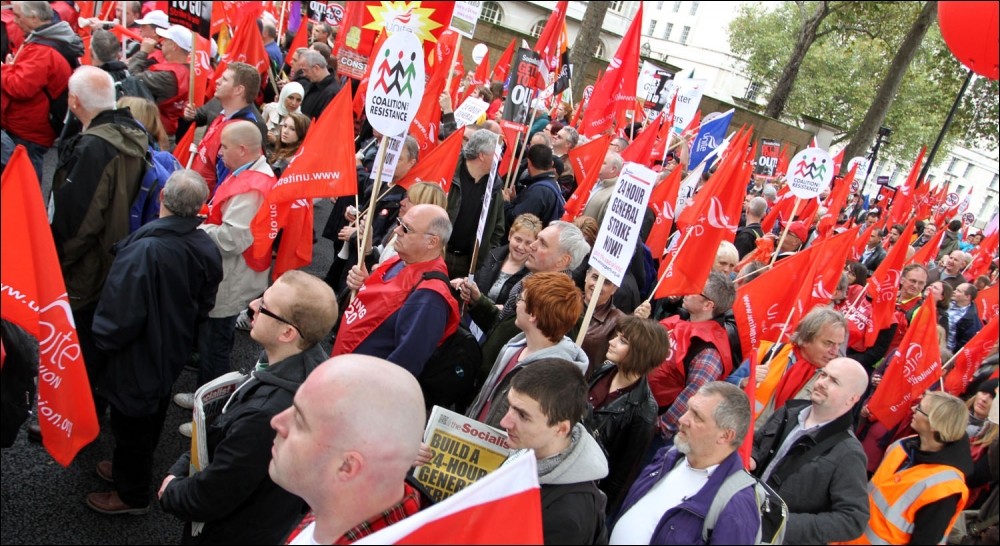
Unite flags - 2012 Oct 20th TUC demo, photo by Senan (Click to enlarge)

In apocalyptic words in 2010, Jerry Hicks warned that if he wasn't elected, it would be a disaster for the union and that it would never recover.

Actually, the huge potential of Unite has started to be realised under McCluskey's leadership. It is far from perfect.

In just two years in a union of up to 1.5 million members across 23 industrial sectors, with the history of the ex-Amicus unions, some of them right-wing, it would be an extremely difficult task under the best stewardship.

Unite is in some ways a mini TUC. It is four to five times the size of PCS. When this is considered, Jerry's words lacked a sense of proportion and perspective.

Despite Unite's weaknesses, there have been clear steps forward. There have been innumerable strikes by Unite members and some notable victories, even if partial and/or short-lived.

The Sparks, London bus workers, Paddy Brennan in Honda Swindon, and now the Doncaster Tesco drivers have all won some gains.

Many others from Unilever, Crown, Remploy and Amnesty, as well as public sector members in the pensions dispute have also engaged in action.

Len has emphasised that not once has he issued a repudiation letter to any Unite members taking unofficial action since becoming general secretary.

He repeated this in the national United Left meeting. He also immediately doubled strike pay to £30 per day.

In the public sector pensions dispute, Unite refused to sign up to the government's 'heads of agreement' and the union's members in the MOD and civil service sector took part in the 10 May strike alongside PCS and others, including Unite health workers.

However, this was under huge pressure from the health national sector committee. But this did show again that under McCluskey's leadership, the union can be pushed into taking action.

In local government, it has followed behind Unison and GMB as it regards itself as a minority union, which it is.

Therefore, unfortunately it didn't see its role as giving a lead and putting pressure on Unison in particular.

Left programme


We believe it is correct to give support to McCluskey, while we raise criticisms where necessary when we think the union hasn't gone far enough.

We will raise our programme during the election, for instance about making Unite a more democratic union, including the election of officers.

We must continue to place demands on Len McCluskey, particularly about the Labour Party and the need for a 24-hour general strike or at least mass coordinated strike action against the Con-Dem austerity onslaught.

On the Labour Party, we disagree with McCluskey's view that the party can be reclaimed. We instead pose the need for Unite to disaffiliate and work with other unions to create a new party for working class people.

At the national United Left meeting, Len said Unite would support Labour councillors expelled for opposing cuts.

He said he would be prepared to put to the union's executive before the next council elections that they give Labour leader Miliband an ultimatum that Labour doesn't stand against them.

He was well aware that this could change the whole relationship between Unite and Labour.

We also need to use the general secretary election to push Unite to lead the call for mass coordinated strike action, up to and including a 24-hour general strike.

This approach has helped prompt Len to state that Unite will ballot and take action alongside PCS on pay, which he says is the next focus for the struggle against the cuts.

Unite could put pressure on Unison and the GMB if it seriously links up with left unions such as PCS.

Unite's United Left has many weaknesses - it is still too much influenced by full-time officials and hasn't been able to attract enough fresh forces - but we still think that it represents the most forces of the organised left. We will continue to strive to build it and make it more democratic and accountable.

Under Len McCluskey's leadership it has been possible to open up the union and push back the forces of the right.

But we shouldn't write off the potential for the right to reassert itself if the union's leadership disappoints.

Instead of following our advice and coming into the United Left after the last general secretary election, Jerry Hicks has continued with his own 'Grassroots Left'.

But we don't believe that Jerry has proved capable of building the broad left alliance that would be essential to drive the union to the left, combat the bureaucracy and build across the wider trade union movement.

The re-election of Len McCluskey is an important step to consolidate the real gains that have been made, which can be the foundation for the union to move forward.