Showing posts with label Unite. Show all posts

Friday, 3 February 2017

Defend Our NHS - 4th March National Demonstration

Saturday 4th March 2017
12pm Tavistock Square, London.

Our NHS is under threat from Tory cuts and privatisation. This year the Red Cross have warned of humanitarian disaster in the NHS. Investment is needed for this vital institution but instead the government are cutting drastically. £22bn is being cut from the NHS in England under the secretive STP cuts. We don't yet know exactly where the £300m+ cuts in the Bristol area will hit but other areas have already announced hospital closures. The Tory government is pushing the NHS toward privatisation so their rich mates can grab a slice of the profits to be made from illness. There is already a creeping privatisation in the health service, with private companies operating at a profit to provide services behind the NHS logo. Recently Richard Branson's Virgin health company took over NHS contracts worth £700m in the Bath area. 
This national demonstration is vital, we must send the message loud and clear:
Save our NHS! No cuts, no closures, no privatisation!

Coach tickets from Bristol can either be booked via Unison or UNITE Trade Unions (non-members welcome) or The People's Assembly:
Unison Area Health Branch:
Tel: 07813142832

UNITE Bristol Area Health Branch:
Tel: 07983233908

(UNITE and Unison both free for members with a £5 returnable deposit or £10 charge for non-members)

The People's Assembly at a cost of £6-£10 at:

Further information about the demo can be found at:


Below an NHS nurse and Socialist Party member explains why they are going on the march:

We're seeing almost daily headlines announcing the NHS is in crisis. From overstretched A&Es, to patients left on trolleys, to staff morale being at an all-time low - our NHS is at breaking point.

The Tories' empty promises in 2010 that the NHS was 'safe in their hands' have been broken time and time again. A real time pay cut of 25% since 2010 has left some NHS staff relying on food banks. Our commitment to caring for our patients is continuously exploited. The jokes about nurses going whole shifts without time for a toilet break are becoming an increasing reality.

We're seeing mass privatisation of services - including those on the frontline. Proposed closures of hospitals, specialist services and A&Es are provoking thousands to go onto the streets in disgust.

The future is one of either fight or be trampled. The mood is gathering among health workers to come down firmly on the side of fighting back. The inspirational struggle of the junior doctors has given confidence to others in the NHS.

The campaign against the pay freeze is now to be debated in parliament after an online petition hit over 100,000 signatures. Despite the attacks from the right-wing media aiming to undermine faith in the NHS, working class people still see it as the jewel in the crown. And despite massive cuts, staff still deliver an overwhelmingly good quality of care.

The national demonstration on 4 March is vital. It's a chance to bring together the hundreds of local campaigns across the country into the national spotlight. It's a chance to show the government that we will fight for our health service.

I'll be marching to defend the NHS for the working class today and for future generations. I'll be marching because NHS workers deserve more than a continuous pay freeze and because the patients I and other NHS workers care for deserve better.

Tuesday, 23 August 2016

1000 Jobs To Be Cut At Bristol City Council

Marvin Rees (right) - Labour mayor doing the bidding of Tory chancellors past and present

TUSC calls on Marvin Rees to reverse decision and fight for necessary funding


Bristol Labour mayor Marvin Rees has announced the cutting of 1000 jobs from Bristol City Council, almost 1 in 6 of the workforce. This is part of a package of £43m cuts, additional cuts of some £60m planned by Rees over the next 4 years will further devastate jobs and services in Bristol.


The Trade Unionist and Socialist Coalition (TUSC) demands that Rees reverses these job cuts and campaigns for the funding stolen by the Tory government to be returned.


Anti-cuts campaigners and trade unions representing council staff have also raised their concerns. The Unite, Unison and GMB unions all have positions nationally of calling on councils not to make cuts and to use reserves and borrowing powers to protect services while demanding more funding from central government.


TUSC former mayoral candidate and Bristol Socialist Party member, Tom Baldwin said:

“It seems that Jeremy Corbyn’s call for opposition to austerity has not reached every level of the Labour Party. These cuts are being driven by the Tory government but here we have a Labour mayor putting forward an eye-watering package of redundancies.

“This will be seen as a betrayal by many of the people who voted for Marvin Rees hoping for a change from the cuts made by George Ferguson. Libraries and care were amongst the areas cut in the last 4 years. Services will be decimated by the latest round of cuts, let alone the extra £60m cuts Rees says he ‘must’ make.

“Austerity is a political choice by the Tory government. They’ve found money to cut taxes for the rich but are cutting council budgets to the bone. Our mayor needs to be exposing this hypocrisy and sticking up for his staff and the vital services they provide, not acting as the Tories’ hatchet man.

 “During this year’s elections TUSC were the only party to consistently warn of the impact of council cuts in the coming years. That’s because we were the only party with a plan to fight those cuts and stick up for jobs and services in this city.

“We call for a no-cuts budget that is based on what Bristol needs and the building of a mass campaign to push back the Tory government and reverse the swingeing cuts they’ve made. The council has significant reserves which should be used, along with prudential borrowing powers, to plug the funding gap while the campaign is built. By mobilising unions, anti-cuts campaigners and the communities that will be hit by the cuts and by linking up with other Labour councils that are willing to fight, the Tory cuts can be overcome.

“Marvin Rees must now adopt that approach if he doesn’t want to be known as the mayor that butchered Bristol’s services. The need to challenge austerity in deeds, not just words, is greater than ever.”

Thursday, 16 October 2014

Fight for Mass Action to End Cuts and Low Pay!

Britain needs a pay rise - how are we going to get it?

When the TUC first organised their 'Britain Needs a Pay Rise' demonstration on 18 October, it is hard to believe that they saw it as an integral part of a campaign of co-ordinated strike action. The first mention of it on their website was 11 February. Surely unbeknown to them, eight months later that date is days after hundreds of thousands of public sector workers have taken industrial action to break the Con-Dem pay freeze.

More than likely, the TUC and the Labour-affiliated unions saw the march as an opportunity to assist Labour in the protracted pre-election period by exposing the anti-working class policies of this Tory-led government, although Labour agrees with the pay freeze!

The fact that starting on 10 July and continuing into October, unions have called out members in local government, education, civil service and now the NHS is a reflection of the pressure that they have been subject to because of the grinding misery that the continuing fall in living standards has represented for millions of workers and their families.

However, the decision of the unions in local government to suspend their strike on 14 October is a major setback to the type of mass co-ordinated action needed to push the government back on pay. But activists in these unions and the NUT teachers union, which had already suspended action will be determined to get them back into the pay dispute.

The symptoms of the growing catastrophe facing working-class families are everywhere. The Trussell Trust, the largest food bank provider in the UK, says it has handed out 913,000 food parcels in the last year, up from 347,000 the year before. It added that there was a "shocking" 51% rise in clients to established food banks. The charity said that more than 30% of visits were put down to a delay in welfare payments but the second biggest reason, given by 20% of food bank users, was low income.

This is despite the social stigma attached to using them. In a recent survey by the University of Manchester, a 55 year old described how she had collected a food parcel on behalf of her grown-up daughter who was too embarrassed to come. She stated: "My daughter doesn't want to be seen as a scrounger." A child said: "We say to my mum make sure you eat but she says she's not hungry...she's just making sure we eat first." A survey by the NASUWT teachers' union revealed that a quarter of teachers have brought food into school to feed hungry pupils and a fifth have bought them lunch.
 
There are similar figures about payday loan companies, who are the suited and booted loan sharks as food banks are modern day soup kitchens. Last year, the charity StepChange handled £110 million-worth of payday loan debt, up from £60 million in 2012.

The so-called respectability of these vultures has now been exposed by the Financial Conduct Authority (FCA) - forcing leading payday loan company Wonga to write off £220m of debts for 330,000 people who couldn't afford to repay it. No wonder, when they charge interest rates over 5,000%!

In his speech to Conservative Party conference, Cameron again tried the Tory 'divide and rule' tactic of targeting benefits. But it was estimated that over half those who would suffer would be low-paid workers or the 'working poor', who earn so little that they qualify for in-work benefits and tax credits.

A report by the Office for National Statistics revealed that pay dropped by 0.2% in August in absolute terms. Yet incomes have been falling in 'real terms' for most of the period since the financial crisis of 2007-08. The Bank of England governor Mark Carney was invited to address this year's TUC and admitted that incomes had fallen by 10% since the crisis. He also thanked the unions for the sacrifice made by their members in "doing their bit" during the crisis! But on closer inspection, the ONS figures reveal a generation gap with those under 25 suffering a loss of 14%! This is hardly surprising when younger workers face the full brunt of zero-hour contracts, temporary work and lower rates of pay for new starters. They will be on worse pensions, if they exist at all. Yet graduates are expected to repay student debts inflated by £9,000 a year tuition fees!

The downward pressure on pay started under the last Labour government. The economic crisis was used by the bosses in the private sector to lower workers' wages and terms and conditions to literally get us to pay for their crisis. Many workers paid the price to retain their jobs by pay freezes or cuts and short-time working. However, the recovery of incomes has been very slow. To most workers, the so-called economic recovery is an utter myth that is only happening for the employers and the politicians, with MPs in line for an 11% pay increase!

Bosses, whether they are private sector employers or the government, have been quick to play off workers against each other. This was attempted in the public sector pensions dispute when they contrasted the so-called 'gold-plated' pensions of these workers with their counterparts in the private sector. In reality, this was a myth, with the average public sector worker receiving £7,000 a year in retirement. Similarly with pay, the fact that the squeeze in the private sector, where union density and organisation is inferior, was greater than the public sector, has been used as justification for the government attack.

The austerity offensive that was unleashed by Osborne in the autumn of 2010 has in effect been a deep recession for public sector workers, as well as working-class communities who rely on their services. The first two years saw public sector pay frozen absolutely, followed by two years of a limit of 1%.

Infamously, even this paltry rise isn't guaranteed in the NHS where up to 55% of workers will get nothing. Yet in the four years from 2010, RPI inflation rose by 4% a year on average. But even this price index, which, by including mortgages, is almost always higher than the CPI index now more commonly used by the government, is an under-estimate of the real cost of living, particularly those facing huge rents.     

Socialists explain that workers in the public and private sectors have to be united to resist the attack on all workers' incomes. Just as those in the private sector made concessions to keep their jobs in the depths of the recession, many public sector workers have been the victims of 90-day redundancy and re-engage notices. These have removed or worsened hard-won elements of their terms and conditions, such as car fuel allowances, that they have relied on as their pay has stagnated.

On top of this, the defeat of the pensions struggle as a result of the capitulation of the right-wing union leaders and the TUC, after the mammoth 2-million strong strike in November 2011 (N30) has meant that public sector workers have had their monthly pension contributions increased. In many cases, this has amounted to an effective cut in wages of anything up to £100 per month.

In addition, the vicious programme of cuts which have also been passed on by Labour councils have seen many public sector workers outsourced and privatised which has been a platform for swingeing wage cuts. The incredible strike by Care UK health sector workers in Doncaster, of over 80 days so far, was triggered by cuts of 25% as a result of being pushed into the private sector.

However, the N30 strike does point the way forward for all workers. That mass strike shook the Con-Dems, forcing Cameron into a volte face over his comments on the morning of the walkout that it was a 'damp squib'. Actually it was a massive show of strength by millions of workers in, arguably, the biggest single day of strike action since the 1926 General Strike.

In almost every town and city, there were mass strike rallies that revealed that any idea of a division between workers could be torn down, as the strikers received tremendous public support. As the reaction to the London tube workers strike earlier this year showed, when the unions act in a decisive way they become a reference point to all workers and others suffering from the brutal cuts and employers' offensives.

On the morning of N30, hundreds of 'The Sparks' - electricians in the construction industry - went from their weekly protest to a number of public sector picket lines. The Sparks were fighting against the imposition of a new BESNA contract that would have cut their wages by up to 35%. But through militant action and an official strike ballot by their union Unite, they were able to defeat the attack.

Undoubtedly, the sight and sounds of workers in the public sector throughout 2011 on strike and on the march, gave confidence to many other workers that it was possible to fight back. In return, victories such as that won by the Sparks and the London bus workers in 2012, who won an Olympic bonus, showed that it is possible to fight and win.

The setback of the pensions battle after the N30 strike has undoubtedly taken its toll on the confidence of workers, especially in the public sector. It opened the door still further and emboldened what is a weak and divided government. The result has been hundreds of thousands of redundancies, many of them would have been workers who strongly identified with the union. Many workers will have asked when contemplating action over pay: "Can we win?", "Will the union go all the way?"

But despite this, the July 10th pay strike of over a million was the biggest strike since N30 and showed that there are big layers of workers who realise that they have to fight to stop the slaughter of their incomes. Despite how anaemic this 'recovery' seems to workers, the fact that the economy has stabilised, at least for now, with perhaps the immediate threat to jobs lessened, can give workers confidence that it's possible to fight on pay. Sometimes in the midst of a deep crisis, workers can feel helpless.

Following the recent impressive action from NHS workers and civil servants on the one hand, and the calling off of the action in local government on the other, it's clear the pay struggle is at a crucial stage. These paltry offers must be rejected. The campaign must be continued and escalated. More strikes must be called before Christmas and into the New Year, with all the public sector involved.
The Socialist Party and the National Shop Stewards Network (NSSN) have been to the fore in building pressure on the TUC and the unions to call a 24 hour general strike. This could unite all workers in every sector to defeat Cameron's austerity and the employers' offensive. It would have huge support from the majority of people who are the victims of the cuts.

A significant breakthrough by a sizable group of workers would have a huge effect in raising the sights of all workers. It would not only shake the ConDems but also lay down a marker to all the mainstream parties, including Labour, who refuse to back the pay strikes because they have accepted Tory austerity.

Scandalously, the leaders of the Labour affiliated unions whose members have been on strike in the councils and the NHS against the pay freeze, accepted Miliband's spending plans at this summer's Labour Policy Forum. They wrongly believe that to go along with this is to protect their members because easing off Labour best ensures their victory at the general election next May.

In reality, they are only maintaining the idea that workers have to accept the cuts. They are loosening the pressure on Labour and disorientating union members and activists who cannot understand why the unions, the paymasters of Labour, are rolling over and being humiliated.

But history won't stop at the election. The incredible energy of the Scottish Independence campaign was a political mobilisation of the working-class and poor for an alternative to the austerity consensus of all the main parties on the bidding of the capitalist establishment. It was the first chance that many would have had to vote in a decisive manner for what they saw as a clear alternative idea.

It is an anticipation of the next months and years in the rest of the UK, as workers struggle politically and industrially to take on and defeat the attack on their incomes and all the other gains won by the working-class, but now are in mortal danger from the cuts and privatisation.

Striving for mass strike action by the unions, whoever is meting out austerity, is a critical element of this. The passing of the £10 an hour minimum wage by the TUC is an opportunity to appeal to the millions of low-paid non-unionised workers to become part of what is still the biggest organised force in society.

But side by side with this is the need for a real political alternative that fights for a more equal, socialist future. The Trade Unionist and Socialist Coalition (TUSC) is best placed to fight for such a mass political vehicle and be a powerful attractive force for those workers in unions that are still affiliated to Labour to break them from that grip.

by Rob Williams, Socialist Party national trade union organiser

Monday, 2 December 2013

End the pay freeze: A united fight in post-16 education, support the strike tomorrow

Bristol university workers on strike in October 2013

Bristol university workers on strike in October 2013


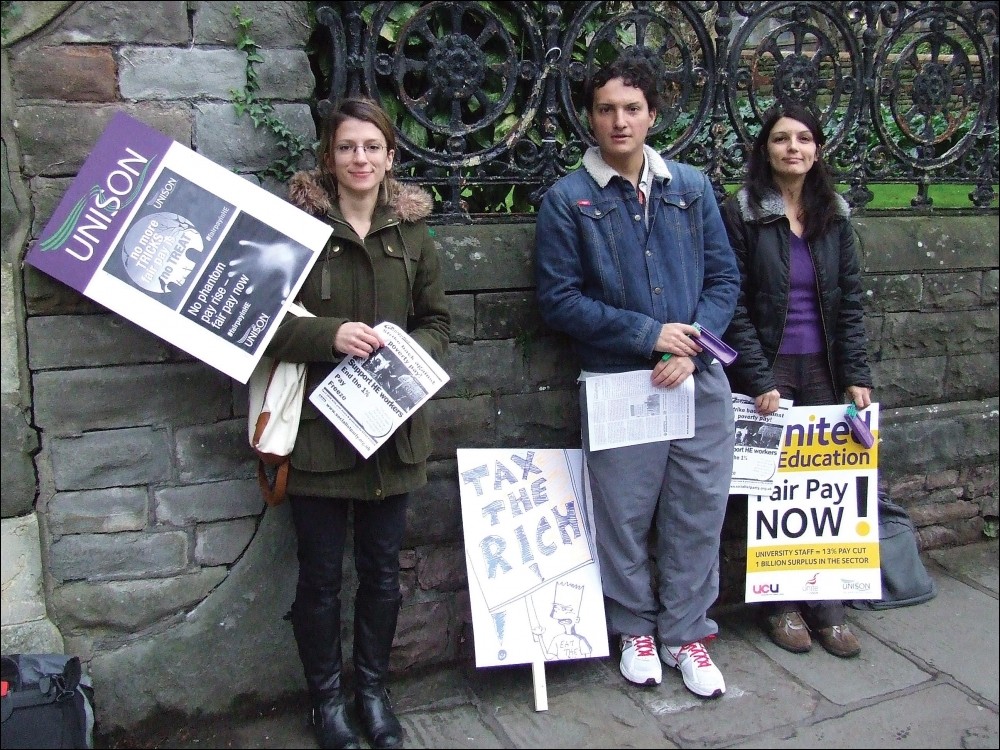
On 3 December university and college workers will be taking action. This strike day involves UCU, Unison and Unite members working in universities who struck on 31 October, now joined by further education (FE) members of UCU in England and higher education (HE) members of EIS in Scotland.

In HE, the employers' organisation UCEA returned to negotiations with the unions, but did not improve on the initial pay offer of 1% that triggered the dispute. Rattled by the 31 October strike, they have asked the individual employers to impose 1%. University workers are fully aware, however, that their employers have multi-million-pound surpluses and reserves while staff incomes have fallen by 13% in real terms since 2008.

FE staff have similarly experienced a 15% real-terms pay cut in the last four years, and have just rejected their employers' offer of a 0.7% increase - that is, another below-inflation rise - with over 70% voting tostrike. This doubtless reflects the anger union members feel when research shows that over half the lecturers in FE work ten hours' unpaid overtime during an average week, for dwindling pay.

Many student unions and the NUS nationally have passed resolutions in favour of the action, with Socialist Students and other campaigning groups building support. Ultimately our interests are all the same - for a public, fully-funded education system, free at the point of use and democratically run.

This background makes the coordinated national strike action particularly positive - the more unions that can be brought out together, the greater chance of success. At the same time, it is important for each dispute to have a strategy and to keep its own momentum.

Industrially, we need to work to build for a 24-hour general strike against austerity; and politically, trade unionists and students need to consider the question of an alternative to the three parties of austerity. Education is been under attack - we need to fight to defend it!

Tuesday, 23 July 2013

Trade unions must build a political voice for the working class

Editorial of the Socialist


"If others want to stick around and be insulted by those whose only interest is our money and not our ideas then that's a matter for them." RMT general secretary Bob Crow made it clear that the Labour leadership's attack on the unions, and Unitein particular, should be a defining moment for working class political representation.
From the platform at the 129th Durham Miners Gala Bob made the case for a new mass party for working people: "We need an alternative party of labour." (See RMT press release on www.tusc.org.uk)

He reminded the massive crowd in the Gala's Big Meeting on Saturday 13 July how the trade unions broke from the Liberal Party over 100 years ago, because it was incapable of representing workers' interests, to form theLabour Party.
On top of all the crimes of New Labour over the last two decades -privatising public services, maintaining Thatcher's anti-union laws, conducting wars, etc - the Labour leaders' recent confirmation that a Labour government will stick with the Con-Dem cuts surely urgently raises the question of a political alternative.

Unite

Bob Crow's speech got a huge response from the crowd. There was also support for the Unite general secretaryLen McCluskey as he rose to speak.
As with many trade unionists around the country, the Gala audience wanted to show solidarity with a trade union leader under vitriolic attack from all the enemies of the working class, including the Blairites, the Tories and the right-wing press.
Len got the best reception when he attacked the Labour leadership for their attempt to scapegoat the unionsaround the Falkirk selection process where Unite had pushed for its preferred candidate. "Labour doesn't have an automatic right to exist...
"The Parliamentary Labour Party today does not look like, or think like, the working class communities it seeks to represent. That is a serious problem... That is what Unite was fighting for in Falkirk - to give the working class a stake in our democracy. I make no apology for that."
But as with the week before, when he cautiously welcomed Labour leader Ed Miliband's 'reform' of how the unions affiliate to Labour, even agreeing with Tony Blair, Len's refusal to draw the necessary conclusions, left many bewildered and disorientated, if not angry and frustrated.
Len posed questions without answering them: "But if we are to go out and convince thousands of working class men and women that they want to sign up to be associate Labour Party members they will not be interested in the rulebook, or even the history.
"They will want to know - will Labour make a difference? ... Will it be different not just from Cameron and his crew but from the Blair-Brown years as well? If we can say 'Yes, Labour has learned, and Labour is on your side' then this scheme will work.
"But if our people - our members - are unclear as to the answer then no amount of persuading will get them to sign up."
This doesn't address Miliband's proposed 'reforms' of the Labour Link which will further dilute the already neutered role of the trade unions in the Labour Party as a collective force for the working class.
Miliband is under pressure from representatives of the capitalist class to block a voice for the working class in this way.
Moreover, given Labour's commitment to working within the limits of capitalism and to maintaining cuts if it forms the next government, and Labour councils' record of implementing cuts, the answer is clear - Labour offers no alternative to austerity.
Rank-and-file trade union activists are disgusted at Miliband's actions, particularly calling in the police to investigate the Falkirk allegations, but also Labour's out-and-out anti-working class policies.
As Bob Crow angrily said on Saturday, why hasn't Miliband called in the police to investigate the scandalous injustice meted out to miners at Orgreave, or the Shrewsbury pickets 40 years ago still continuing today after successive Tory, Labour and Con-Dem governments?
We encourage Unite branches to discuss the model motion (see box) and all members of the affiliated unions to raise Falkirk and the question of disaffiliation in their branches.

Break with Labour


We say it is time for the trade union movement to take the bold step of breaking with New Labour, not to go into 'non-political' trade unionism, but to use its political strength to form a new collective voice, a mass workers' party, that could appeal to the disenchanted, the poor and all the victims of austerity and the capitalist system by putting forward fighting socialist policies.
Undoubtedly, there will be some in the unions and on the left who argue this is impossible. Ultimately they hope against hope that, despite all the evidence to the contrary, Labour can somehow be reformed.
The Falkirk debacle is a damning demonstration of the lengths to which the Labour leadership and their ruling class backers, including in the press, will go to resist any challenge to their complete control of the party and its policies and candidates.

New formations

The early Labour pioneers, such as Kier Hardie, prepared the ground for the advances Labour made from 1906 onwards when workers' mass struggles against the system showed the need for the working class to take independent political action.
Who could question that, given the pro-cuts policies of all the traditional main parties, alternatives can't develop rapidly in the resulting political vacuum.
Despite their limitations new formations have emerged in Europe. In Italy, Beppe Grillo's Five-Star Movement appeared to come from nowhere and in Greece, Syriza's anti-austerity programme sparked its rapid electoral rise.
In Britain, anger at the main parties has been demonstrated by abstentionism and votes for the right-wing nationalist Ukip, including by a section of workers who want to 'kick the main parties'. This adds urgency to the need to build a real workers' alternative.
Imagine a left challenge with the financial resources of the unions or even just the £3 million annual affiliation fee of Unite to Labour compared to the shoestring that the Trade Unionist and Socialist Coalition (TUSC) attempts to operate on, notwithstanding the involvement and backing of the RMT.
The Socialist Party is also a key component of TUSC and we believe that it is tenaciously playing a pioneering role, arguing the case for a political voice for the working class and providing a way for anti-cuts fighters to stand as candidates against councillors voting through austerity.
TUSC sees itself as facilitating and campaigning for the building of a new mass workers' party. A new formation, based on the unions and the resources provided by their millions of members and the basic anti-cuts and anti-capitalist policies expounded at Durham by Len McCluskey and Bob Crow, embracing all those being battered by these brutal cuts would have a massive appeal across society and, in fact, shove the political debate to the left.

What Unite should do:

Unite members, in their branches, stewards committees and constitutional committees of the union, should pass resolutions defending the union against these attacks and calling for a full, democratic discussion of the alternative. In particular, they should call on the leadership to implement the following plan of action:
  • An emergency executive council should be called to discuss the crisis.
  • The EC should pass a resolution for a recall rules conference which would have the objective of removing the references to Labour Party affiliation from the rulebook, thereby facilitating disaffiliation. This conference should also discuss political representation for the working class.
  • Should this be carried, Unite should call meetings and conferences of trade unionists, from affiliated and non-affiliated unions, including those linked toTUSC. These events should have the aim of forming a new workers' party, which would have the programme of fighting the cuts, scrapping the anti-trade union laws and opposing privatisation of public services. Such a party would truly reflect the needs of the working class and fight in workplaces, communities and in elections for socialist ideas.

Sunday, 14 April 2013

McCluskey Wins UNITE GS election

The full election results are as follows:
Jerry Hicks 79,819 votes
Len McCluskey 144,570 votes
Number of ballot papers found to be invalid 1,412
Total number of valid votes cast 224,389
Turnout 15.2 per cent

Len's statement here: http://www.unitetheunion.org/news/lenmccluskeyreelectedasunitegeneralsecretary/

UnionNews video here:

Saturday, 5 January 2013

Unite the Union general secretary election

Unite the Union general secretary election
Socialist Party statement


Unite general secretary Len McCluskey has decided to bring forward the next election for general secretary by almost three years.

Because of his age, realistically he would otherwise be a 'one-term' general secretary.

This move has been agreed after wide consultation on the left, including ourselves. Peter Taaffe and Rob Williams had a two-hour meeting with Len McCluskeywhere he asked for our party's endorsement of the steps he was preparing to take.

The Socialist Party has agreed to give him critical support. This is despite some political disagreement such as on Unite's continued support for New Labour.

This does not mean we will automatically endorse all decisions and actions of Len McCluskey and Unite's leadership.

We will argue for the need for Unite to break the link with New Labour, which has clearly indicated that, if it wins the next general election, will continue the present government's cuts.

Some, like Jerry Hicks, who has now declared that he will stand, and the Socialist Workers Party, have tried to argue that the early election is undemocratic and smacks of past sharp practice by right-wing ex-Amicus [one of the unions which merged to become Unite] general secretaries.

Some other activists, particularly from the ex-Amicus wing will have genuine concerns as well. But we have to frankly explain that it's not just a case of what is done but who does it and for what reasons.

Unlike with right-wing union leaders in the past or in the future, this election is not being brought forward in order to push Unite to the right but to consolidate the union for the left.

Providing the rank and file is strengthened, we believe that a victory for Len McCluskey can achieve this.

Ultimately the essential considerations are: what are the interests of Unite members, the left and the wider working-class?

Len McCluskey's leadership since 2010

The election of Len McCluskey in 2010 as the first general secretary of the merged union was a victory for the left in Unite and the wider trade union movement.

The Socialist Party supported his candidature rather than that of Jerry Hicks because we believed that Len was best placed to defeat the right wing.

A victory for the 'Simpsonite' [Derek Simpson, the previous Amicus general secretary] candidate Les Bayliss would have been a major setback for the left.

It would have meant Unite lining up with the other big unions, Unison and the GMB, along with the TUC bureaucracy against the smaller left unions.

Instead, Unite voted in favour of Resolution 5 at the 2012 TUC congress, supporting the idea of moving towards a general strike against austerity.

At the post-congress general council executive, Len McCluskey lined up with the likes of RMT general secretary Bob Crow to defeat the TUC leadership's attempt to effectively stop all talk of a general strike.
Unite flags - 2012 Oct 20th TUC demo, photo by Senan (Click to enlarge)

In apocalyptic words in 2010, Jerry Hicks warned that if he wasn't elected, it would be a disaster for the union and that it would never recover.

Actually, the huge potential of Unite has started to be realised under McCluskey's leadership. It is far from perfect.

In just two years in a union of up to 1.5 million members across 23 industrial sectors, with the history of the ex-Amicus unions, some of them right-wing, it would be an extremely difficult task under the best stewardship.

Unite is in some ways a mini TUC. It is four to five times the size of PCS. When this is considered, Jerry's words lacked a sense of proportion and perspective.

Despite Unite's weaknesses, there have been clear steps forward. There have been innumerable strikes by Unite members and some notable victories, even if partial and/or short-lived.

The Sparks, London bus workers, Paddy Brennan in Honda Swindon, and now the Doncaster Tesco drivers have all won some gains.

Many others from Unilever, Crown, Remploy and Amnesty, as well as public sector members in the pensions dispute have also engaged in action.

Len has emphasised that not once has he issued a repudiation letter to any Unite members taking unofficial action since becoming general secretary.

He repeated this in the national United Left meeting. He also immediately doubled strike pay to £30 per day.

In the public sector pensions dispute, Unite refused to sign up to the government's 'heads of agreement' and the union's members in the MOD and civil service sector took part in the 10 May strike alongside PCS and others, including Unite health workers.

However, this was under huge pressure from the health national sector committee. But this did show again that under McCluskey's leadership, the union can be pushed into taking action.

In local government, it has followed behind Unison and GMB as it regards itself as a minority union, which it is.

Therefore, unfortunately it didn't see its role as giving a lead and putting pressure on Unison in particular.

Left programme


We believe it is correct to give support to McCluskey, while we raise criticisms where necessary when we think the union hasn't gone far enough.

We will raise our programme during the election, for instance about making Unite a more democratic union, including the election of officers.

We must continue to place demands on Len McCluskey, particularly about the Labour Party and the need for a 24-hour general strike or at least mass coordinated strike action against the Con-Dem austerity onslaught.

On the Labour Party, we disagree with McCluskey's view that the party can be reclaimed. We instead pose the need for Unite to disaffiliate and work with other unions to create a new party for working class people.

At the national United Left meeting, Len said Unite would support Labour councillors expelled for opposing cuts.

He said he would be prepared to put to the union's executive before the next council elections that they give Labour leader Miliband an ultimatum that Labour doesn't stand against them.

He was well aware that this could change the whole relationship between Unite and Labour.

We also need to use the general secretary election to push Unite to lead the call for mass coordinated strike action, up to and including a 24-hour general strike.

This approach has helped prompt Len to state that Unite will ballot and take action alongside PCS on pay, which he says is the next focus for the struggle against the cuts.

Unite could put pressure on Unison and the GMB if it seriously links up with left unions such as PCS.

Unite's United Left has many weaknesses - it is still too much influenced by full-time officials and hasn't been able to attract enough fresh forces - but we still think that it represents the most forces of the organised left. We will continue to strive to build it and make it more democratic and accountable.

Under Len McCluskey's leadership it has been possible to open up the union and push back the forces of the right.

But we shouldn't write off the potential for the right to reassert itself if the union's leadership disappoints.

Instead of following our advice and coming into the United Left after the last general secretary election, Jerry Hicks has continued with his own 'Grassroots Left'.

But we don't believe that Jerry has proved capable of building the broad left alliance that would be essential to drive the union to the left, combat the bureaucracy and build across the wider trade union movement.

The re-election of Len McCluskey is an important step to consolidate the real gains that have been made, which can be the foundation for the union to move forward.

Monday, 5 November 2012

Videos from TUC march - Rally votes for General Strike!


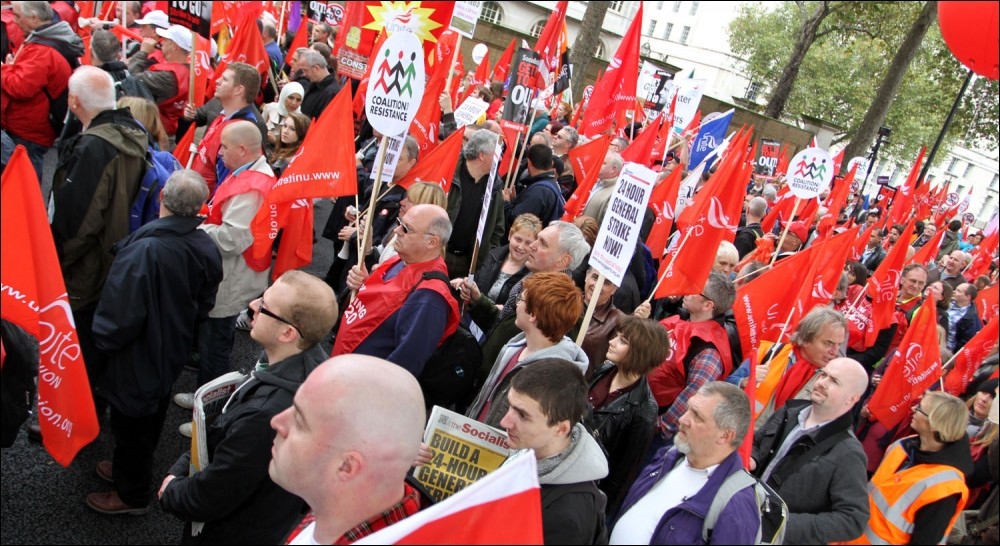
Around 150000 marched through London to Hyde Park. Len Mcluskey, UNITE's General Secretary, called the rally to vote for a General Strike - this was passed!

Tuesday, 1 May 2012

Pensions & Cuts: Strike back on 10th May

By John McInally, National vice-president, Public and Commercial Services union (PCS), personal capacity

The PCS executive committee has called national strike action on 10 May (M10) as part of a united campaign with other unions. Strikes will take place in three of the four sectors being affected by the government's attacks on pensions - civil service, health and education.

This M10 trade union coalition is needed to challenge a government of millionaires which is trying to force low-paid workers to pay more, work longer and get less in their pensions.


(Bristol PCS on the 30 June 2011 coordinated public sector strike of PCS NUT, UCU and other unions, photo Matt Carey)
The government's aim is to cut pensions to make privatisation more 'affordable'. They want to cut or destroy the vital services that bind our communities together and allow their banking and big business paymasters to squeeze as much profit out of what remains.

But there's £120 billion in uncollected taxes, largely from the rich. Big business is sitting on over £750 billion that they could invest to create jobs. Not one cut to our public services is necessary.

The M10 action will be on the day after the Queen's Speech, which will set out the coalition government's next set of cuts. This includes forcing through more pension changes that will mean civil and public service workers paying more each month and working up to eight years longer. They also have plans for regional and local pay which, if implemented, would mean lengthy pay freezes for many in the most deprived areas of Britain.
Attack on pensions

The attack on pensions is a critical element of the government's assault on working people. To concede on pensions would give the Con-Dems a green light to step up their attacks.

The pensions battle gives the trade union movement the chance to build the widest coalition to stop the government's plans. 30 November saw the biggest strike in modern history and the government was shaken. If that action had continued, there is no doubt the government would have been stopped. And it still can be!

The government has given no concessions on the core issues on pensions of paying more, working longer and getting less. So it was a major error by the TUC leadership to fall for the government's divide and rule tactics and accept their 'Heads of Agreement' on pensions last December. This craven behaviour risked demoralising workers and it was a major boost for the government.

Along with a number of other unions, PCS opposed this sell-out. PCS played a major role in re-building the trade union coalition. PCS's Left Unity conference in London on 7 January, which saw over 500 activists from all public sector unions come together to build a fightback, was a critical turning point.

In an indicative ballot, 90% of members voted to reject the government's offer and 72% supported further action. Members voted on the clear understanding that any further action would be on the basis of a "strong campaign" capable of winning concessions. 28 March (M28) was set for the re-launch of the industrial action, but it then transpired that key allies in the alliance could not or would not take part.

The situation was quite simple, the alliance could not deliver the type of action our members expected. Rather than press ahead with M28, the PCS national executive voted to spend a few weeks re-building the coalition so that successful action could be organised.

In the middle of a battle it is important to aim for maximum unity. Members and activists were disappointed that M28 did not go ahead but understood the reasons.

We wanted to wait a few weeks to deliver effective action - as will now happen - on the basis of a greatly strengthened alliance. That alliance will now be bigger than the 30 June strikes and covers three out of the four pensions sectors - civil service, education and health.
Building in strength

The pensions battle is building in strength as workers realise the full scale of the attacks. On 10 May other unions, including Unite in health and the civil service, Northern Ireland's main public service union Nipsa, lecturers' union UCU, whose executive is to make a formal decision to strike this week, and RMT in the Royal Fleet Auxiliary will take part.

Teachers' union NUT is meeting to make decisions on regional rolling action and national action, including in June.

The Police Federation will also be holding a 25,000 strong demonstration on London on 10 May against attacks on their pensions, jobs and pay and privatisation. The British Medical Association is also balloting its members.

Crucially, the GMB is balloting for rejection of the deal. This is a significant development. While the union will not take part on M10 it raises the prospect that one of the biggest public sector unions could be part of a growing coalition. By the summer we could see action on a far bigger scale than many thought likely.

To carry out its pensions cuts, the government needs to introduce legislation that can take up to nine months. And the whole package doesn't come into full force until 2015, giving us 18 months to two years to stop them or win concessions

The government, with the shameful connivance of TUC leader Brendan Barber and Unison general secretary Dave Prentis, have tried to give the impression that the pensions dispute is all done and dusted. Their instruction from Labour leader Ed Miliband is clearly: "don't rock the boat guys".

But this dispute is only just beginning. The choice will be bow down and let these gangsters kick us into the ground, or fight back. PCS will continue to be at the forefront of this battle.

Make the M10 strike a success:
  • Organise a workplace meeting to prepare for the strike
  • If your union isn't striking discuss how to put pressure on your leadership. If applicable link up with other unions
  • You could organise a public meeting in your town or city via the unions in dispute or trades council, anti-cuts campaign or National Shop Stewards Network. Explain the need to prepare for further action
  • Plan for a demonstration in your town or city on the day
  • All united - invite private sector workers, young people, pensioners, benefit claimants etc, to any public meetings, rallies and demonstrations

Friday, 6 January 2012

Unite unanimously rejects NHS pension 'offer'

Press release from Unite website:  http://www.unitetheunion.org/news__events/latest_news/unite_unanimously_rejects_nhs.aspx 
The government’s latest proposals on NHS pension ‘reform’ - the ‘Heads of Agreement’ document - were unanimously rejected by Unite, the largest union in the country, today (Thursday 5 January).

Unite’s health sector national industrial committee (HSNIC) rejected the ‘Heads of Agreement’ as a basis for a satisfactory outcome.

Unite general secretary Len McCluskey said: ”Our NHS executive unanimously rejects the government’s pernicious attempts to make hard working and dedicated NHS staff pay more, work longer and get less when they retire.

”The government’s attacks on public sector pensions are politically motivated, as part of an overall design to privatise the NHS, cut public services, break-up the national pay agreements, and disrupt legitimate trade union activities and organisation.

”Unite believes it is important to continue a campaign to maintain a fair and equitable system of public sector pensions and calls on ministers to enter into real, genuine and meaningful negotiations on the future of NHS pensions and public sector pensions.”

Unite’s concerns centre on three areas:
A high proportion of NHS staff will see their pension contributions jump from the current 6.5 per cent to 9.3 per cent by 2014/15, and other staff will see their contributions leap by nearly 50 per cent, with some paying 14.5 per cent of their salary into their pensions.
The linking of the NHS retirement age to the ever-increasing age that people will receive their state pensions. The state retirement age is set to rise to 66 in 2020 and 67 by 2026, with the prospect of working even longer in future decades. Unite is concerned that, for example, paramedics and nurses could be doing heavy lifting into their late 60s.
The proposed accrual rate for NHS staff is worse than the planned rates for other public sector schemes. Because this will be based on career average earnings, it will hit women who had taken career breaks to raise their children hardest.

The Unite HSNIC is due to meet again on 11 January to formulate future strategy. Unite has 100,000 members in the health service.

This stand only reaffirms the important of Saturday's organising conference called by PCS Left Unity national committee. Saturday 7th January, 11am-4pm. Friends Meeting House, 173 Euston Road, London, NW1 2BJ.  CONFIRMED SPEAKERS INCLUDE: Mark Sertwotka PCS, Roger Bannister Unison NEC member (personal capacity), Kevin Courtney NUT, Mark Campbell UCU and John McDonnell MP. CHAIRED BY Janice Godrich, PCS President
http://www.facebook.com/events/248169425248977/
http://www.leftunity.org.uk/

Thursday, 17 November 2011

Unite votes Yes to strike action on 30 November

From Socialist Party notebook: http://www.socialistparty.org.uk/articles/13166/17-11-2011/unite-votes-yes-to-strike-action-on-30-november
Members of the union Unite who work in the public sector have voted resoundingly in favour of industrial action to defend their pensions.
Three in four of Unite members who voted have said `yes' to joining the national day of action on November 30.
In Unite's three main aggregate ballots of health, civil service and local authority workers, 75 per cent of Unite members voted in favour of action on a turnout of 31 per cent.

Wednesday, 9 November 2011

Support today's two national demos - Construction workers and students

There are two important demonstrations in London tomorrow, the first is a national construction worker's protest and the second is a nationally organised student demo against cuts and fees, the police are trying to scare people away by threatening to use rubber bullets. If your going to one, you should be able to make the other, and Socialist Party members will be intervening on both including members from the South West. Hope to see you there.

Construction workers' national demonstration
Wednesday 9th November 2011
7am
The Pinnacle building site, Bishopsgate, London


National student demonstration
Wednesday 9th November 2011
Assemble 12 noon
University of London Union, Malet Street, London

Monday, 5 September 2011

Report on Southmead Social Care demo


By Frankie Langeland, South Bristol Socialist Party

'Thank you, you are bloody marvellous.'  ended Bob Taylors emotional speech at a Bristol rally last Saturday against the selling off of homecare in the city.
Mr Taylors wife, Pat, had previously been given 2 years to live but as he put it 'they (the doctors) must have underestimated Homecare.'
Mr Taylor told the carers at the rally that they were the blue ribbon of Bristol care, praising the service that wasn't driven by profit saying that 'Profit and care are incompatible.'

The rally was held after a short march starting at the greenway community centre in Southmead, where a by election has been called. 

250 came out to show they are against the proposed privatisation, and a city poll showed that 97% of people are against the proposals overall.

Privatising Homecare would put 1000 vulnerable adults care at risk as well as 250 jobs. The Lib Dem led council say that in house care is costing the council twice as much compared to a privatised service, However Bristol has seen this year in the Winterborne scandal that private care comes with a much higher cost!

The Rally itself was a mixed bag, including a statement read out from the Bishop of Bristol!
Disgracefully Tory MP for Bristol North West, Charlotte Leslie was given a gushing introduction by a UNITE steward, but the crowd didn't give her such a warm welcome heckling about the Tory cuts nationwide.
Again Kerry McCarthy Labour MP for Bristol East who attacked the Tories cuts got jeers from the crowd asking her 'What about PFI?' Labour shouldn't assume that we all have short memories!

John McInally, Vice President of the PCS spoke on behalf of the Bristol Anti  Cuts Alliance, saying that we are in an unremitting class war adding 'There is a consensus between the main political parties that there is no alternative to the cuts. Well that is an absolute nonsense' McInally also called for communities and trade unions to unite together against the attacks on us.

Finally film director Ken Loach made a surprise appearance, He remembered when 'Welfare' first became nationalised saying 'Think what we had we had healthcare, we had housing that was built for and paid for for the purpose of housing ordinary people, we owned the mines, we owned the railways, then the steel industry. We don't own it anymore they've ripped it away from us. We need to remember where we were to see how much we have lost.'

Loach also spoke about the problem of political representation saying 'the political cliques all support privatisation.' 

In response to the by election in  Southmead   UNITE launched a 'don't vote Lib Dem' Campaign (the Lib Dems currently being in control of the council)  Loach appeared to pick up on this saying 'I understand the tactic of saying don't vote lib Dem but we're not coned into thinking that if we vote either Tory or Labour they're not going to do the same thing, Because they will and we know they will.'

Loach was also critical of the labour party saying they would never be a party to lead a broad labour movement and that they were a party of privateers which was met by cheers from the crowd.

I spoke to some of the homecare workers after the rally they all spoke about the uncertainty they faced in their jobs and how they had been under attack for a long time.

But with everyone I spoke to they all said 'its about the service users.' This shows the carers that Bob Taylor spoke about, committed to providing the best service they can despite being under attack by their own council and government!

Bristol Homecare workers are just another story in the ConDem's cuts agenda, and like so many others they are fighting back not only for themselves but for the service users they care for, the demo on Saturday showed they are not alone in their fight and have enormous support from the workers of Bristol

The Socialist Party demands and end to the cuts agenda and to re nationalise the services that have been sold off already.
We should be learning from the Winterborne scandal not following in it's foot steps!

Thursday, 1 September 2011

Southmead rally and day of action - Saturday 3rd September

Please visit: http://www.bristolanticutsalliance.org.uk/


The campaign against Bristol City Council’s plan to privatise care homes and other social care services and cut funding to voluntary sector organisations is now supported by Britain’s three biggest unions, Unite, Unison & GMB.

More details about the campaign here…

http://www.bristolanticutsalliance.org.uk/2011/07/28/unite-unison-gmb-throw-their-weight-behind-campaign-to-defend-social-care-services-in-bristol/

http://www.bristolanticutsalliance.org.uk/2011/08/09/latest-news-about-our-campaign-to-save-social-care-services-in-bristol/

UNITE have published three leaflets which can be downloaded from the BADACA website Growing The Economy, Fair Wages & Tax Justice For All,Trade Union & Employment Rights. Also a statement ‘Cuts Are Not the Answer‘ from their National Executive.

The care homes under threat include Bowmead, Brentry, Broomhill, Hayleigh, Maesknoll and St Peter’s, plus Coombe, Rockwell, Wellhay and Greville. Also under threat are day-care services including Lanercost, Lawrence Link, St George, Shire Link, Dover Court, North Bristol Drop In, South Bristol Drop In and New Horizons, as well as other day care services for people with dementia. And of course all the voluntary sector organisations whose funding is threatened – full list of threatened organisations here.

BADACA leaflet about cuts & privatisation of Bristol social care services

“What can I do?”

Sign the e-petition on the council website set up by Steve Preddy of Unite…
http://epetitions.bristol.gov.uk/epetition_core/view/homecare

Saturday Stalls in August- if you can help out with a BADACA stall one Saturday in August, please email us at admin@bristolanticutsalliance.org.uk
http://www.facebook.com/event.php?eid=260971757247032

Day of Action – 3rd September – in the week of the Southmead By-election let’s send a message to the LibDem council!!
http://www.bristolanticutsalliance.org.uk/2011/08/09/day-of-action-southmead-by-election-lets-send-the-libdems-a-message/

http://www.facebook.com/event.php?eid=197094060352043

Mass lobby of Bristol City Council, College Green – 5pm – Tuesday 6th September
http://www.facebook.com/event.php?eid=128214383935316

Wednesday, 31 August 2011

Bristol ‘home help’ privatisation sparks protest rally on 3 September

Unite press release - http://www.unitetheunion.org/news__events/latest_news/bristol__home_help__privatisat.aspx?lang=en-gb

The health needs of more than 1,000 of Bristol’s home-based elderly and vulnerable residents face privatisation, Unite, the largest union in the country, has warned.

And Unite said that the move to hand in-house homecare services to private companies is ‘playing Russian roulette’ with their health, as private companies had already gone into liquidation recently.

Unite also alleges that the privatisation agenda is motivated by the Liberal Democrats, the largest group on the no overall-control Bristol city council, as ‘revenge; for the 2007 defeat of Cllr John Kiely, the then city council executive member for health and social care, who was promoting this policy, despite a 10,000-signature petition against privatisation of homecare services.

Now Unite is organising a march and rally on Saturday, 3 September to Save Bristol’s in-house Homecare Services.

Unite represents the vast majority of the 250 staff helping infirm older people, the disabled, those with mental health problems and the terminally ill to remain living with dignity in their own homes.

Unite said that the residents were already being transferred to private providers, without the option of remaining with Bristol Homecare Services, before the consultation period had been completed, and said that one of these companies had gone into liquidation – 'Care Mart' in the last month.

Unite regional officer Steve Preddy said: ”The council is playing Russian roulette with the welfare of this very vulnerable group by forcing through this privatisation agenda. It should reverse this policy immediately.

”The Bristol area does not have a great reputation for care, as the case of the abuse of mentally ill adults at the Winterbourne View Home, run by a neighbouring local authority, has proved.

”Unite believes that one of the motivations for the Liberal Democrats in pursuing this policy is as revenge for the defeat of Cllr Kiely in the Easton ward in 2007 – he was a champion of this misguided policy.

“The fact that one of these private companies have gone into liquidation recently does not engender confidence, especially as it is Bristol Homecare Services that are picking up the pieces and, ironically, providing the home help that this firm manifestly failed to do.

”Our members, not only fear for their jobs and terms and conditions, but for the welfare of the people they care about on a daily basis, year-in, year-out.

”We urge the people of Bristol, who care about the disadvantaged, to attend our march and rally on Saturday 3 September.”

Notes to news editors:

For further information please contact Steve Preddy on 07764 467 443 and/or Unite communications officer Shaun Noble on 07768 693 940

Details of the march and rally on Saturday 3 September.

12:30pm - gather at Greenway Centre, Doncaster Road, Southmead, Bristol, BS10 5PY

1:00pm - march through Southmead to Glencoyne Square, Southmead, Bristol, BS10

Unite also aims to hold a demonstration ahead of the next full Bristol city council meeting on Tuesday, 6 September from 17:00 on College Green at the Council House in Bristol.

Monday, 1 August 2011

UNITE convenor at Honda Swindon sacked - REINSTATE PADDY BRENNAN!

From National Shop Stewards Network: http://www.shopstewards.net/news.130.htm


The National Shop Stewards Network has just received word that Paddy Brennan, UNITE Convenor at the Swindon Honda plant has been suspended from work. More details to follow when we get them, but Paddy's suspension is a provocative attack on a prominent trade union fighter and by extension an attack on the right to organise at Honda. The Honda trade union leadership have been enthusiastic members of the National Shop Stewards Network since its inception and now they need our help. We demand Paddy's reinstatement and the NSSN pledges to do all it can in support of this.

Please text messages of support to Paddy on 07503 174 827 and email letters of protest to humgen@honda-eu.com. More updates to follow.

Friday, 3 June 2011

Unite the Union agrees uncompromising anti-cuts policy

Circulated by BADACA: http://www.bristolanticutsalliance.org.uk/2011/06/03/unite-the-union-agrees-uncompromising-anti-cuts-policy/


CUTS ARE NOT THE ANSWER - ORGANISING AND FIGHTING FOR THE ALTERNATIVE
Unite‘s Executive Council unanimously confirms its opposition to all Government spending cuts. We commit ourselves to fight this ideologically driven assault on our much valued public services and welfare state.
This assault on our class is designed to shift the blame for the economic crisis to the public sector and make working people pay for a crisis not of our making but caused by the negligent and irresponsible behaviour of financial institutions, gambling for profits in an unregulated market for financial products.
The consequences of these actions, coupled with the failure of both national and international regulators to prevent even the worst excesses of the free market and their promotion of self regulation, are now being felt by workers across the globe. Further, the economic crisis has given government the opportunity to promote and further its ideological attack on collective trade unionism, social and employment protection and the wider social fabric of our society.
Of course there is an alternative;
*collect the missing tax billions from the banks, multinationals, rich and powerful in our society and close the loopholes and avoidance scams that enable them to opt out of making their fair and proper contribution.
*introduce a Robin Hood tax to collect revenue from all financial transactions, bonuses and share options and raise tax rates at the top to ensure a fairer contribution from those most able to make one.
*maintain public spending and invest in our future, keeping people in jobs and growing our economy to create new ones. Supporting public services as well as our private sector, construction, manufacturing and support services is vital to rebalancing our economy.
We congratulate our General Secretary and this Executive Council in promoting our position of opposing all Government‟s cuts and the call for co-ordinated industrial action, but much more needs to be done:
1. Unite‘s position on the cuts must be effectively communicated to our officers and staff, our constitutional committees, shop stewards and activists, within our political structures and to Unite MPs and councillors as well as within our wider communities.
We have to end confusing messages being communicated within certain sections of our union sympathetic to the Labour leadership‟s message of “cuts too far, to fast” – the so-called “dented shield approach”.
2. We must do more to inform, inspire and engage with our lay representatives, shop stewards and activists across all sectors of our Union. We must equip them with the arguments they need to engage our members at work and within local communities if the fight back against the cuts is to be effective. This campaign requires leadership from the top but also grassroots activity at local level.
3. We encourage all workplaces, branches and constitutional committees to send resolutions to their Regional and National Industrial Sector Committees as well as to this Executive Council supporting actions for consideration.
4. We firmly believe coordinated industrial action is an essential tool in the fight before us and ask the General Secretary to write urgently to all officers, branches and constitutional committees with a strong message of encouragement to take up the fight and to initiate a series of communications and promotional materials to support our activists in developing the arguments for action. While decisions on industrial action will of course be taken by our members in democratic ballots, they must be confident in an alternative and know that they have their Union‟s full support in taking action.
When members of any union are taking industrial action against cuts Unite members in workplaces not taking industrial action are encouraged to protest and show solidarity as far as they can.
5. Industrially, it must be clear that we will support all members fighting back. Unite recognises the importance of advancing our members interests by fighting for improved pay and conditions even in these difficult times, while in our public services specifically our full resources must be given to those fighting against job losses and compulsory redundancy, pay cuts and/or freezes and the privatisation or outsourcing of work.
6. We support the initiative in developing training for our activists. It is critical that we up-skill our officers and activists in preparation for delivering our fight back strategy. Providing evidence to support the fact that we are not “all in this together‟ such as the fact provided by recent evidence from the High Pay Commission that chief executives of FTSE 100 companies earn an average of £3.7 million which is 145 times the average wage.
7. We are seeing an employers‘ offensive unleashing itself against all workers – on their pay and conditions, their pensions and their collective bargaining rights. If workers vote to take strike action, they should be encouraged to co-ordinate strike dates with others in dispute to maximise their effect. We ask the General Secretary to ensure that mechanisms are put in place to enable such coordination to develop.
8. We particularly urge the General Secretary to ensure that this union immediately engages with other like minded public and private sector unions with a view to our working together on an urgent programme of co-ordinated strikes over pensions and pay cuts, redundancy, privatisation and outsourcing of work. This should however not stand in the way of Unite taking a lead or acting alone in the defence of our members interests wherever necessary.
9. We believe we must communicate our position within the Labour Party at all levels and make it clear that Unite cannot support a position based on government cuts being “too far, too fast”. We must seek urgent dialogue with elected councillors on ways in which, by working together, we can reach agreement on alternatives to cutting, outsourcing or privatising services and jobs. We are very clear that we will reject and fight any attempt by councils to use the economic crisis in an opportunistic way to attack and/or undermine trade unionism, our agreements or facilities.
10. We must ensure that Labour MPs and councillors receive an unequivocal message from our union supporting our policy of opposing all cuts. Elected councillors must know they will receive the full support of this union if they face disciplinary or other action for supporting union policy. We must ensure Unite fully supports councillors who oppose cuts to local services.
Finally, we are determined that Unite will never abandon those who face the most serious cuts of all; the poor and vulnerable in our society including the disabled, the unemployed and those on low incomes who are now beginning to suffer real hardship as the first £18 billion of Welfare Benefit cuts begin to bite.
Some are our members but many are not, our success in fighting the cuts will require us to stand shoulder to shoulder with those at the sharp end. We recognise that the most vicious cuts of all are hitting those who often have no voice.
We urge and encourage our activists, shop stewards and members to get involved in the fight back, linking up trade unionists with groups coordinating actions locally and nationally such as UK Uncut and the Coalition of Resistance, as well as students, pensioners, tenants associations, community groups, the unemployed and welfare claimants.
This is a fight to defend our class. We must redouble our efforts to ensure we will win that fight. This Executive Council and our unions leadership is fully committed to this strategy and must now ensure that this message runs through our union, at all levels and in everything we do.
Adopted by the Unite Executive 19th May 2011