Showing posts with label UK riots. Show all posts
Showing posts with label UK riots. Show all posts
Sunday, 28 August 2011
CWU: Appeal for Union member affected by riots
The Communication Workers Union are backing calls from London members to help a postman who was burned out of his home during the disturbances in the area earlier this month. Read about their campaign here: http://www.cwu.org/news/archive/appeal-for-postman-riot-victim.html

Thursday, 18 August 2011
Youth Fight For Jobs and Day-Mer Youth organise in Tottenham
By Martin Powell-Davies
A week on from the riots, 'Youth Fight for Jobs' and 'Day-Mer Youth' organised an excellent meeting in Tottenham last night to discuss the way forward for the community and local youth. The meeting was introduced by Steve Hedley from the RMT and Vik Chechi from Youth Fight for Jobs (YF4J) but, refreshingly, most time was left for those in the audience to give their own opinions.

Contributions from a wide range of ages and backgrounds all reached a similar conclusion - that youth had every reason to be angry but that rioting helped nobody. However, unlike the hypocritical condemnation being spouted by the press and politicians, everyone who spoke wanted to seriously reflect on why the riots had broken out and, crucially, suggest ways to help the youth and community productively organise action over the many grievances facing working people across all of London's communities.
Before the meeting, YF4J had held a protest against the closure of youth services by Haringey's Labour Council. Plans were outlined to organise further demonstrations to oppose council cuts in the future.
David Lammy, Tottenham's Labour MP, came in for strong criticism for his failure to explain the real grievances facing local people and for not speaking out against the cuts and the stop-and-search harassment suffered by local youth. Calls for community campaigns and trade unions to stand their own anti-cuts candidates in the London Assembly elections were applauded.
The vindictive sentences being handed out on rioters were contrasted with the 'looting' of our services and taxes by the wealthy - with Osborne now suggesting he will even abolish the 50p tax rate for the wealthy.
A local youth, Young Deacon, performed "Failed by the System" that has so much more to say about the riots than the demonisation of black youth being spouted by many of the tabloids. Have a look on:http://www.opendemocracy.net/ourkingdom/ourkingdom/young-deacon-failed-by-system
Zoe, a young teacher, spoke at her anger about the way that youth were being scapegoated in the media and for the way many pupils were labelled as 'failures' at an early age. Others pointed out that the killing of Mark Duggan by the police, the incident that had sparked the riots in the first place, must not be forgotten. Youth Fight for Jobs have been calling for an independent trade-union and community led enquiry into his death.
Trade unionists also spoke about the need for unions to show a way forward by taking strike action against cuts and austerity - especially by continuing and extending the action against pensions in the autumn. Many present said they would be be attending the NSSN Rally and Lobby on September 11th to call on the TUC to organise co-ordinated strike action across the public sector. Nina Franklin, NUT President, will be speaking as well as Bob Crow from the RMT and Mark Serwotka from the PCS.
When teachers return to school in September, both teachers and school students will undoubtedly be discussing the shocking events of August. We certainly don't need lectures from the press, politicians and the powerful to follow their high moral standards!
Teachers, as ever, will be trying to offer genuine support and help to young people so that they can make the most of the opportunities open to them and not follow the dead-end of rioting. However, teachers and students alike will be increasingly asking what opportunities are really available to embrace the many talents of our youngsters? It's not enough for Ministers to condemn 'criminality', it is their responsibility to provide decent jobs, training and education for our school leavers.
http://electmartin1.blogspot.com/2011/08/youth-fight-for-jobs-organise-in.html
http://www.youthfightforjobs.com/
http://daymer.org/
A week on from the riots, 'Youth Fight for Jobs' and 'Day-Mer Youth' organised an excellent meeting in Tottenham last night to discuss the way forward for the community and local youth. The meeting was introduced by Steve Hedley from the RMT and Vik Chechi from Youth Fight for Jobs (YF4J) but, refreshingly, most time was left for those in the audience to give their own opinions.

Contributions from a wide range of ages and backgrounds all reached a similar conclusion - that youth had every reason to be angry but that rioting helped nobody. However, unlike the hypocritical condemnation being spouted by the press and politicians, everyone who spoke wanted to seriously reflect on why the riots had broken out and, crucially, suggest ways to help the youth and community productively organise action over the many grievances facing working people across all of London's communities.
Before the meeting, YF4J had held a protest against the closure of youth services by Haringey's Labour Council. Plans were outlined to organise further demonstrations to oppose council cuts in the future.
David Lammy, Tottenham's Labour MP, came in for strong criticism for his failure to explain the real grievances facing local people and for not speaking out against the cuts and the stop-and-search harassment suffered by local youth. Calls for community campaigns and trade unions to stand their own anti-cuts candidates in the London Assembly elections were applauded.
The vindictive sentences being handed out on rioters were contrasted with the 'looting' of our services and taxes by the wealthy - with Osborne now suggesting he will even abolish the 50p tax rate for the wealthy.
A local youth, Young Deacon, performed "Failed by the System" that has so much more to say about the riots than the demonisation of black youth being spouted by many of the tabloids. Have a look on:http://www.opendemocracy.net/ourkingdom/ourkingdom/young-deacon-failed-by-system
Zoe, a young teacher, spoke at her anger about the way that youth were being scapegoated in the media and for the way many pupils were labelled as 'failures' at an early age. Others pointed out that the killing of Mark Duggan by the police, the incident that had sparked the riots in the first place, must not be forgotten. Youth Fight for Jobs have been calling for an independent trade-union and community led enquiry into his death.
Trade unionists also spoke about the need for unions to show a way forward by taking strike action against cuts and austerity - especially by continuing and extending the action against pensions in the autumn. Many present said they would be be attending the NSSN Rally and Lobby on September 11th to call on the TUC to organise co-ordinated strike action across the public sector. Nina Franklin, NUT President, will be speaking as well as Bob Crow from the RMT and Mark Serwotka from the PCS.
When teachers return to school in September, both teachers and school students will undoubtedly be discussing the shocking events of August. We certainly don't need lectures from the press, politicians and the powerful to follow their high moral standards!
Teachers, as ever, will be trying to offer genuine support and help to young people so that they can make the most of the opportunities open to them and not follow the dead-end of rioting. However, teachers and students alike will be increasingly asking what opportunities are really available to embrace the many talents of our youngsters? It's not enough for Ministers to condemn 'criminality', it is their responsibility to provide decent jobs, training and education for our school leavers.
http://electmartin1.blogspot.com/2011/08/youth-fight-for-jobs-organise-in.html
http://www.youthfightforjobs.com/
http://daymer.org/
Monday, 15 August 2011
Liverpool Socialist Party: Statement on Liverpool Riots
From: http://www.socialistparty.org.uk/articles/12516
Liverpool & District Socialist Party is appalled at the current rioting which has resulted in the destruction of working peoples' homes, workplaces, and the community facilities and shops they rely on.
We recognise that there are those who are using theriots to engage in criminal activity and this is to be condemned. In condemning the wanton destruction we believe that the conditions for the initial disturbances have been created by mass unemployment, social deprivation and the massive cuts which have been imposed by the Con-Dem government and implemented by local authorities.
We believe that further riots are possible unless radical socialist measures are implemented. The systematic destruction of jobs, services and communities prepared this over two decades, since the Liverpool 47 socialist councillors were undemocratically forced out of office.
The "yobs" and "thugs" ultimately responsible are the main parties' politicians and their cronies the bankers and developers.
One-third of Liverpool's children are in households with no-one working. Almost 6,000 16-24 year-olds are on Job Seekers' Allowance.
Young people have seen their EMA college grant scrapped, costs for bus travel rocket, university fees raised to £9,000, and the Connexions youth careers service slashed to the bone amidst mass unemployment and dozens of applicants each chasing one of a handful of jobs.
The council should immediately reverse this year's £5.5 million (28%) cut to youth services, cancel the £5.05 million cut they intend next year, and reverse and cancel the £6.658 million cut to library and leisure services.
Connexions suffered a £2.1 million cut this year by Merseyside local authorities. This irresponsible action must be immediately reversed in full.
We call on the Liverpool City Council to organise a democratic discussion with the residents, community groups, trade unionists and young people of the areas affected, to draw up a plan of increased and sufficient public services.
This must include youth services and job creation. Both emergency and planned measures should be implemented by the council through borrowing and using reserves.
Rioting is the other uglier face of the L1 glitter ['Liverpool One' is a new large retail development]. While city centre and prestige projects are flaunted by the authorities and employers, our communities and youth are neglected.
High-skill well-paid jobs were replaced by service sector drudgery - low-paid or even unpaid. The council's so-called "apprenticeships" are an inadequate drop in the ocean.
We need job creation on a much larger scale, led by the council and on trade union rates of pay. We need training schemes to lead to real jobs not back to the dole.
Added to this are the colossal ongoing cuts being proposed by the council: £91 million this year, £50 million next year and a similar sum the year after that.
These must be reversed now.
The Labour group must demand that the Con-Dem millionaire government returns the £millions they have stolen from our city!
We are holding a public meeting next week to discuss how these policies should be implemented. The meeting is on Tuesday 16th August, 7.30pm, The Casa pub (downstairs), 29 Hope Street, L1 9BQ.
The whole situation is unacceptable. This autumn we are joining young people from across Liverpool and around the country to recreate the 1930s' most famous political protest, in a 280-mile "Youth March for Jobs" from Jarrow to London organised by campaign group Youth Fight for Jobs at www.youthfightforjobs.com .
Liverpool & District Socialist Party is appalled at the current rioting which has resulted in the destruction of working peoples' homes, workplaces, and the community facilities and shops they rely on.
We recognise that there are those who are using theriots to engage in criminal activity and this is to be condemned. In condemning the wanton destruction we believe that the conditions for the initial disturbances have been created by mass unemployment, social deprivation and the massive cuts which have been imposed by the Con-Dem government and implemented by local authorities.
We believe that further riots are possible unless radical socialist measures are implemented. The systematic destruction of jobs, services and communities prepared this over two decades, since the Liverpool 47 socialist councillors were undemocratically forced out of office.
The "yobs" and "thugs" ultimately responsible are the main parties' politicians and their cronies the bankers and developers.
One-third of Liverpool's children are in households with no-one working. Almost 6,000 16-24 year-olds are on Job Seekers' Allowance.
Young people have seen their EMA college grant scrapped, costs for bus travel rocket, university fees raised to £9,000, and the Connexions youth careers service slashed to the bone amidst mass unemployment and dozens of applicants each chasing one of a handful of jobs.
The council should immediately reverse this year's £5.5 million (28%) cut to youth services, cancel the £5.05 million cut they intend next year, and reverse and cancel the £6.658 million cut to library and leisure services.
Connexions suffered a £2.1 million cut this year by Merseyside local authorities. This irresponsible action must be immediately reversed in full.
We call on the Liverpool City Council to organise a democratic discussion with the residents, community groups, trade unionists and young people of the areas affected, to draw up a plan of increased and sufficient public services.
This must include youth services and job creation. Both emergency and planned measures should be implemented by the council through borrowing and using reserves.
Rioting is the other uglier face of the L1 glitter ['Liverpool One' is a new large retail development]. While city centre and prestige projects are flaunted by the authorities and employers, our communities and youth are neglected.
High-skill well-paid jobs were replaced by service sector drudgery - low-paid or even unpaid. The council's so-called "apprenticeships" are an inadequate drop in the ocean.
We need job creation on a much larger scale, led by the council and on trade union rates of pay. We need training schemes to lead to real jobs not back to the dole.
Added to this are the colossal ongoing cuts being proposed by the council: £91 million this year, £50 million next year and a similar sum the year after that.
These must be reversed now.
The Labour group must demand that the Con-Dem millionaire government returns the £millions they have stolen from our city!
We are holding a public meeting next week to discuss how these policies should be implemented. The meeting is on Tuesday 16th August, 7.30pm, The Casa pub (downstairs), 29 Hope Street, L1 9BQ.
The whole situation is unacceptable. This autumn we are joining young people from across Liverpool and around the country to recreate the 1930s' most famous political protest, in a 280-mile "Youth March for Jobs" from Jarrow to London organised by campaign group Youth Fight for Jobs at www.youthfightforjobs.com .
Fire Brigades Union: Sickened by the silence of politicians over fire service cuts
Taken from: http://www.fbu.org.uk/?p=3963#more-3963
The Fire Brigades Union says fire crews are ‘sickened’ by the silence of politicians over fire service cuts. Politicians have been queuing up to question police cuts, but none have yet challenged the same cuts to the fire service.
The union has been inundated by fire crews complaining about the lack of opposition to major fire service cuts in wake of widespread civil disturbances. The strongest and most recent comments have come from fire crews working in areas of recent unrest.
Fire crews have made similar comments over recent years in the aftermath of floods, extensive wildfires and in dealing with extreme winter weather. Like civil disturbances involving widespread arson, these incidents can tie up crews for protracted periods, sometimes months.
The last wave of cuts saw the loss of 1,000 frontline posts by April 2011. But ever increasing Government cuts will see that rise to at least 6,000 by 2014.
The cuts are being concentrated on full-time fire crews in largely urban areas, some of which have taken the brunt of recent unrest. The biggest cuts have happened and more threatened in Manchester, Merseyside, West Midlands, Yorkshire and the South West.
Recent civil unrest has shown how easily and quickly fire services can be stretched and struggle to cope. These disturbances, like others in the past, have seen widespread and major arson.
The FBU warns the fire service will also reach breaking point dealing with major incidents such as floods, wildfires and extreme winter weather. These incidents are more frequent and can last for weeks and even months.
Andy Dark, FBU Assistant General secretary said: “Fire crews are angry and sickened by the silence on widespread frontline fire service cuts. We are already stretched and struggling and that will only get worse.
“It’s not only civil unrest that highlights the problems. We’ve faced mass wildfires, terrible floods and freezing winter weather which stretched fire crews for weeks and even months.
“Claims that fire services can fall back on each other and pool resources don’t stand up when the cuts are widespread. The overall pool of frontline resources is being drained away and it will get worse year after year.
“Pre-election promises not to cut frontline services have proved worthless. You don’t get much more frontline than a 999 response and we’re being cut to pieces.
“The police are facing the same issues, but at least this is now being challenged and there is public debate. Why is their silence on frontline fire service cuts and how does the Government expect us to cope with far fewer frontline crews in the years ahead?
“We’re over-stretched and struggling now when we have to deal with a whole range of major incidents. We’ll be at breaking point when the cuts really bite over the next two years.”
Central Government grants to fire and rescue service budgets are being slashed by 25% in the next four years. The budget cuts are staged to get worse year on year – so called ‘back-loading’.
The job cuts – mostly losses through not replacing those who leave – cover wholetime, retained and firefighters in control. The heaviest losses are to wholetime firefighters.
Saturday, 13 August 2011
UK Riots: Mass trade-union and labour movement needed
Analysis By Judy Beishon, Socialist Party of England & Wales -
http://www.socialistparty.org.uk/articles/12534
The four days of riots that followed the shooting dead of Mark Duggan by the police in Tottenham sent a massive wave of shock across the country.
"Over the last few days the state has lost control of England's streets" was the panic ridden comment of the Financial Times. Five people tragically died, over 100 people lost their homes and over 48,000 shops, pubs, clubs and restaurants were affected in 28 town centres.
Sporting and leisure events were cancelled and virtual curfews operated in many areas - from Hackney in London to Toxteth in Liverpool - out of fear of venturing onto the streets.
In the areas where the eruptions broke out, almost no one felt completely safe, for themselves, their families and their homes. In places not directly affected, people feared what could come.
That these events have changed the political landscape and impacted strongly on mass consciousness, is without doubt. Internationally there was also shocked reaction, with exaggerated comparisons being made with violence in Somalia and other former or existing conflict zones.
Just a year before the London Olympics the British government's international standing has been severely damaged. Prime minister David Cameron dismissed the street eruptions as "criminality pure and simple" and branded "pockets" of UK society as "sick".
However the sickest pocket of all in society is him and his fellow multi-millionaires in the British ruling class, who have nothing in common with the ordinary people who have been the hardest hit victims of the looters and arsonists.
http://www.socialistparty.org.uk/articles/12534
The four days of riots that followed the shooting dead of Mark Duggan by the police in Tottenham sent a massive wave of shock across the country.
"Over the last few days the state has lost control of England's streets" was the panic ridden comment of the Financial Times. Five people tragically died, over 100 people lost their homes and over 48,000 shops, pubs, clubs and restaurants were affected in 28 town centres.
Sporting and leisure events were cancelled and virtual curfews operated in many areas - from Hackney in London to Toxteth in Liverpool - out of fear of venturing onto the streets.
In the areas where the eruptions broke out, almost no one felt completely safe, for themselves, their families and their homes. In places not directly affected, people feared what could come.
That these events have changed the political landscape and impacted strongly on mass consciousness, is without doubt. Internationally there was also shocked reaction, with exaggerated comparisons being made with violence in Somalia and other former or existing conflict zones.
Just a year before the London Olympics the British government's international standing has been severely damaged. Prime minister David Cameron dismissed the street eruptions as "criminality pure and simple" and branded "pockets" of UK society as "sick".
However the sickest pocket of all in society is him and his fellow multi-millionaires in the British ruling class, who have nothing in common with the ordinary people who have been the hardest hit victims of the looters and arsonists.
Con-Dems responsible
The Socialist Party gives absolutely no support to rioting as a method of protest, but we place the blame for what has taken place firmly on the Con-Dem government and say that it must be removed from office.
This government, on top of previous governments, has worsened and presided over a nightmare situation for working class youth, and many in the middle class too.
Even young people with the greatest determination to 'succeed' are in despair over the shortage of jobs on decent pay and affordable accommodation that could give them independence from parents and a decent future.
It's no surprise that some young people have become so marginalised through lack of opportunity that they have become involved in gang crime, and many of them have developed - out of bitter experience - an overriding hatred of the police, mainstream politicians and other representatives of capitalist authority.
An onlooker to the riots in Hackney was quoted in the Times as noting: "Unfortunately this is about as empowered as many of these lads have ever felt in their lives and ever will feel".
A general "kick against authority" was among the verdicts of the Independent newspaper. How sickening has been the moralising about "teaching young people respect" and "the difference between right and wrong" as Brian Reade wrote in the Mirror and others have done.
However mistaken - or criminal, as a fringe element of arsonists etc were - the young people who were involved in the eruption can see how "wrong" the greed, corruption and amassing of vast wealth at the top of society is, with the resulting huge inequality.
And what "respect" did MPs show when they stuffed their pockets with expenses, or top police and politicians show when they tried to protect Murdoch's phone hackers? What an irony that the London Met police were trying to quell this wave of violence without having their chief commissioner's post filled because the ex-chief had resigned under a cloud of corruption.
Not so 'mindless'
Plenty of riot participants who have been dismissed as non-political 'mindless criminals' have made political comments to the media against the rich, MPs and of course the police, whose act of brutality triggered the start of this wave of rioting.
The strong anger at Mark Duggan's shooting by the police was justified, especially as it has since been officially confirmed that the initial police version of what happened was false.
As with the shooting of Jean Charles de Menezes in 2005 and the death of Ian Tomlinson in 2009, the truth of what happened was initially suppressed. Black people in particular have been treated almost universally as criminals by the police, they are seven times more likely to be stopped by the police than white people, and this rises to 26 times more in 'stop and searches' carried out under the 1994 Criminal Justice and Public Order Act.

But the wave of chaotic and violent revolt encompassed many other sections of youth as well as a section of the black youth in Tottenham, becoming very mixed in composition, with some areas - such as in Enfield - having predominately white participants, and others drawing from a number of ethnic minorities.
As the court cases are showing, the rioting and looting involved low paid workers as well as the unemployed - a reflection of the scale of anger and alienation that also exists in this layer.
But much of the media is deliberately playing up the participation of young people who have jobs in order to downplay the plight of the unemployed "have-nots"; however, one article mentioned the truth: that those appearing in court are overwhelmingly young, male and unemployed (Guardian 12.8.11).
The eruption took a different form in each area. For instance in the London boroughs of Tottenham and Hackney it took place in the midst of working class communities and was a relatively indiscriminate lashing out.
In Manchester, small independent shops were among those looted, but a particular target was the major chain shops and luxury goods. But whatever form the rioting took, and whatever momentary kick was gained by giving "a hamfisted two-finger salute to the authorities" as a Guardian journalist described it, the consequences show that it was counter-productive, for the participants, for the communities that suffered the destruction of people's homes, livelihoods and in some cases lives, and for working people in general.
Heavy sentencing
Over 1,800 people have been arrested and hundreds charged. Offences vary from the minor to the very serious, but magistrates have been rapidly dishing out draconian 'teach them a lesson' sentences for even the most trivial cases.
Some of the young people charged have no previous convictions and made the mistake of momentarily succumbing to temptation to steal goods that were no longer locked away - and are now facing draconian, disproportionate prison sentences as a result.
These include a college student who has been jailed for six months for stealing a £3.50 case of bottled water and a recent university graduate who took a TV and quickly handed it back in after the riots, saying she didn't know why she had taken it.
The Guardian reports that 3.5% of all cases heard in magistrates' courts last year resulted in remand in jail, but for the cases heard so far following the riots, it is 60%.
Cameron recently said that he had given Coulson, the disgraced former News of the World editor, a "second chance", but he will offer no such thing to the hundreds of young people who got caught up in deeds this week on the spur of the moment that they later regretted.
Those judging them are part and parcel of a judicial system that prioritises the defence of the private property of the rich, and are clearly pursuing a reactionary political agenda in these cases.
The trade union movement should demand the setting up of a democratically run inquiry into the riots involving elected representatives of trade unions and community organisations, that could also set the parameters on how the offences are dealt with, with the right to review sentences already imposed.
The prison population in Britain is already the highest it has ever been and a majority of prisons are overcrowded. The rate of rehabilitation is very poor; almost half of all prisoners are reconvicted within a year of release.
More repressive powers
It is not just the participants in the riots who will suffer the strong arm of the state forces, but trade unionists, anti-cuts campaigners, environment campaigners and others will now be faced with increased police powers and crowd control equipment in future struggles if the government's present plans are carried out.Cameron has said water cannon will be available at 24 hours notice. But a feature of the eruptions was "flash riots" - spreading fast through use of Blackberry Messenger and other social networking.
Water cannon are useless in this type of situation as they can't be everywhere at once. But they can be used against more static crowds and pre-organised march routes, that are usual in organised demonstrations of the labour movement.
When parliament - for the second time in a month - was reconvened on Thursday, other plans for repressive powers were outlined, including using army intervention; extra dispersal and curfew powers; increased powers to order the removal of face coverings; the spraying of semi-permanent dye; restricting the movement of 'gangs'; and blocking access to social networking media during times of 'social unrest'.
The eviction of offenders from council homes has also been raised. At the start of the riots, the police took a relatively low-key approach as they were terrified of provoking an escalation, but as criticism mounted they became more aggressive, including driving armoured vehicles at rioters in Lambeth and Ealing.
The future use of plastic bullets (baton rounds) was being discussed, though these lethal weapons may not be employed at this stage as some senior police representatives are opposed to it.
These include Hugh Orde, president of the Association of Chief Police Officers, who authorised water cannon and baton rounds in Northern Ireland in the past, but said during the riots:
"I do not think it would be sensible in any way shape or form to deploy water cannon or baton rounds in London.
"Baton rounds are very serious bits of equipment. I would only deploy them in life-threatening situations.
"What is happening in London is not an insurgency that is going to topple the country".
However, a major campaign needs to be launched against the increased powers that are being proposed, which will reduce the democratic rights of everyone.
No increase in repressive measures will remove the deprivation and discontent that lay behind the riots - they will only increase it, especially when considered together with the scale of the spending cuts that are still to be carried out and the extremely weak state of the world and British economies.

Firefighters in Tottenham, August 2011, photo Paul Mattsson (Click to enlarge)
Fear of crime
A misconception by some - particularly by left organisations that condone the rioting - is that the riots will inevitably damage the fortunes of the government.
The ruling class and government were definitely shaken by the events and were struggling to regain control of the situation. Meetings of Cobra, the government's emergency civil contingency committee were hastily convened, the government was widely criticised and Nick Clegg was booed when he visited Birmingham.
The events have also exacerbated divisions within the government, especially at present over its planned 20% cut in the police force budget.
The Socialist Party gives absolutely no support to rioting as a method of protest, but we place the blame for what has taken place firmly on the Con-Dem government and say that it must be removed from office.
This government, on top of previous governments, has worsened and presided over a nightmare situation for working class youth, and many in the middle class too.
Even young people with the greatest determination to 'succeed' are in despair over the shortage of jobs on decent pay and affordable accommodation that could give them independence from parents and a decent future.
It's no surprise that some young people have become so marginalised through lack of opportunity that they have become involved in gang crime, and many of them have developed - out of bitter experience - an overriding hatred of the police, mainstream politicians and other representatives of capitalist authority.
An onlooker to the riots in Hackney was quoted in the Times as noting: "Unfortunately this is about as empowered as many of these lads have ever felt in their lives and ever will feel".
A general "kick against authority" was among the verdicts of the Independent newspaper. How sickening has been the moralising about "teaching young people respect" and "the difference between right and wrong" as Brian Reade wrote in the Mirror and others have done.
However mistaken - or criminal, as a fringe element of arsonists etc were - the young people who were involved in the eruption can see how "wrong" the greed, corruption and amassing of vast wealth at the top of society is, with the resulting huge inequality.
And what "respect" did MPs show when they stuffed their pockets with expenses, or top police and politicians show when they tried to protect Murdoch's phone hackers? What an irony that the London Met police were trying to quell this wave of violence without having their chief commissioner's post filled because the ex-chief had resigned under a cloud of corruption.
Not so 'mindless'
Plenty of riot participants who have been dismissed as non-political 'mindless criminals' have made political comments to the media against the rich, MPs and of course the police, whose act of brutality triggered the start of this wave of rioting.
The strong anger at Mark Duggan's shooting by the police was justified, especially as it has since been officially confirmed that the initial police version of what happened was false.
As with the shooting of Jean Charles de Menezes in 2005 and the death of Ian Tomlinson in 2009, the truth of what happened was initially suppressed. Black people in particular have been treated almost universally as criminals by the police, they are seven times more likely to be stopped by the police than white people, and this rises to 26 times more in 'stop and searches' carried out under the 1994 Criminal Justice and Public Order Act.

But the wave of chaotic and violent revolt encompassed many other sections of youth as well as a section of the black youth in Tottenham, becoming very mixed in composition, with some areas - such as in Enfield - having predominately white participants, and others drawing from a number of ethnic minorities.
As the court cases are showing, the rioting and looting involved low paid workers as well as the unemployed - a reflection of the scale of anger and alienation that also exists in this layer.
But much of the media is deliberately playing up the participation of young people who have jobs in order to downplay the plight of the unemployed "have-nots"; however, one article mentioned the truth: that those appearing in court are overwhelmingly young, male and unemployed (Guardian 12.8.11).
The eruption took a different form in each area. For instance in the London boroughs of Tottenham and Hackney it took place in the midst of working class communities and was a relatively indiscriminate lashing out.
In Manchester, small independent shops were among those looted, but a particular target was the major chain shops and luxury goods. But whatever form the rioting took, and whatever momentary kick was gained by giving "a hamfisted two-finger salute to the authorities" as a Guardian journalist described it, the consequences show that it was counter-productive, for the participants, for the communities that suffered the destruction of people's homes, livelihoods and in some cases lives, and for working people in general.
Heavy sentencing
Over 1,800 people have been arrested and hundreds charged. Offences vary from the minor to the very serious, but magistrates have been rapidly dishing out draconian 'teach them a lesson' sentences for even the most trivial cases.
Some of the young people charged have no previous convictions and made the mistake of momentarily succumbing to temptation to steal goods that were no longer locked away - and are now facing draconian, disproportionate prison sentences as a result.
These include a college student who has been jailed for six months for stealing a £3.50 case of bottled water and a recent university graduate who took a TV and quickly handed it back in after the riots, saying she didn't know why she had taken it.
The Guardian reports that 3.5% of all cases heard in magistrates' courts last year resulted in remand in jail, but for the cases heard so far following the riots, it is 60%.
Cameron recently said that he had given Coulson, the disgraced former News of the World editor, a "second chance", but he will offer no such thing to the hundreds of young people who got caught up in deeds this week on the spur of the moment that they later regretted.
Those judging them are part and parcel of a judicial system that prioritises the defence of the private property of the rich, and are clearly pursuing a reactionary political agenda in these cases.
The trade union movement should demand the setting up of a democratically run inquiry into the riots involving elected representatives of trade unions and community organisations, that could also set the parameters on how the offences are dealt with, with the right to review sentences already imposed.
The prison population in Britain is already the highest it has ever been and a majority of prisons are overcrowded. The rate of rehabilitation is very poor; almost half of all prisoners are reconvicted within a year of release.
More repressive powers
It is not just the participants in the riots who will suffer the strong arm of the state forces, but trade unionists, anti-cuts campaigners, environment campaigners and others will now be faced with increased police powers and crowd control equipment in future struggles if the government's present plans are carried out.Cameron has said water cannon will be available at 24 hours notice. But a feature of the eruptions was "flash riots" - spreading fast through use of Blackberry Messenger and other social networking.
Water cannon are useless in this type of situation as they can't be everywhere at once. But they can be used against more static crowds and pre-organised march routes, that are usual in organised demonstrations of the labour movement.
When parliament - for the second time in a month - was reconvened on Thursday, other plans for repressive powers were outlined, including using army intervention; extra dispersal and curfew powers; increased powers to order the removal of face coverings; the spraying of semi-permanent dye; restricting the movement of 'gangs'; and blocking access to social networking media during times of 'social unrest'.
The eviction of offenders from council homes has also been raised. At the start of the riots, the police took a relatively low-key approach as they were terrified of provoking an escalation, but as criticism mounted they became more aggressive, including driving armoured vehicles at rioters in Lambeth and Ealing.
The future use of plastic bullets (baton rounds) was being discussed, though these lethal weapons may not be employed at this stage as some senior police representatives are opposed to it.
These include Hugh Orde, president of the Association of Chief Police Officers, who authorised water cannon and baton rounds in Northern Ireland in the past, but said during the riots:
"I do not think it would be sensible in any way shape or form to deploy water cannon or baton rounds in London.
"Baton rounds are very serious bits of equipment. I would only deploy them in life-threatening situations.
"What is happening in London is not an insurgency that is going to topple the country".
However, a major campaign needs to be launched against the increased powers that are being proposed, which will reduce the democratic rights of everyone.
No increase in repressive measures will remove the deprivation and discontent that lay behind the riots - they will only increase it, especially when considered together with the scale of the spending cuts that are still to be carried out and the extremely weak state of the world and British economies.
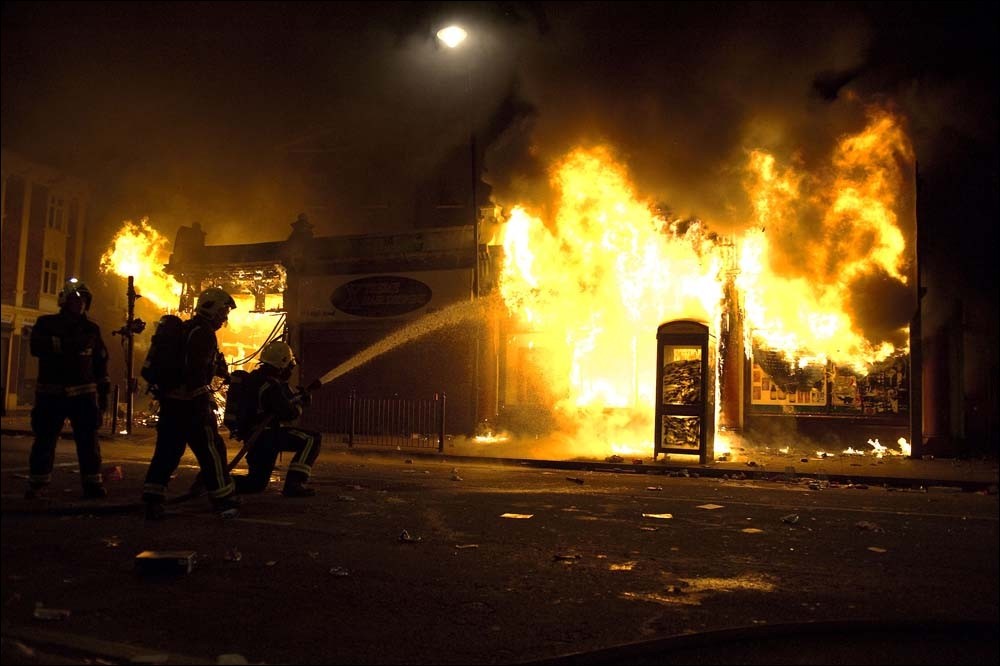
Firefighters in Tottenham, August 2011, photo Paul Mattsson (Click to enlarge)
Fear of crime
A misconception by some - particularly by left organisations that condone the rioting - is that the riots will inevitably damage the fortunes of the government.
The ruling class and government were definitely shaken by the events and were struggling to regain control of the situation. Meetings of Cobra, the government's emergency civil contingency committee were hastily convened, the government was widely criticised and Nick Clegg was booed when he visited Birmingham.
The events have also exacerbated divisions within the government, especially at present over its planned 20% cut in the police force budget.
But as the eruption ebbed, the government started to play on the widespread fear and insecurity that had developed in order to pose as the toughest executors of law and order.
It is no accident that in the special House of Commons sitting yesterday, both the government coalition and Labour MPs repeated again and again that these riots were 'simply criminal', in a crude attempt to both exploit people's fears and to divert attention away from the major crisis issues in society - the failing economy, level of inequality, spending cuts, etc.
The extensive riots that broke out in city suburbs in France and lasted three weeks in the autumn of 2005 did not prevent right wing Nicolas Sarkozy from winning the French presidential election in 2007, through exploiting the political weakness of the workers' movement.
Fear of crime can lead to increased polarisation in society, made worse by the propaganda of government ministers trying to attract support. All young people can suffer from this - with a whole generation potentially being demonised and labelled as troublemakers.
Danger of disunity
Another danger in the present situation is of racial and ethnic division developing in some areas, for instance in Birmingham, where many believe that racism played a part in the terrible mowing down by a car driver of three young Asian men.
The far fight British National Party and the English Defence League have both declared that they will organise to 'defend' communities, which means that they will spread racism and division as much as they can.
In contradistinction to this, local shopkeepers and communities quickly mobilised across ethnic and racial lines to defend business premises and homes in a number of areas during the rioting.
Sikh men in Southall organised to defend mosques and Hindu temples as well as Sikh temples. Turkish, Kurdish and Bangladeshi shopkeepers mobilised in Hackney to defend major streets and premises.
Had the riots continued, these initiatives could have been developed into democratically organised, mass, united defence of communities, with elected organising committees, as the Socialist Party would have called for.
It was also the case that after the riots, in many areas a mass of people turned out onto the streets to help clear up the mess and restore things to normal and donations poured in to help those who had lost homes and small businesses.
Taking all the above points into account, the applauding of looting in the Socialist Worker newspaper this week is totally wrong. An article by Gary McFarlane incredibly said:
"Karl Marx was exactly right when he talked about expropriating the expropriators, taking back what they have taken from us. That's what looting by poor working class people represents and in that sense it is a deeply political act".
The article even tries to excuse arsonists who placed people in danger of burning to death, by saying:
"No one set out to try and kill or injure those living above [business] premises."
What a travesty to suggest that Marx would have supported the looting of goods from small businesses or arsonists setting alight to people's homes, rather than the mass, organised working class action that he actually stood for, against the capitalist class.
Mass, organised protest needed
The danger of renewed flair-ups of rioting remains - in coming days as well as months. Nothing is being done to begin to tackle the causes - even by taking measures such as the relatively straightforward steps that the Socialist Party has demanded, like restoring basic youth services that have been recently cut.
It is very urgent that the trade union and anti-cuts movement responds with concrete avenues for demonstrating workers' unity and solidarity across all communities, to turn and channel the anger shown in the riots in a progressive direction.
In particular, the four million strong public sector of the trade union movement needs to exert a massive show of strength this autumn to tell the government, through a united day of strike action, that it will not accept the programme of spending cuts.
The lobby of the TUC organised by the National Shop Stewards Network on 11 September is very important in building pressure on the TUC leadership for this action.
The trade union leaders have a responsibility to take initiatives to cut across potential division and to attract young people and the unemployed into trade union organised action for a massive programme of job creation, investment in social house building, defence of public services, and other measures to improve people's lives and basic conditions.

Tottenham riots, August 2011 , photo Paul Mattsson (Click to enlarge)
The Con-Dem government will not reap significant support from its 'law and order' propaganda offensive if the trade union movement builds for well prepared, well stewarded, mass industrial action, putting forward an alternative to the Con-Dems' stance and cuts agenda, and calling for the removal of this government that is driving the cuts through.
However, the Labour Party has no real alternative to offer, it has just echoed Tory condemnation of violence. A few Labour politicians, such as Harriet Harman, have tentatively drawn a link between the riots and the government's spending cuts, but without of course mentioning that Labour supports most of those cuts.
So this raises even more forcefully the burning need for urgent steps to be taken towards the creation of new mass workers' party - one that can put forward a programme in the interests of ordinary working people across the country.
Following the widespread and profound shock of people at the riots, as well as the dangers of right-wing forces benefiting, there will also be many people questioning the nature of the system we live in and drawing the conclusion that it is deeply flawed and needs to be fundamentally changed.
The outburst of unorganised groups and individuals acting in a misdirected, chaotic, dangerous, mistaken way, caused the forces of the state to be temporarily overstretched.
Imagine what a mass movement of workers, acting in a highly organised, disciplined and democratically controlled way could do, to advance the interests of the overwhelming majority of people in society.
Armed with a socialist programme, of public ownership of the major companies and a planned economy, such a movement would be invincible, and could bring in a socialist government capable of offering youth a future that would provide them with decent living standards, and use and develop their talents and energies productively.
It is no accident that in the special House of Commons sitting yesterday, both the government coalition and Labour MPs repeated again and again that these riots were 'simply criminal', in a crude attempt to both exploit people's fears and to divert attention away from the major crisis issues in society - the failing economy, level of inequality, spending cuts, etc.
The extensive riots that broke out in city suburbs in France and lasted three weeks in the autumn of 2005 did not prevent right wing Nicolas Sarkozy from winning the French presidential election in 2007, through exploiting the political weakness of the workers' movement.
Fear of crime can lead to increased polarisation in society, made worse by the propaganda of government ministers trying to attract support. All young people can suffer from this - with a whole generation potentially being demonised and labelled as troublemakers.
Danger of disunity
Another danger in the present situation is of racial and ethnic division developing in some areas, for instance in Birmingham, where many believe that racism played a part in the terrible mowing down by a car driver of three young Asian men.
The far fight British National Party and the English Defence League have both declared that they will organise to 'defend' communities, which means that they will spread racism and division as much as they can.
In contradistinction to this, local shopkeepers and communities quickly mobilised across ethnic and racial lines to defend business premises and homes in a number of areas during the rioting.
Sikh men in Southall organised to defend mosques and Hindu temples as well as Sikh temples. Turkish, Kurdish and Bangladeshi shopkeepers mobilised in Hackney to defend major streets and premises.
Had the riots continued, these initiatives could have been developed into democratically organised, mass, united defence of communities, with elected organising committees, as the Socialist Party would have called for.
It was also the case that after the riots, in many areas a mass of people turned out onto the streets to help clear up the mess and restore things to normal and donations poured in to help those who had lost homes and small businesses.
Taking all the above points into account, the applauding of looting in the Socialist Worker newspaper this week is totally wrong. An article by Gary McFarlane incredibly said:
"Karl Marx was exactly right when he talked about expropriating the expropriators, taking back what they have taken from us. That's what looting by poor working class people represents and in that sense it is a deeply political act".
The article even tries to excuse arsonists who placed people in danger of burning to death, by saying:
"No one set out to try and kill or injure those living above [business] premises."
What a travesty to suggest that Marx would have supported the looting of goods from small businesses or arsonists setting alight to people's homes, rather than the mass, organised working class action that he actually stood for, against the capitalist class.
Mass, organised protest needed
The danger of renewed flair-ups of rioting remains - in coming days as well as months. Nothing is being done to begin to tackle the causes - even by taking measures such as the relatively straightforward steps that the Socialist Party has demanded, like restoring basic youth services that have been recently cut.
It is very urgent that the trade union and anti-cuts movement responds with concrete avenues for demonstrating workers' unity and solidarity across all communities, to turn and channel the anger shown in the riots in a progressive direction.
In particular, the four million strong public sector of the trade union movement needs to exert a massive show of strength this autumn to tell the government, through a united day of strike action, that it will not accept the programme of spending cuts.
The lobby of the TUC organised by the National Shop Stewards Network on 11 September is very important in building pressure on the TUC leadership for this action.
The trade union leaders have a responsibility to take initiatives to cut across potential division and to attract young people and the unemployed into trade union organised action for a massive programme of job creation, investment in social house building, defence of public services, and other measures to improve people's lives and basic conditions.
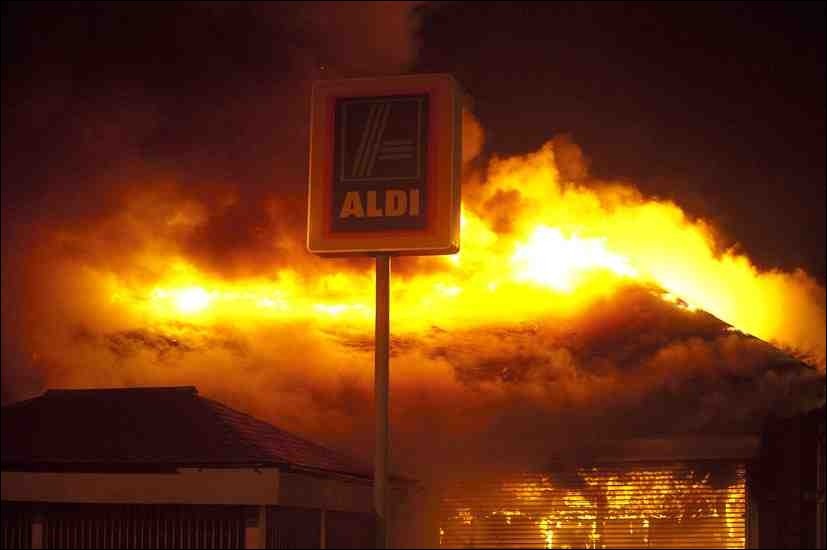
Tottenham riots, August 2011 , photo Paul Mattsson (Click to enlarge)
The Con-Dem government will not reap significant support from its 'law and order' propaganda offensive if the trade union movement builds for well prepared, well stewarded, mass industrial action, putting forward an alternative to the Con-Dems' stance and cuts agenda, and calling for the removal of this government that is driving the cuts through.
However, the Labour Party has no real alternative to offer, it has just echoed Tory condemnation of violence. A few Labour politicians, such as Harriet Harman, have tentatively drawn a link between the riots and the government's spending cuts, but without of course mentioning that Labour supports most of those cuts.
So this raises even more forcefully the burning need for urgent steps to be taken towards the creation of new mass workers' party - one that can put forward a programme in the interests of ordinary working people across the country.
Following the widespread and profound shock of people at the riots, as well as the dangers of right-wing forces benefiting, there will also be many people questioning the nature of the system we live in and drawing the conclusion that it is deeply flawed and needs to be fundamentally changed.
The outburst of unorganised groups and individuals acting in a misdirected, chaotic, dangerous, mistaken way, caused the forces of the state to be temporarily overstretched.
Imagine what a mass movement of workers, acting in a highly organised, disciplined and democratically controlled way could do, to advance the interests of the overwhelming majority of people in society.
Armed with a socialist programme, of public ownership of the major companies and a planned economy, such a movement would be invincible, and could bring in a socialist government capable of offering youth a future that would provide them with decent living standards, and use and develop their talents and energies productively.
Tuesday, 9 August 2011
PCS statement on the riots
An excellent statement that cuts through the media accounts and gets to the question of why this has happened and what can we do about it. Taken from: http://www.pcs.org.uk/en/news_and_events/news_centre/index.cfm/id/E0A7A515-CEFA-48A4-865EFD52B0A653D3
Thousands of our members live and work in the communities that have been hit by the vandalism and looting of recent days. Tragically many people have lost their homes, and many more their workplace, potentially their job and income too.
We echo the words of the Fire Brigades Union, “these events illustrate the bravery and commitment of London’s firefighters, and the entire capital will be grateful to them”. Our emergency services in London and other cities have once again shown that they play a vital role in protecting the public.
Public sector workers, from police community support officers to welfare advisers and from teachers to youth workers, will have a huge role to play in rebuilding and in maintaining a sense of community. The government has spent recent months disrespecting these workers and attacking their jobs, pensions and pay; it is time for that to stop and for them to recognise their valuable contribution to society.
As communities clear up, we have to step back and recognise these disturbances did not happen in a vacuum. It is not condoning violence to say that simply dismissing this as 'mindless criminality' is to give up on our responsibility to look for causes and solutions.
Youth unemployment is at its highest level on record, and further and higher education costs are set to soar. Public services are being slashed in many communities with councils cutting youth services and eligibility to housing. Welfare cuts and privatisation mean jobcentres are being closed and benefit cuts are causing anguish and hardship to many.
Our society is more unequal than at any point since the 1930s. There will be those who will call for tougher sentencing and more police powers, but these will not solve the very deep problems facing our country. As PCS has argued, we need investment to create the jobs and build the infrastructure that our communities need.
We should also resist attempts to demonise young people in general. They have been the biggest victims of this recession. The lawlessness of the financial and political elites is a much larger problem that our society must address.
In the coming days and weeks, we must address the complex issues that have led to the recent days' incidents across London and elsewhere, and caused so many to be rightly shocked and appalled.
Thousands of our members live and work in the communities that have been hit by the vandalism and looting of recent days. Tragically many people have lost their homes, and many more their workplace, potentially their job and income too.
We echo the words of the Fire Brigades Union, “these events illustrate the bravery and commitment of London’s firefighters, and the entire capital will be grateful to them”. Our emergency services in London and other cities have once again shown that they play a vital role in protecting the public.
Public sector workers, from police community support officers to welfare advisers and from teachers to youth workers, will have a huge role to play in rebuilding and in maintaining a sense of community. The government has spent recent months disrespecting these workers and attacking their jobs, pensions and pay; it is time for that to stop and for them to recognise their valuable contribution to society.
As communities clear up, we have to step back and recognise these disturbances did not happen in a vacuum. It is not condoning violence to say that simply dismissing this as 'mindless criminality' is to give up on our responsibility to look for causes and solutions.
Youth unemployment is at its highest level on record, and further and higher education costs are set to soar. Public services are being slashed in many communities with councils cutting youth services and eligibility to housing. Welfare cuts and privatisation mean jobcentres are being closed and benefit cuts are causing anguish and hardship to many.
Our society is more unequal than at any point since the 1930s. There will be those who will call for tougher sentencing and more police powers, but these will not solve the very deep problems facing our country. As PCS has argued, we need investment to create the jobs and build the infrastructure that our communities need.
We should also resist attempts to demonise young people in general. They have been the biggest victims of this recession. The lawlessness of the financial and political elites is a much larger problem that our society must address.
In the coming days and weeks, we must address the complex issues that have led to the recent days' incidents across London and elsewhere, and caused so many to be rightly shocked and appalled.
Mark Serwotka - General Secretary
Janice Godrich - President
Subscribe to:
Posts (Atom)