Tuesday, 31 July 2012

Report from second day of strike action at Remploy Bristol

Bristol Socialist Party sends solidarity to the Bristol Remploy Workers after their second day of strike action last Thursday. Please sign the Unite/ GMB petition here.

Report by Tom Baldwin

Once again the strike at Remploy in Bristol was 100% solid with all the workers out and most on the picket line.

The sun was shining and the pickets were in a good mood but there was no dent in their determination to fight the attacks on Remploy.

The people we spoke to wanted to talk about politics and clearly saw their struggle in the context of the economic crisis, high unemployment and the cuts.

There was support for linking up with other workers under attack and for the National Shop Stewards Network lobby of the TUC on 9th September, which is calling for a one-day general strike against austerity.

I spoke to Mark Cambridge, a Unite member in Remploy and asked him why he was out:

"We're on strike to speak up and stand up for our rights. In Remploy Bristol in particular we are concerned about the effects of possibly being TUPE'd over to a private company and our years of service not being recognised.

Basically we're standing up for our futures and for future generations of disabled people. We're showing we're no longer the little people who can be easily rolled over. We must fight to get the support we need, especially in this economic crisis."

I also asked him what he thought the next step was for Remploy workers:

"We need to coordinate with other groups of workers and raise national awareness. There are still a lot of people that don't know what Remploy is or what's being done to us.

"That's our key aim. We want to build support and be in a stronger position to take on the government when parliament meets again in six weeks."

Lib Dems in Bristol inflicting care home privatisation

By Robin Clapp

In a week where spiv firms like G4S have shown they couldn't organise a proverbial in a brewery and hospitals are told they're bankrupt because PFI contracts have begun to, predictably, go belly-up, it might have been advisable for Bristol City Council's Lib Dem leadership to hold back from their announcement that they intend giving up on providing public care homes in favour of seeking partnerships with the private sector.

Eight care homes will close across the city, displacing over 200 residents and costing the jobs of over 300 dedicated staff.

This comes on top of the privatisation of the home care service and drastic cuts in grants to the voluntary sector.

Previously even the Tories blanched at these steps before dutifully falling behind their coalition partners, while the New Labour leaders seem either to have undertaken a collective vow of silence or, at most, are timorously asking whether this step is wise. Not a word about what they would do.

Under the guise of offering "consumer choice",councillors have resorted to mouthing increasingly discredited platitudes like "social enterprise" and "not for profit provision" as offering the best ways ahead.

Yet just up the road in south Gloucester, BBC's Panorama last year exposed the scandal of where these words can lead when the "make a quick buck and cut costs to the bone" private sector gets its snout into the care budget.

This example is one of many. All three mainstream parties are in it together in town halls, preparing cutsthat represent an ideological attack on public welfare and social provision.

So it's left to the trade unions, community groups, service users and the anti-cuts alliance to sound the alarm bells and spell out the catastrophe that lies ahead for elderly and vulnerable people if this privatisers' charter gets the green light. We'll be lobbying the Cabinet on 26 July, then the full council meeting.

We'll demand there that the council should immediately use its £60 million reserves to plug any urgent spending gaps and renew and update the current in-house provision. A city-wide campaign of opposition will then be stepped up.

The private sector cannot provide good quality services. The Bristol and District anti-cuts Alliance (BADACA) will stand shoulder to shoulder with all those who are prepared to resist this latest assault and campaign for a national, publicly funded social care service based on need.

Wednesday, 25 July 2012

PCS calls off Home Office ‘Olympic strike’ after 'considerable progress'

From: http://union-news.co.uk/2012/07/pcs-calls-off-home-office-olympic-strike-after-extra-staff-are-posted-in/

by Pete Murray - 25th July 2012, 11.14 BST

PCS general secretary, Mark Serwotka has announced the union has called off the planned Home Office strike.

It follows a meeting between union officials and Home Office official yesterday at which he said the union had made ‘genuine progress’ on their issues of concern.

The decision comes ahead of a hearing at the High Court in London at which government lawyers are seeking an injunction to try to stop the planned strike tomorrow by thousands of Home Office staff.

Mark Serwotka said the case rested on a ‘minor technicality’ over 12 members based in continental Europe and that the union was in discussion with Treasury lawyers of whether the two sides would continue with the legal case.

Mark Serwotka said last night’s talks had released ‘significant new investment’ in Home Office staffing at border controls, with 800 new jobs, including at Heathrow, Gatwick and Luton airports and a further 300 jobs at passport offices.

Also speaking at the news conference at PCS head office, the secretary of the union’s Home Office section, Paul O’Connor said members preparing to go on strike had been subjected to ‘absolutely outrageous vilification’ in the run-up to the strike.

“They have stood firm in the face of that vilification.

“This is a significant step forward in terms of jobs in very crucial public services and that our people in this country depend upon.”

Officials describe the government’s change of heart as ‘a welcome step towards a recognition that the Home Office has been cracking under the strain of massive job cuts’ – with long queues at airports, a backlog of 276,000 unresolved immigration and asylum cases, and reports of holidaymakers having to wait weeks and travel miles across the country to get a passport.

The union says it has secured a commitment to ongoing negotiations to address the issues under dispute, in particular efforts to avoid compulsory redundancies in the passport agency.

Mark Serwotka told the news conference that management had agreed to discuss whether ‘a handful’ of compulsory redundancy notices against workers at passport offices in south Wales can be resolved.

Austerity Games highlights plight of young people

From: http://www.youthfightforjobs.com

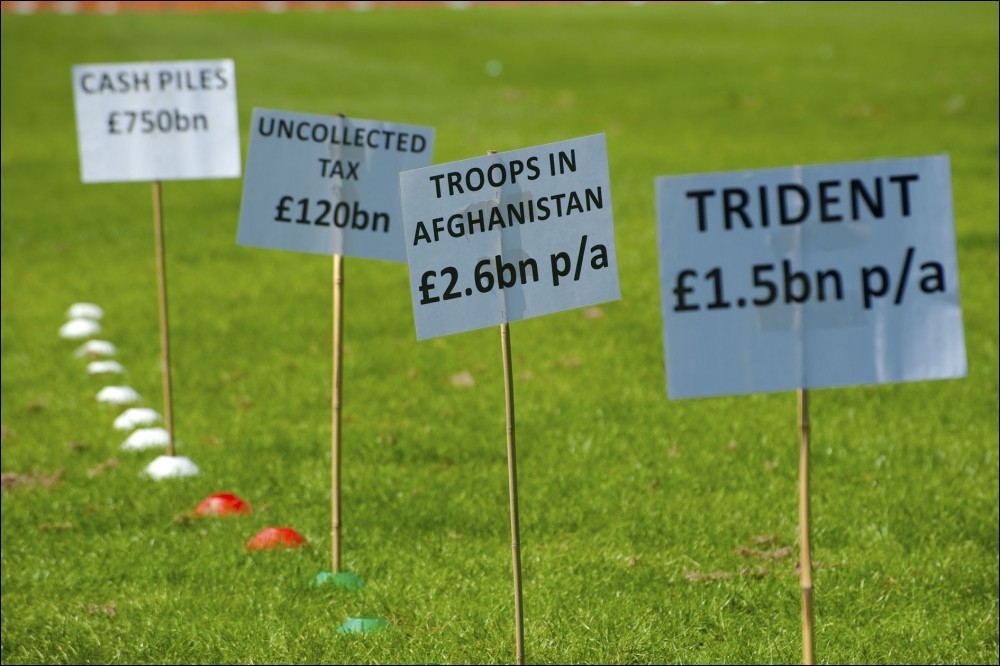
As the world’s eyes focus on the Olympics, one of the greatest events in the sporting calendar, young people and trade unionists from across the country arrived on Hackney Marshes, east London, to compete in the alternative Austerity Games.

Despite Hackney council’s over-zealous banning of the games, closing the toilets and cafĂ© and locking the car-park gates, the games were a huge success.

The council’s attitude is just another example of what has been widely recognised as an officious clampdown on protest and extreme levels of security and protection of corporate sponsorship for the London 2012 Games.

The example of the bagel shop, swooped on for getting into the Olympic spirit and arranging bagels in the shape of the Olympic rings, shows the lengths these drones will go to to protect the likes of Coca-Cola, Samsung and Visa.

Free from the corporate restraints of the nearby high security-fenced Olympic park, wearing and drinking anything of their choice, the Austerity athletes lined up to highlight the plight of young people in Britain today.


Read the rest of the article, with more pictures: http://www.youthfightforjobs.com/wordpress/wordpress/?p=523

Monday, 16 July 2012

Socialist Party report: Bristol protests counter racist EDL

About 1,000 anti-racist demonstrators gathered in various locations across Bristol to protest against the march of the far-right, racist English Defence League (EDL) on Saturday 14 July. As the event coincided with the Bristol Pride event there was also a separate anti-racist march organised by the LGBT community.

Pressure from campaigners had forced the EDL to keep their march confined to backstreets of the city, far away from passers-by and ordinary Bristolians. Their march which was only seven minutes long, muscled up a national mobilisation of only 300 supporters. An enormous £500,000 was spent policing it.

There were over 1,000 police officers drafted in from all over the country, with 14 arrests on the day including for racially aggravated assault.

In the days preceding the march the police had written a series of belligerent articles in the local press sowing confusion and attempting to intimidate anti-EDL protesters into staying at home. This even went so far as a last minute change of venue, with protesters being warned not to assemble in the planned assembly point in the centre of Bristol.

This did not prevent trade unionists, anti-racists, members of community groups and even young families with children from assembling in the centre for a march through the city and rally in the nearby Castle Park.


Confusion


The main organisers of the event, a temporary group set up under the name 'We Are Bristol', in reality Unite Against Fascism, also bear some responsibility for the confusion on the day.

Weeks of organising meetings between UAF and local anarchist groups had unfortunately resulted in the calling of two separate events, one in the centre of town and one at Temple Meads railway station.

Even as late as the week before, no negotiations had begun with the police, no march had been organised beyond a 'static protest', and no trade union stewards had been appointed or organised to help defend the march from EDL attack or police harassment.

The Bristol & District Anti-Cuts Alliance had raised concerns about this and put out a call for stewards. As a result, on the day, local trade unionists, including Socialist Party members and a large delegation from PCS, stepped up to steward the protest.

But even after the march had begun to move, led by various trade union banners from across the region including Cardiff Trades Council, there was an attempt by UAF to 'hold the centre' and keep part of the protest in one place, despite having no clear strategy for breaking through police lines or confronting the EDL.

It was at this point that several protesters were arrested and the police moved in to kettle the remaining protesters. This would have cut the protest in half before it had even started but was fortunately prevented by the trade union stewards who kept the march together.


Fighting Austerity

Assorted Labour Party members - councillors, an MP and a prospective mayoral candidate - turned up to speak at the final rally. However, no criticism of New Labour's support for austerity was raised by the UAF's speakers. Only Roger Thomas, speaking in a personal capacity from PCS, drew attention to the Labour Party's culpability in administering the cuts that destroy communities and help racism to thrive, and called for an alternative of jobs and homes, not racism.

This message got a great response and shows that many demonstrators understood that the fight against racism and all forms of discrimination needs to be linked to a fight against the conditions that divide us in the first place.

The UAF organisers said they could not take up these questions because they wanted a 'broad umbrella' that would maximise turnout on the day. However, a mass united demo was not achieved, instead there were disparate protests.

Faith groups and Muslim community leaders followed the Liberal Democrat councillors in tolerating the EDL's march in return for holding a 'multi-faith' event in celebration of diversity on Sunday 15 August. Some Muslim leaders even went so far as to call for dialogue with the EDL!

It was the organised labour movement that was best able to outnumber and embarrass the EDL on the day, and even though, as a result of the massive police presence, we could not physically block the EDL from marching, this was still a success.

But the EDL and groups like them will not be defeated unless we can build fighting organisations to resist the austerity that does so much to alienate and divide ordinary people of all races, religions and backgrounds.

Video: Bristol Demonstration against EDL


Trade Unions, Trades Councils, anti cuts alliance and anti fascist groups came together for a mass protest against the EDL march on July 14th. This shows the march along Baldwin Street, from to Centre to Bristol Bridge. The EDL had a 7 minute walk, down the back streets of Bristol where they were then caged in Queen Square.

Thursday, 12 July 2012

LGBT rights: Sexuality, austerity and socialism

Kick the EDL Out of Bristol
Anti-Racist and Proud @ Bristol Pride Parade 
Assemble 11am at Berkeley Square (BS8) for march to College Green, more details here

Article from: The Socialist newspaper, 4 July 2012


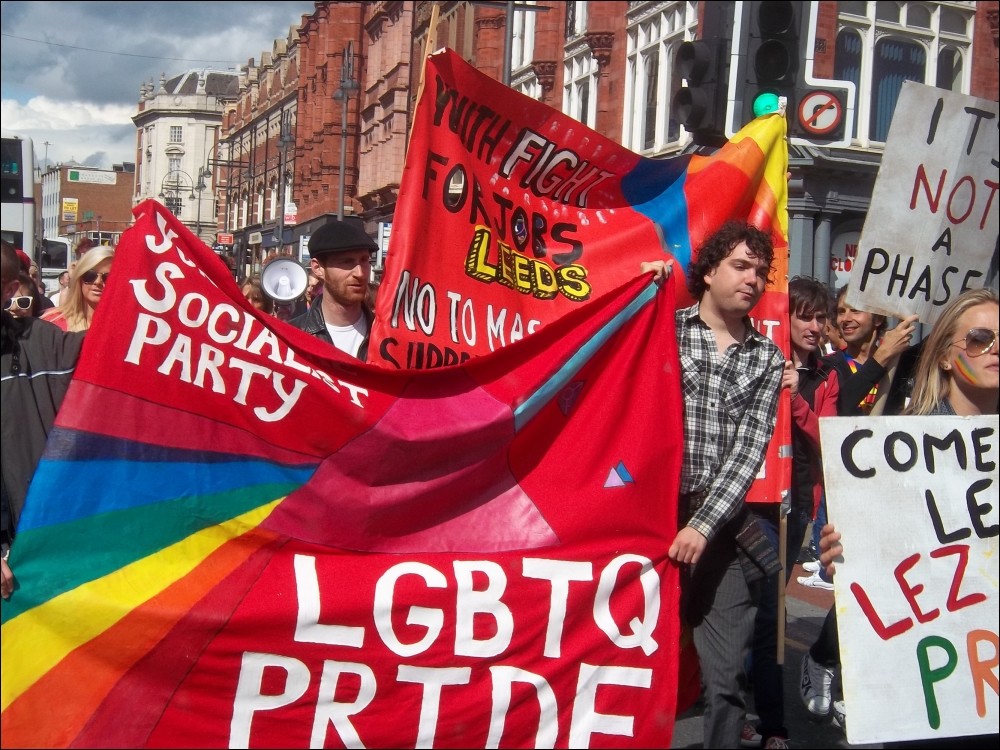
Leeds Pride 2011, photo Leeds Socialist Party (Click to enlarge)

In 78 countries, homosexual acts are still illegal. In five of these the maximum penalty is death. In Ukraine a law is currently being considered that would make it illegal to talk about lesbian, gay, bisexual and trans (LGBT) issues in the media. As internationalists, socialists oppose oppression around the globe.
This year's London Pride event will be World Pride. The Socialist Party and its LGBT group will be participating and putting forward the ideas outlined in the articles here. We will have a new pamphlet available - Sexuality, austerity and socialism - a collection of articles from the Socialist as well as some new ones.

Many Lesbian, Gay, Bisexual, Trans and Queer (LGBTQ) people are looking for an alternative to the non-political scene that has been the backdrop to our lives for the past 15 to 20 years. Yes, much has been achieved - anti-discrimination laws, civil partnerships and adoption rights to name a few legal reforms - and social attitudes have changed for the better, but homophobia, biphobia and transphobia have not gone away.

Many LGBTQ people face discrimination on a daily basis, including being unable to come out for fear of family, workplace or social rejection. Passing laws banning discrimination does not end prejudice. Growing numbers of LGBTQ people, especially young people, are coming to the conclusion that legal reform is not enough. How can we win not just LGBTQ rights but also liberation?

The key issue in politics today is the austerity plan being imposed by the Con-Dem coalition against public services and the welfare state. This will hit all working and middle class people. Economists have said that as of spring 2012 only around 10% of the planned cuts have been implemented. There is much pain promised until well beyond the next election, scheduled for 2015. This applies whoever is in government, as Labour plans cuts too, but at a slower pace.

Cuts will hit LGBTQ people especially hard. There will be direct attacks on some services specifically used by us, such as youth groups and voluntary sector organisations. Galop, the police monitoring and liaison organisation, and Broken Rainbows, the LGBT domestic violence advice and support service have already been threatened with funding cuts, though this was fought off the first time it was attempted.
NHS

Plans to chop up and privatise the NHS will lead to a loss of expertise and specialist services used by LGBTQ people. If GPs are commissioning services they may not have the necessary knowledge or be accountable. This will particularly hit trans people looking for gender reassignment, which is already limited.

The abolition of incapacity benefit will have a massive effect on people living with HIV/AIDS, whatever their sexuality. Introducing "individual budgets" to buy support services will be no good if appropriate services don't exist. Many sufferers will be forced on to Jobseeker's Allowance or could lose their benefits entirely.

Will there be direct attacks on our rights, like Section 28, the Thatcher government measure banning the "promotion of homosexuality" by local authorities? Section 28 was part of an act which forced local authorities to put council services out to be privatised and attacked jobs and conditions for local government workers.

The viciously homophobic propaganda campaign around Section 28 was used to scapegoat LGBT workers and divert attention from the effects of Tory policy. Left-wing councils were accused of wasting money on lesbian and gay centres and groups.

Many in the LGBTQ communities remember Section 28 and hate the Tories for it. Have the Tories changed? Prime minister David Cameron and some other top Tories conspicuously claim to be 'gay-friendly'. The coalition leaders are looking towards some form of marriage equality but probably not giving differently sexed couples the right to enter into civil partnerships.

Socialists support marriage equality as a democratic right but Tories claim to support marriage equality to "strengthen the family". By this they mean that family members should do the caring work, often without financial support and on very meagre benefits, which should be done by social services and the NHS.

Cameron wants to "decontaminate the Tory brand" and gain the support of a layer of wealthy LGBT people. His record belies his claims. He opposed the repeal of Section 28, opposed equal adoption rights and the Tories sit, at his behest, with homophobic far-right parties in the European Parliament.

An open and direct attack on LGBTQ rights is less rather than more likely at present. With the LGBTQ communities being more visible and better organised than in the 80s, this would inevitably outrage and radicalise wider layers especially of young people.
Scapegoating

Probably the biggest current threat is that cuts can lead to scapegoating. Recession and austerity raises tension within society and some will look to blame and take out frustration on minorities. It is no coincidence that homophobic hate crime in the West End of London increased by 21% in the year to the end of February 2011. This area includes Soho and is promoted as the safest place for LGBTQ people in Britain with numerous bars and clubs.

Scapegoating will be encouraged, even if not openly, by elements in the Tory party. There were a number of attacks on gay rights and marriage equality by Tory MPs and journalists in the early months of 2011 just as the cuts started to bite. At some stage any capitalist government under pressure may resort to homophobia, biphobia and transphobia to divide workers. Capitalist politicians need a reservoir of reactionary ideas in society, which they can draw on if they are under threat.

Attacks against LGBTQ communities will lead to a fightback - just as a mass campaign opposed Section 28 and brought LGBTQ communities together against a common foe. This gave confidence, visibility and led to many of the advances of the past 20 or so years.

Capitalism diverted the mood of confidence down a commercial route and into the opening up of bars, venues and festivals. Pride events became depoliticised. LGBTQ people need somewhere to meet and socialise, but the commercial scene excludes those who don't feel they 'fit in', can't afford to go out drinking or clubbing in an environment where prices can be very high or just live too far away from the scene. Many perceive the scene as trashy and over-sexualised. Outside big cities there may be no Queer or LGBT 'alternative' scene.

Socialist Party members campaigning at Pride, photo Chris Newby


Only working class action can create unity against prejudice and root out backward ideas. As the effect of cuts and the fightback against them grow in society as a whole, LGBTQ people will want a piece of the action. Strike action and mass demos will inspire and draw in whole layers of our communities.

The Socialist Party calls for a mass demonstration, organised by the trade unions, in particular their LGBT Groups, and LGBTQ community and campaigning organisations for full marriage equality and against the cuts. This could cut across any attempts to scapegoat LGBTQ people, make clear that we are not prepared to accept a legal reform, however important, as a sop from a government attacking our living standards and build unity with other workers and oppressed groups fighting attacks.

The Socialist Party's aim is the transformation of society, with the vast wealth of global society being democratically controlled by the currently disenfranchised 99%, not used for the super-wealthy 1% that capitalist governments work for. On this basis, services could be expanded, not cut, with human relationships being revolutionised for the better, including an end to oppression and prejudice. This is the only guarantee of LGBTQ liberation.

The Socialist Party calls for:
  • The immediate introduction of equal marriage rights for same sex couples and the right for couples of different sexes to enter into civil partnership
  • No penalisation of trans people in marriage proceedings
  • Investment in job creation, decent housing and public services to reduce economic pressure on relationships
  • A mass movement against the cuts, led by the trade unions and involving community campaigns, minority groups and young people
  • Rebuilding a militant LGBTQ movement to fight for equality and genuine liberation for all
  • Pride not profit: keep big business out of Pride events
  • A new mass workers' party to offer real political representation for ordinary people, including all minorities