Showing posts with label General Strike. Show all posts

Thursday, 8 September 2016

Organise mass working class resistance to austerity

Come to the National Shop Stewards Network rally at the TUC Congress

Join fellow trade unionists and socialists including Shadow Chancellor John McDonnell and BFAWU (Bakers Union) general secretary Ronnie Draper on the NSSN lobby of the TUC in Brighton on 11 September, 1pm in the Ashdown Suite, Holiday Inn, 137 King's Road (seafront), Brighton, BN1 2JF


Junior doctors and teachers march together in a joint BMA and NUT demonstration in April. Now Cameron is gone we need to get Hunt and the rest of the Tories out photo Paul Mattsson   

Rob Williams, Socialist Party industrial organiser
TUC congress is taking place at the end of what has seemed like a hot summer, industrially at least. In the run up to the event, the figures for days lost in industrial action in 2015 were published.

On the surface, they are alarming. The lowest number of workers on strike - 81,000 - in a single year since records began in 1893 and only 170,000 days lost through action - the second lowest in history. In the 1980s, on average more than three million days were lost.

No doubt the conclusion drawn by the pessimists and cynics within the trade union movement will be that this confirms that the organised working class is too weak to defeat the employers and their government.

In fact, the TUC press officer, Michael Pidgeon, has used the figures to argue that the Tories had no need to bring in the repressive Trade Union Act, the biggest attack on the unions since Thatcher's anti-union laws three decades ago.

They will also be used to justify the absolutely baleful role of the right-wing union leaders in the fight against Tory austerity over the last six years. No serious campaign of co-ordinated strike action has been called against the biggest jobs cull ever seen in the public sector. Last year, it was estimated that 400,000 workers had been sacked, with the possibility of another half a million going by 2020.

Opportunity

The biggest opportunity to confront the cuts was the 2011 struggle to defend public sector pensions which saw 2 million workers walk out on the 30 November strike that year. If that dispute had been continued and escalated, it had the potential to stop Cameron and Osborne's austerity offensive in its tracks. Instead, the conscious sell-out only emboldened the Tories to go further.

The result has been devastating in terms of jobs, services and pay as well as pensions, which have contributed to the 10% drop in wages with increased pension contributions. No wonder the income of workers in the UK is still at pre-crisis levels. It was this position that forced joint action over pay in 2014. Although that too only lasted one day.

But it would be a huge mistake to draw pessimistic conclusions from a superficial view of these statistics. In some respects, they are a reflection of the disappointment of workers at the seeming inability of the unions to lead an effective fight against the Tory cuts.

As we have pointed out, this is the responsibility of the right-wing union leaders. Two of the three leaders who were primarily responsible for the ending of the pensions dispute, then leader of the TUC Brendan Barber and GMB general secretary Paul Kenny, were knighted by Cameron. The other, Unison general secretary Dave Prentis, is under increasing pressure from members of his union because of his role.

Joint action

The ability of the Tories to drive through cuts in the public sector (which has a majority of union members and is where their density is greatest) without large-scale joint action over the last two years has undoubtedly had an effect on the figures.

But this masks the huge discontent and anger that exists. This has been reflected in individual union disputes in the public sector. For example, there have been national disputes by civil servants' union PCS and the Fire Brigades Union.

There have also been prominent local disputes, such as by Unite members in Bromley and Greenwich councils and Unison in Glasgow and Barnet. Socialist Party members have been prominent in some of these struggles.

There are many other disputes that don't even make the figures. Over the last few months there has been an uprising of teaching assistants in Derby and then Durham against pay cuts of up to 23% by Labour councils.

In Durham, 500 of these low paid workers filled a meeting and launched a public campaign but no actual official strike days have yet been sanctioned by theunions, Unison and the GMB.
Similarly, there have been three incredible disputes in London recently, at Deliveroo, UberEats and among contracted cleaners. It is likely that not one day of their action is officially recorded as neither of the small independent unions involved - the United Voices of the World (UVW) and the Independent Workers Union of Great Britain (IWGB) - have a recognition agreement with the employer.

Nevertheless both Deliveroo drivers and UVW cleaners have won victories against their brutal working conditions. Many of these workers are migrants and many have to hold down two or more jobs to have any chance of a living.

'Self-employment'

Their struggles should be celebrated and show that it is possible for unions to flourish in the era of zero-hour contracts and bogus self-employment. The trade union movement, especially 'new unionism' in the late nineteenth century, was built in similar exploitative conditions.
The strikes also showed a number of features that are becoming increasingly common. The use of social media has been important to advertise the disputes and build solidarity, including protests and financial support.

UberEats workers ride into town to face down their bosses photo Scott Jones, photo Scott Jones   (Click to enlarge)

The IWGB raised £8,000 in two days in their dispute with Deliveroo. PCS raised over £100,000 that helped pay National Gallery strikers during their dispute that lasted over 100 days last year. In fact, a number of disputes are seeing longer action.

Some of these disputes - such as those by BFAWU bakers' union members in 2-Sisters plants in Sheffield and Newport and PCS in the Welsh and Scottish Museums - were over employers attacking premium pay to compensate for the increase to the new National Living Wage.

The RMT has appeared to be on strike on all fronts - including Eurostar, Virgin East Coast, Southern Rail and ScotRail. Many of these have also involved protracted action. There have also been bitter disputes by Unite members on the buses in Leeds and Weymouth.

Construction workers went on strike at the Fawley oil refinery in Hampshire to ensure that migrant workers were paid the same as UK workers. Also, the first strike took place in the offshore oil industry for nearly 30 years. Both of these strikes got results.

Trade Union Act

The Tories may find that their Trade Union Act could actually up the ante, as the new law means that disputes could be timed out after six months, forcing a re-ballot. Workers could draw the conclusion that they might as well go all-out from the beginning.

Actually, far from dismissing the threat from the unions, the right-wing Tory press have a far more realistic appraisal of the potential threat of the unions.

They have particularly been fulminating about the rail strikes, demanding the immediate introduction of the new undemocratic higher voting thresholds or even outlawing strikes altogether!

In response to the new strike figures, Matthew Lynn of the Telegraph wrote, "Strike action may have fallen to the lowest levels in over a century - but the sooner it is eliminated completely the better." He was railing against the Southern Rail strike but also what he calls the 'public sector middle class'.

Of course, the most prominent of disputes among this group has been the inspirational junior doctors. They exploded onto the scene, not just on picket lines outside hospitals but campaigning in town and city centres.

Scandalously, the overwhelming support they have received from fellow trade unionists and the public hasn't matched by that of the TUC and most union leaders, especially in health.

However, the junior doctors have rejected the government's offer and are embarking on the next phase of action. It should be a key debate at TUC congress to turn support into active solidarity. 

At the very least there should be a national TUC demonstration in support of the BMA doctors' union and also widened to defend the NHS.

National demonstration

There is already a national demonstration called by the National Union of Students and lecturers' union UCU in November to defend education, just as national action has been taking place by teachers and lecturers.

The potential exists to bring all these struggles together. 90 years after the 1926 general strike, an increasing number of workers are groping towards the understanding that mass strike action can transform the political, as well as the industrial, situation.

The attempted Blairite coup against Jeremy Corbyn has deliberately deflected attention away from the historic crisis within the Tories after Brexit. The main architects of the brutal austerity offensive, Cameron and Osborne, are history.

May's government has no authority and she is only prime minister because of a defeat for an administration she was part of. In any other circumstance, there would be a clamour for a general election. Even if only semi-consciously, workers can feel that this is a weak government and this will only increase as more workers engage in action.

The National Shop Stewards Network (NSSN) is again holding a rally before the start of TUC congress.

Its two main themes will be for the unions to prepare the mass strike action necessary to take on what's left of the Tories and also to defend the left Labour leadership of Jeremy Corbyn against the Labour right. Shadow chancellor John McDonnell will be addressing the rally alongside leaders from some of the most militant unions.

The political and industrial are beginning to fuse. The second Corbyn wave, created by the whip of Blairite counter-revolution, has drawn more workers into the struggle against the Labour right.

Workers understand how much is at stake as the right wing try to turn the political clock back. This is not a period of passivity but one of increasing volatility. If given a lead it can develop into a mass movement of struggle to defeat the Tories and their Blairite agents.

Join fellow trade unionists and socialists including John McDonnell and Ronnie Draper on the NSSN lobby of the TUC in Brighton on 11 September, 1pm in the Ashdown Suite, Holiday Inn, 137 King's Road (seafront), Brighton, BN1 2JF

Thursday, 16 October 2014

Fight for Mass Action to End Cuts and Low Pay!

Britain needs a pay rise - how are we going to get it?

When the TUC first organised their 'Britain Needs a Pay Rise' demonstration on 18 October, it is hard to believe that they saw it as an integral part of a campaign of co-ordinated strike action. The first mention of it on their website was 11 February. Surely unbeknown to them, eight months later that date is days after hundreds of thousands of public sector workers have taken industrial action to break the Con-Dem pay freeze.

More than likely, the TUC and the Labour-affiliated unions saw the march as an opportunity to assist Labour in the protracted pre-election period by exposing the anti-working class policies of this Tory-led government, although Labour agrees with the pay freeze!

The fact that starting on 10 July and continuing into October, unions have called out members in local government, education, civil service and now the NHS is a reflection of the pressure that they have been subject to because of the grinding misery that the continuing fall in living standards has represented for millions of workers and their families.

However, the decision of the unions in local government to suspend their strike on 14 October is a major setback to the type of mass co-ordinated action needed to push the government back on pay. But activists in these unions and the NUT teachers union, which had already suspended action will be determined to get them back into the pay dispute.

The symptoms of the growing catastrophe facing working-class families are everywhere. The Trussell Trust, the largest food bank provider in the UK, says it has handed out 913,000 food parcels in the last year, up from 347,000 the year before. It added that there was a "shocking" 51% rise in clients to established food banks. The charity said that more than 30% of visits were put down to a delay in welfare payments but the second biggest reason, given by 20% of food bank users, was low income.

This is despite the social stigma attached to using them. In a recent survey by the University of Manchester, a 55 year old described how she had collected a food parcel on behalf of her grown-up daughter who was too embarrassed to come. She stated: "My daughter doesn't want to be seen as a scrounger." A child said: "We say to my mum make sure you eat but she says she's not hungry...she's just making sure we eat first." A survey by the NASUWT teachers' union revealed that a quarter of teachers have brought food into school to feed hungry pupils and a fifth have bought them lunch.
 
There are similar figures about payday loan companies, who are the suited and booted loan sharks as food banks are modern day soup kitchens. Last year, the charity StepChange handled £110 million-worth of payday loan debt, up from £60 million in 2012.

The so-called respectability of these vultures has now been exposed by the Financial Conduct Authority (FCA) - forcing leading payday loan company Wonga to write off £220m of debts for 330,000 people who couldn't afford to repay it. No wonder, when they charge interest rates over 5,000%!

In his speech to Conservative Party conference, Cameron again tried the Tory 'divide and rule' tactic of targeting benefits. But it was estimated that over half those who would suffer would be low-paid workers or the 'working poor', who earn so little that they qualify for in-work benefits and tax credits.

A report by the Office for National Statistics revealed that pay dropped by 0.2% in August in absolute terms. Yet incomes have been falling in 'real terms' for most of the period since the financial crisis of 2007-08. The Bank of England governor Mark Carney was invited to address this year's TUC and admitted that incomes had fallen by 10% since the crisis. He also thanked the unions for the sacrifice made by their members in "doing their bit" during the crisis! But on closer inspection, the ONS figures reveal a generation gap with those under 25 suffering a loss of 14%! This is hardly surprising when younger workers face the full brunt of zero-hour contracts, temporary work and lower rates of pay for new starters. They will be on worse pensions, if they exist at all. Yet graduates are expected to repay student debts inflated by £9,000 a year tuition fees!

The downward pressure on pay started under the last Labour government. The economic crisis was used by the bosses in the private sector to lower workers' wages and terms and conditions to literally get us to pay for their crisis. Many workers paid the price to retain their jobs by pay freezes or cuts and short-time working. However, the recovery of incomes has been very slow. To most workers, the so-called economic recovery is an utter myth that is only happening for the employers and the politicians, with MPs in line for an 11% pay increase!

Bosses, whether they are private sector employers or the government, have been quick to play off workers against each other. This was attempted in the public sector pensions dispute when they contrasted the so-called 'gold-plated' pensions of these workers with their counterparts in the private sector. In reality, this was a myth, with the average public sector worker receiving £7,000 a year in retirement. Similarly with pay, the fact that the squeeze in the private sector, where union density and organisation is inferior, was greater than the public sector, has been used as justification for the government attack.

The austerity offensive that was unleashed by Osborne in the autumn of 2010 has in effect been a deep recession for public sector workers, as well as working-class communities who rely on their services. The first two years saw public sector pay frozen absolutely, followed by two years of a limit of 1%.

Infamously, even this paltry rise isn't guaranteed in the NHS where up to 55% of workers will get nothing. Yet in the four years from 2010, RPI inflation rose by 4% a year on average. But even this price index, which, by including mortgages, is almost always higher than the CPI index now more commonly used by the government, is an under-estimate of the real cost of living, particularly those facing huge rents.     

Socialists explain that workers in the public and private sectors have to be united to resist the attack on all workers' incomes. Just as those in the private sector made concessions to keep their jobs in the depths of the recession, many public sector workers have been the victims of 90-day redundancy and re-engage notices. These have removed or worsened hard-won elements of their terms and conditions, such as car fuel allowances, that they have relied on as their pay has stagnated.

On top of this, the defeat of the pensions struggle as a result of the capitulation of the right-wing union leaders and the TUC, after the mammoth 2-million strong strike in November 2011 (N30) has meant that public sector workers have had their monthly pension contributions increased. In many cases, this has amounted to an effective cut in wages of anything up to £100 per month.

In addition, the vicious programme of cuts which have also been passed on by Labour councils have seen many public sector workers outsourced and privatised which has been a platform for swingeing wage cuts. The incredible strike by Care UK health sector workers in Doncaster, of over 80 days so far, was triggered by cuts of 25% as a result of being pushed into the private sector.

However, the N30 strike does point the way forward for all workers. That mass strike shook the Con-Dems, forcing Cameron into a volte face over his comments on the morning of the walkout that it was a 'damp squib'. Actually it was a massive show of strength by millions of workers in, arguably, the biggest single day of strike action since the 1926 General Strike.

In almost every town and city, there were mass strike rallies that revealed that any idea of a division between workers could be torn down, as the strikers received tremendous public support. As the reaction to the London tube workers strike earlier this year showed, when the unions act in a decisive way they become a reference point to all workers and others suffering from the brutal cuts and employers' offensives.

On the morning of N30, hundreds of 'The Sparks' - electricians in the construction industry - went from their weekly protest to a number of public sector picket lines. The Sparks were fighting against the imposition of a new BESNA contract that would have cut their wages by up to 35%. But through militant action and an official strike ballot by their union Unite, they were able to defeat the attack.

Undoubtedly, the sight and sounds of workers in the public sector throughout 2011 on strike and on the march, gave confidence to many other workers that it was possible to fight back. In return, victories such as that won by the Sparks and the London bus workers in 2012, who won an Olympic bonus, showed that it is possible to fight and win.

The setback of the pensions battle after the N30 strike has undoubtedly taken its toll on the confidence of workers, especially in the public sector. It opened the door still further and emboldened what is a weak and divided government. The result has been hundreds of thousands of redundancies, many of them would have been workers who strongly identified with the union. Many workers will have asked when contemplating action over pay: "Can we win?", "Will the union go all the way?"

But despite this, the July 10th pay strike of over a million was the biggest strike since N30 and showed that there are big layers of workers who realise that they have to fight to stop the slaughter of their incomes. Despite how anaemic this 'recovery' seems to workers, the fact that the economy has stabilised, at least for now, with perhaps the immediate threat to jobs lessened, can give workers confidence that it's possible to fight on pay. Sometimes in the midst of a deep crisis, workers can feel helpless.

Following the recent impressive action from NHS workers and civil servants on the one hand, and the calling off of the action in local government on the other, it's clear the pay struggle is at a crucial stage. These paltry offers must be rejected. The campaign must be continued and escalated. More strikes must be called before Christmas and into the New Year, with all the public sector involved.
The Socialist Party and the National Shop Stewards Network (NSSN) have been to the fore in building pressure on the TUC and the unions to call a 24 hour general strike. This could unite all workers in every sector to defeat Cameron's austerity and the employers' offensive. It would have huge support from the majority of people who are the victims of the cuts.

A significant breakthrough by a sizable group of workers would have a huge effect in raising the sights of all workers. It would not only shake the ConDems but also lay down a marker to all the mainstream parties, including Labour, who refuse to back the pay strikes because they have accepted Tory austerity.

Scandalously, the leaders of the Labour affiliated unions whose members have been on strike in the councils and the NHS against the pay freeze, accepted Miliband's spending plans at this summer's Labour Policy Forum. They wrongly believe that to go along with this is to protect their members because easing off Labour best ensures their victory at the general election next May.

In reality, they are only maintaining the idea that workers have to accept the cuts. They are loosening the pressure on Labour and disorientating union members and activists who cannot understand why the unions, the paymasters of Labour, are rolling over and being humiliated.

But history won't stop at the election. The incredible energy of the Scottish Independence campaign was a political mobilisation of the working-class and poor for an alternative to the austerity consensus of all the main parties on the bidding of the capitalist establishment. It was the first chance that many would have had to vote in a decisive manner for what they saw as a clear alternative idea.

It is an anticipation of the next months and years in the rest of the UK, as workers struggle politically and industrially to take on and defeat the attack on their incomes and all the other gains won by the working-class, but now are in mortal danger from the cuts and privatisation.

Striving for mass strike action by the unions, whoever is meting out austerity, is a critical element of this. The passing of the £10 an hour minimum wage by the TUC is an opportunity to appeal to the millions of low-paid non-unionised workers to become part of what is still the biggest organised force in society.

But side by side with this is the need for a real political alternative that fights for a more equal, socialist future. The Trade Unionist and Socialist Coalition (TUSC) is best placed to fight for such a mass political vehicle and be a powerful attractive force for those workers in unions that are still affiliated to Labour to break them from that grip.

by Rob Williams, Socialist Party national trade union organiser

Monday, 1 July 2013

7th Annual NSSN Conference: Building the rank and file, planning the way forward

From: http://shopstewards.net/2013/06/7th-annual-nssn-conference-building-the-rank-and-file-planning-the-way-forward/?fb_source=pubv1


There may well have been a pause in struggle on the part of some trade union leaders, but there has been no pause in the struggle for ordinary trade unionists and campaigners. This was the key point made by Linda Taaffe, Secretary of the National Shop Stewards Network (NSSN) in her opening address to the NSSN’s seventh annual conference this Saturday.

The NSSN conference successfully brought together the key activists from these struggles in a packed hall at the Camden Centre. Among the many topics for discussion and debate was the task of ending the ‘pause’ in struggle at the top of the trade movement and making the demand of a 24 hour general strike a reality.
This discussion was given practical form by the action plan introduced by NSSN Chair Rob Williams and passed unanimously by the delegates present.

The key points of the action plan were an NSSN rally at the TUC Congress at Bournemouth on September 8thfollowed by a lobby of Congress.

In the run up to the Congress NSSN supporters were encouraged to pass motions in support of a 24 hour general strike in their shop stewards committees, union branches, anti-cuts group and trades councils. Each region of the NSSN was encouraged to hold regional meetings to build for the lobby of the TUC and popularize the call for a general strike.

Finally the action plan pledged to energetically build the TUC demonstration outside the Tory Party Conference in Manchester on September 29th and organise an NSSN contingent on it which will march behind a banner calling for a 24 hour general strike.
In moving the action plan, Rob Williams said it was a scandal that almost 12 months on from the TUC congress voting for the Prison Officers Association (POA) motion calling on the TUC to consider the practicalities of a General Strike, precious little action in that direction had occurred.

In his speech Rob made clear that the NSSN supports all tactics in the struggle but the NSSN was unapologetic in its view that mass strike action led by the trade unions must be central in defeating the austerity drive of the government and the employers.

In this way the mass organisations of the workers movement could draw behind them all of those whose lives have been ripped apart by cuts.

In Brazil and Turkey the entry of ordinary people into struggle had shifted society to the left in those countries. This was a glimpse, he said, of the effect a 24 hour General strike could have in this country. Working people would feel their collective power and have their sights risen to what is possible when a mass movement confronts an intransigent government.
The theme of the general strike was addressed by many of the platform speakers and by activists making contributions from the floor.

John Reid, London Regional Secretary of the Rail, Maritime and Transport Union (RMT) brought fraternal greeting from his union. He told the audience that the RMT conference reaffirmed its support for the NSSN and for the idea of a General Strike.

Steve Gillan, General Secretary of the POA and mover of the general strike motion at the TUC Congress pointed out that his union had taken more industrial action in the 19 years since their trade union rights were stripped from them by the then Tory government than in the previous 70 years. The willingness of the POA to defy anti-trade union laws in defence of their members is an example to other trade union leaders hesitating to throw their full support behind the general strike call.

Donald McDougall, secretary of the Unite Honda branch in Swindon added his support to the campaign for a general strike in a short but powerful speech from the floor.

Martin Powell-Davies, from the National Union of Teachers (NUT) national executive reported on the success of the joint strike action by teachers in the north-west on 27th June. Teachers from the NUT and NASUWT took strike action in 22 Local Authorities. This was an excellent start, Martin said, but he insisted it must be the beginning of wider action. The strike in the north-west suffered a complete media black out. A national strike by teachers would not be so easy for the media to ignore, he said. Martin ended his contribution with a point that applies to teachers and the general strike equally; “We need to be out together to win”

The need for national action was made clear by Communication Workers Union General Secretary Billy Hayes. To big applause he informed conference 96% of his members had voted to oppose privatisation of Royal Mail. A vote to pursue a pay offer got 99% in favour. Billy remarked on the ‘coincidence’ that three days after the vote Royal Mail management approached the CWU to open up talks on a pay offer! The CWU now has a number of live industrial disputes around issue of privatisation.

Chris Baugh, Assistant General Secretary of the Public and Commercial Services union (PCS) reviewed the course of industrial struggle since November 30th 2011. Commenting on the decision of the GMB and Unison to settle the pensions dispute he said it was, at best, a terrible tactical decision or at worst a deliberate attempt to knock the stuffing out of the November 30th action. PCS has been forced to soldier on alone in the interim. Chris pointed out that a variety of trade unions are preparing action in the autumn. To big applause he declared that all unions taking action should get in a room together and begin planning a coordinated response to austerity.
The conference did not solely discuss the general strike though. There was also a wide range of speakers fresh from local industrial disputes or community campaigns.

Michael Ologun, Unite shop steward from the Equinox Housing group related his workmates struggle against 25% cuts, including strike action. In a sober but positive balance sheet of the strike Michael made the point that their action had won a deferral of the cuts. Michael pointed out this action was in the context of a workplace that had been largely unorganised not too long ago. Using their success in organising in the workplace and standing up to management, Michael urged the conference to get active in their workplace, telling them; “You can make a difference”.

Paddy Brennan, convenor at the Honda factory in Swindon brought greetings from his workplace. In his speech he thanked the NSSN for their support during his successful campaign against victimisation at the plant.

Steve North, branch secretary of Salford Unison (like all members of that union, speaking in a personal capacity) asked conference to support upcoming industrial action by Future Directions staff in Rochdale over cuts to pay and terms and conditions. He also read out a message of support from Gearge Tapp. George is a longstanding supporter of the NSSN who was a steward at last year’s conference. For many years George has campaigned tirelessly against blacklisting in the building industry. During this campaigning George was hit by a car in a hit and run incident on a picket line and seriously injured. George’s long term recovery prevented him from attending this year’s conference but he was keen to ensure he had a presence in spirit at the conference. Supporters of the NSSN wish George a speedy recovery and a return to his vital role in the struggle against blacklisting.

In a moving personal account Hannah Roche related the harsh conditions facing young workers in call centres Helen Pattison from the Youth Fight for Jobs initiative ‘Sick of Your Boss’ reported on the campaigns work in organising young people in the retail sector in cooperation with Unite.

The conference had a distinctly international feel to it. The closing plenary had a speaker from the radical French trade union federation SUD. However it was events in Turkey that were at the centre of discussion at the conference. NSSN supporters Steve Hedley, Assistant General Secretary of the RMT and Martin Powell-Davies visited Taksim Square as solidarity delegates from their respective unions. In a commission chaired by Martin Powell-Davies, Steve Hedley gave an eye witness account of the brutal crackdown on protestors in Taksim and Gezi Park on 12th June. He was joined by Oktay Sahbaz from the Turkish and Kurdish group Day-Mer. Oktay also spoke at the conference closing plenary. Day-Mer has been one of the key organisers of the almost daily solidarity protests in London with the movement in Turkey. Oktay thanked the NSSN for their support and participation in those protests. Oktay gave a brief history of developments in Turkey that led up to the explosion in popular protest. In a wide ranging speech Oktay emphasised that the movement has helped to break down divisions between Turks, Kurds, Alevi’s and other minorities. Of particular importance has been a new sense of solidarity between ordinary Turkish workers and Kurdish people through their shared experience of state brutality. The recent shooting of Kurdish demonstrators has triggered an unprecedented wave of solidarity and protests in Turkish cities.

The Bedroom Tax has provoked one of the biggest grass roots campaigns since the coming to power of the coalition. NSSN supporters have thrown themselves into organising anti-bedroom tax campaigns across the country. A special session on fighting the tax was well attended. Tommy Sheridan from the Scottish Anti-Bedroom Tax campaign gave a powerful speech on the inspiring work of the campaign north of the border.

In his opening remarks Tommy articulated the feelings of many working class people on the bedroom tax, which explains opposition to the tax goes far beyond those affected. “I am not personally affected by the bedroom tax but I am offended by the bedroom tax”. Tommy condemned the hypocrisy of politicians who make the very poorest in society homeless while they live in tax payer funded mansions! To a standing ovation Tommy pledged that the campaign in Scotland would meet any threat to evict people with “a wall of human solidarity”.
State harassment has been a feature of life for labour movement activists as long as the movement has existed. This has been underlined this year with revelations of state collusion with blacklisting and police infiltration of labour movement organisations.

Chris Baugh reminded conference that the state is very well aware of the importance of shop stewards and activists in defending the working class. It is the reason, he said why the state spends so much time harassing and spying on them.

This point was underlined by Lois Austin in her speech at the closing plenary. Lois is the former chair of Youth Against Racism in Europe, an organisation that played a key role in driving the BNP out of Tower Hamlets and fighting for justice for Steven Lawrence in the early 90’s. So effective was YRE that it attracted the attention of the security forces and was targeted by police spy Peter Francis.

In her speech Lois rejected the idea that this was the work of ‘a few bad apples’. Spying on peaceful political organisations was state policy. She called for a wide ranging inquiry that included those who had been spied upon. If that was not forthcoming from the state, Lois said, those effected should look to set up their own inquiry.

In contrast to other gatherings of activists the discussion at the NSSN conference was not just about organising the opposition to austerity, important as that is. There was also a number of important contributions on the alternative.

Padraig Mulholland, President of the Northern Ireland Public Services Alliance (NIPSA) brought fraternal greetings from the NIPSA General Council. In his speech he said NIPSA was producing educational material for its members exploring the causes of the economic crisis. A central part of this material will explain that crisis is an organic part of the capitalist system.

Steve Gillan responded to the governments plans to build a super prison by declaring; “Rather than spend £200 million on building a new super prison in Wales I’d rather see £200 million spent on helping to keep people out of prison” A perfect illustration of the different approach of the labour movement to that of the government and employers.

A number of speakers explained that attacks on the conditions of working people were inevitable under capitalism. The struggle in the workplaces and the communities against day to day attacks are important but it must also include a political expression and a socialist alternative.

This was a theme of the conference from the outset as John Reid reported that the RMT conference affirmed that it would use all its resources to campaign for the replacement of the capitalist system with a democratic socialist system.

By the end of the conference delegates went away armed with the ideas and tactics to change our movement in order to change our society.

Saturday, 1 December 2012

This Friday is the anniversary of N30…TUC name the date for a 24 hour general strike!

From the National Shop Stewards Network bulletin, subscribe here: http://shopstewards.net/

Yes…on Friday it will be 12 months ago to the day when over 2 million public
sector workers went on strike to defend their pensions. It may have been just
a year ago but how many have forgotten about that day? The biggest single day
of strike action this country has seen for possibly 85 years, since the
general strike of 1926. But we believe that when you close your eyes and
remember how great a day that was or look at the photos you took or the videos
on YouTube, you’ll realise that it really did happen and it IS possible for
workers to take action in their millions. Because that’s what happened on N30
2011.

It wasn’t just a strike, it was a mobilisation of working people. The streets
were full in London, Glasgow, Belfast and Cardiff but also Taunton, Brighton,
Newcastle and almost every town and city throughout the country. We’ve no
doubt that it was the sights and sounds of workers and their unions on the
march again that has led to the countless disputes this year, including
victories like the Sparks, London buses and the Sova recycling workers in
Sheffield.

N30 should have been the beginning of a programme of co-ordinated action that
could have defeated this government. But some of the union leaders settled and
killed the momentum, despite the best efforts of those like PCS, POA, RMT,
Unite, ISU, NIPSA and UCU who tried to salvage the dispute this May. But N30
showed that our demand that the TUC co-ordinate a 24-hour general strike
against the billions of pounds of cuts we’ve had and the 80% to come isn’t a
pipedream but necessary and possible. If a strike of the proportions of N30
was organised with the time for unions to prepare properly and co-ordinate
ballots and live disputes, how many other workplaces would see it as the
chance to raise their grievances against their employer – to strike together
in maximum strength?

N30 2012 will be like most days are this year – a day of strikes and protests.
PCS members in the Department of Transport will be on strike and all other PCS
branches will holding protests and to build for their national strike ballot
in the New Year on pay and to fight attacks on terms and conditions and union
facility time. Low-paid cleaners in RMT will be on the 2nd day of a 48 hour
strike for a decent wage.

We’ll be supporting these workers but imagine what we could achieve, if we
went on strike together? The NSSN has called a lobby of the TUC General
Council on Tuesday December 11th – now from 8.30am. It’s outside TUC HQ in
Great Russell Street, London WC1B 3LS. We took up to a 1000 union activists to
Brighton to lobby the TUC conference in September to successfully build
support for the POA motion calling for the unions to “consider the
practicalities of a general strike”. Come to the lobby on December 11th and
let the union leaders know how “practical” and absolutely vital it is!

Monday, 5 November 2012

Videos from TUC march - Rally votes for General Strike!


Around 150000 marched through London to Hyde Park. Len Mcluskey, UNITE's General Secretary, called the rally to vote for a General Strike - this was passed!

Friday, 21 September 2012

We can beat Con-Dems' austerity: March on 20 October TUC demo

Please come along on the 20th October TUC demonstration. Local travel details can be found here: http://falseeconomy.org.uk/travel/south-west/BS/t1

John McInally, the national vice-president of the Public and Commercial Services union (PCS) spoke in favour of the resolution calling for general strike action against austerity at the recent TUC Congress. The motion was moved by Steve Gillan, general secretary of the POA prison officers' union, seconded by Bob Crow, leader of the RMT transport union and received overwhelming support. This is John's speech:


The motion calls for coordinated action and 'far-reaching' campaigns, including considering the practicalities of a general strike against the government's austerity programme.

Austerity is a sanitised expression for what is an unremitting class war on our people.

The aim is to achieve, on the basis of the cuts and privatisation programme, the biggest transfer of wealth and power in many generations.

At its core is a 'race to the bottom' that is ripping the heart out of our communities.

It means the driving down of wage levels, massive job cuts, the destruction of the welfare state and the NHS and the public services that provide the basis of a civilised existence for working people.

This unprecedented assault can only proceed because of the poisonous political consensus that exists among the major parties - shamefully including Labour - that says there is no alternative to the market and the barbaric proposition that the acquisition of obscene wealth and profit by a tiny unaccountable elite comes before the needs of millions.

Those millions are crying out for an alternative.

They watch in fear and disgust as one outrage follows another:
The Libor fixing rate affecting millions of workers
Banks laundering drug money
Government-instigated hate campaigns against the disabled and unemployed

30 November [public sector strike] demonstrated the massive strength and potential of our movement.

But rather than building on that tremendous display of class solidarity the abject surrender [by right-wing tradeunion leaders] that followed sent out a message of division, despair and defeatism.

We now have an opportunity to send out a message of hope - loud and clear - that we intend to harness the full strength of our movement and class to stop the austerity programme in its tracks.

The 20 October [TUC demonstration] must be more than another protest march - it must be the platform on which we build coordinated action on the widest possible front across both the public and private sector.

Every union here has a legitimate dispute on pay, pensions, jobs, privatisation or a related issue.

So, let's hear no nonsense about the difficulties or legalities of organising coordinated action.

Let's not fixate about the 'scary words', general strike.

Let us rather sit down together and agree a date for joint action and wider campaigning across the trade union movement as soon as practicably possible after 20 October.

A 24-hour strike as a start to an effective programme of coordinated industrial action and wider campaigning would irrevocably shift the balance of forces in our favour.

How many times must it be said - campaigning works and action gets results.

We have recently won thousands of jobs in the civil service by organising action.

The attacks are increasing, not abating. Millions are waiting for a lead to fight back. Let's provide that lead.

Monday, 17 September 2012

Socialist Party Public Meeting: Can The Unions Lead The Fight Back?

East Bristol Socialist Party Public Meeting
Can The Unions Lead The Fight Back?

Wed 19th Sept 7:00pm
Stag & Hounds Pub, Old Market, BS2 0EJ 

After the National Shop Stewards Network lobby of the TUC in Brighton, guest speaker Mark Baker from the PCS national executive committee (personal capacity) reviews the TUC congress and the prospects for a successful fight back against the government cuts agenda.

Socialist Party members and supporters meet on Wednesday evenings in the Stag & Hounds Pub, 74 Old Market Street, BS2 0EJ between 7.00pm and 8.30pm.

Once a month on the first Tuesday a city-wide aggregate meeting is held in Cheltenham Road Library, BS6 5QX at 7.30pm, often with a visiting guest speaker.

For any other information about meetings or joining the Socialist Party, call/text Matt on 07936 712 962 or email ma_gordon@hotmail.co.uk

Thursday, 6 September 2012

NSSN: Lobby the TUC this Sunday – Strike against austerity! - come on the coach from Bristol

All march together on 20 October, then strike together! Join us in demanding the TUC build for a 24 hour general strike against austerity.

Assemble 1pm at The Level park – Union Road, Brighton BN2 for march at 1.30pm to Brighton  Conference Centre and then rally at Metropole Hotel, on the seafront, including Bob Crow, RMT general secretary, Mark Serwotka, PCS general secretary, Steve Gillan, POA general secretary, Remploy reps and more!

Add your own reasons why you think we should be lobbying and striking here! SIGN THE PETION here!
Bristol Coach leaving Bristol at 8am from Anchor Road by @Bristol 

Thursday, 29 December 2011

PCS Left Unity conference - 7th Jan 2012

PCS Left Unity National Committee
DEFEND PENSIONS - ESCALATE ACTION
NAME DAY FOR NATIONAL STRIKE

Organising Conference Saturday: Friends Meeting House
(opp. Euston Station) 7th January 2012 11am – 4pm

Chair: Janice Godrich PCS President

Speakers: Mark Serwotka PCS General Secretary
John McDonnell MP
Kevin Courtney DGS NUT (personal capacity)
Roger Bannister UNISON NEC (personal capacity)
Mark Campbell UCU NEC (personal capacity)
Zita Holbourne BARAC
Kevin Donnelly Unite United Left
   
The PCS Left Unity National Committee invites all activists from all unions to an organising conference on the 7th of January to debate how we can build the campaign to defend our pensions and fight the cuts and prevent any unacceptable “deal” that makes us work longer, pay more and get less.

This will be an organising conference, not just a debating forum. It is intended to arm activists with the issues so they can go back to their workplaces and into their unions in order to build a campaign that will secure justice on pensions.

To cover costs there will be a registration fee of £5 for waged delegates. 

FAIR PENSIONS FOR ALL - STOP THE CUTS - NO PRIVATISATION

Friday, 16 December 2011

Message from PCS LEft Unity on Pensions Strike

From Janice Godrich, President of PCS, on behalf of PCS Left Unity:

“PCS Left Unity is organising an open meeting at Friends Meeting House, Euston Road, London on Saturday 7 January to demand further action on pensions, this meeting will be open to all reps in any union that took action on N30 and is to put pressure on union leaderships to name a further strike day, please pass on to all your contacts in other unions, put the date in your diary and attend, more details will be issued shortly.”

URGENT: Stop the Pensions Sell Out

Press release from the NSSN:  http://www.shopstewards.net/ 

A recall conference of the Public Sector Liaison Group (PSLG), the body that brings together TUC affiliated public sector unions, will be convened on Monday 19th December at 3PM.

At this meeting TUC General Secretary Brendan Barber will attempt to sell Francis Maude's latest pensions offer as the basis for a settlement of the dispute to trade union leaders.

In a bid to head off this damaging out come the NSSN and other left trade union activists are calling for a lobby of the PSLG before it meets. Trade unionists will have the opportunity to voice their opposition to Maude's proposals and demand further action in the New Year.

The NSSN will be demanding:

Reject Maude's latest pensions proposals which will mean all public sector workers having to work longer, pay more, and get less.

No to secret deals by union leaders over the heads of the membership. We demand democratic control of the negotiations.

We demand that the date is set for the next co-ordinated public sector strike early in the New Year. UNISON Scotland has already proposed 25 January as the date of the next strike.

The lobby will begin at 2:00 PM at Congress House, 23-28 Great Russell Street. WC1B 3LS

The NSSN urges all of it's supporters and readers to come down to the lobby and build the pressure for further action in defence of pensions.

Sunday, 27 November 2011

Fair Pensions For All - All Out On November 30th

BADACA Circular: http://www.bristolanticutsalliance.org.uk/

23 unions are now joining the strike next Wednesday. Although the primary focus of the strike is public sector pensions, in reality millions of people wil be striking against the government's whole programme of cuts that threatens services and jobs as well as pensions. There will be a huge demonstration in Bristol. Make sure you're part of it. A flyer for the demonstration on November 30th can be downloaded from here. The front of the flyer makes a good poster. Print it out and stick it in your window. See latest updates here and on Facebook here.

Make sure you're on the demonstration and rally - assemble at College Green at 11am before marching to Castle Park.

If you can, go to the BRI for midnight on Tuesday/Wednesday to greet the first strikers as they leave the building. There will then be a candlelit vigil. Some people will meet earlier in the Zero Degrees bar in Park Row before going to the BRI - from 10pm in Zero Degrees

We will be handing out copies of Bristol Fightback on the march. If you can help with this please email admin@bristolanticutsalliance.org.uk as soon as possible

BADACA and unions involved in the strike have stressed to the local media that we see the OccupyBristol camp on College Green as part of our movement against government cuts. Wednesday's demonstration will help put the them even more in the spotlight. Please support them in any way you can. They have appealed in particular for: firewood, blankets, food, money, entertainment, volunteers, campers, arts & crafts materials & wooden boards. Go down to see them. Check out their FaceBook pages here and their website here. Call the camp information line on 07415 139 464. There is more information on the BADACA website here which will be updated regularly. Photos of the camp can be seen here .

While next Wednesday's strike is the most important step so far in the fight against the cuts, there are two important announcements that we need to be aware of - the government will announce details of more cuts for next year and Bristol City Council will publish its draft budget including major cuts to jobs and services from April 2012. BADACA will publish information on these cuts as soon as possible. Look out for this information over the next week or so and join us in the fightback.

On December 14th there wil be a lobby of South Gloucestershire Council, opposing their plans to privatise the Home Care service with the loss of 140 jobs. Please support if you can - details are below.

Sunday, 20 November 2011

List of union ballot results for strike against pension cuts

AEP 64% for strike action

ASPECT 75.1% for strike action

ATL (30 June ballot mandate still valid)

CSP 86% England & Wales for strike action (89.1% Scotland)

FDA 81% for strike action

GMB 83.7% for strike actionwww.gmb.org.uk/newsroom/latest_news

NAHT 75.8% for strike action

NASUWT 82% for strike action

NUT (30 June ballot mandate still valid)

PCS (30 June ballot mandate still valid)

Prospect 75% for strike action

SCP 85.3% for strike action

SOR 86% for strike action

UCATT 83% for strike action https://www.ucatt.org.uk/content/view/1166/30/

UCU (30 June ballot mandate still valid)

Unison 82% for strike action

Unite 75% for strike actionwww.unitetheunion.org/resources

Sunday, 18 September 2011

Pictures of NSSN lobby on TUC website

The NSSN lobby on the day before the TUC represented rank-and-file pressure than undoubtedly put pressure on the union tops to call action on 30th November. These pictures show that the NSSN can not be ignored!

Thursday, 30 June 2011

Strike and day of action today!

From: http://www.bristolanticutsalliance.org.uk/


BADACA is working together with PCS, NUT, ATL, UCU and Bristol Trades Union Council to make the day of action on June 30th a success. A demonstration is planned in the city centre in the middle of the day along with other events highlighting the extent of the cuts and the fightback against them. Full details of the day coming soon. We will need people to help distribute publicity.

Thursday, 16 June 2011

Strike on June 30th to defend pensions, jobs and services!

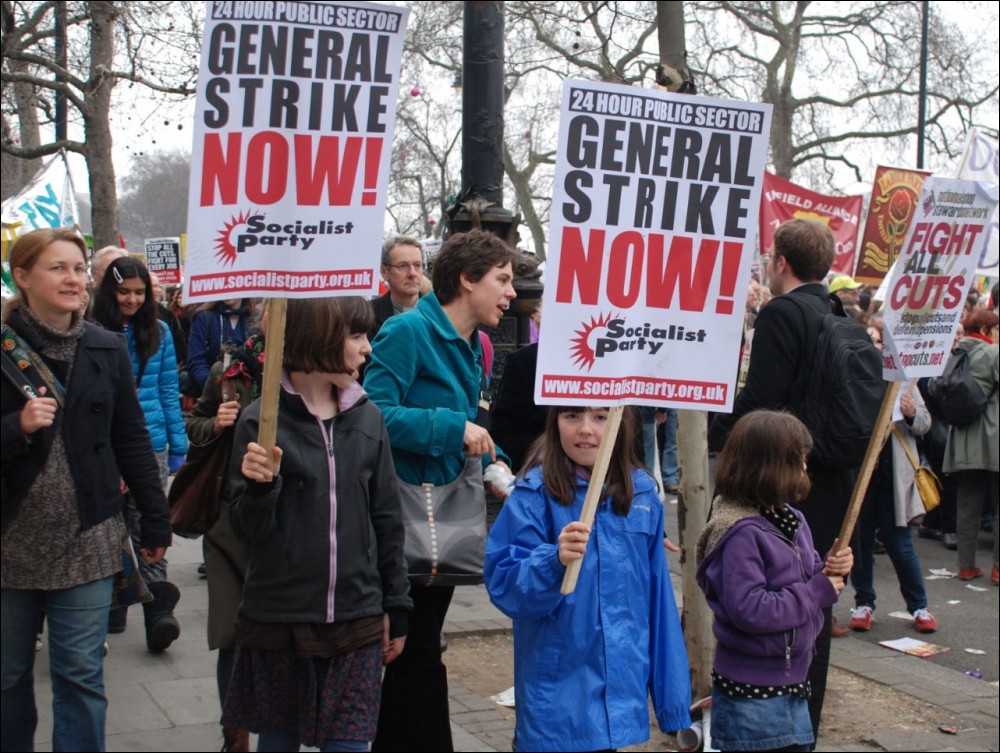
For a 24 hour public sector general strike now! Photo by Suzanne Beishon

Civil servants, teachers and lecturers balloted to strike on 30 June against the Con-Dems' attacks on public sector pensions and public services. The National Union of Teachers has voted 92% in favour of the action, while the Association of Teachers and Lecturers has voted 83% in favour of its first ever strike. London underground drivers in the RMT union are also due to take strike action on that day against victimisation of trade union activists.
Chris Baugh, assistant general secretary of the PCS civil servants union, spoke in a personal capacity at the National Shop Stewards Network conference on 11 June. Here is an extract from his speech.
Someone once said the Tories never talk about class war because they're usually too busy practising it. This crisis, caused by nearly 30 years of a high octane deregulated capitalism, fuelled by an explosion of credit and reckless speculation, has become the excuse for an all-out assault on nearly all the major social gains won by working-class people in the post-war years.
Perhaps the most callous elements of the cuts are reflected in the abolition of EMA student payments, the Sure Start children centre closures, the cuts in benefits to the disabled.
This is a government that is working to dilute 2,000 separate pieces of legislation, even the equality act that only came on the statute book in April. Everything is up for grabs.
But trade unions remain the major obstacle to the Tory-Liberal plans. It's why big business politicians introduced the anti-union laws. It's why the media attacks trade unions. It's why the employers pick out our activists and reps. It's why Vince Cable - supposed to be a restraining influence on the Tories - is already talking about even more limits on the right to strike.
This is a government that is fearful of the trade unionmovement. There is a massive and growing anger against the bailout to the bankers and the financial institutions and the attempt to make the working class pay the price for a crisis not of our making. The evidence was shown in the student protests, shown in the magnificent turnout on 26 March, shown by the action that we plan to take on 30 June, as the first wave of coordinated action.
If you're a worker in any other part of the public sector you will be asking the question: 'why are we not taking action with our brothers and sisters in the civil service and education institutions?'
The PCS will continue to press the Trades Union Congress for coordinated strike action and to build direct support with individual unions. We expect to be joined by millions of public sector workers in the autumn in the second wave of the sustained strike action that will be needed to challenge this government.
This is an enormous opportunity to reach out to the ranks of the most exploited sections of the workforce, the millions who aren't in unions, the millions who are unorganised. PCS has found that when the union is prepared to speak and act for its membership, that's when people are prepared to join, that's when they're prepared to get involved, that's when people are prepared to come forward and become reps in their own trade union.
We can start to challenge the dictatorship of the international markets, which are dictating the policy of individual governments. We can show that international worker's solidarity is not some utopian idea, it is the most powerful antidote to the neoliberal consensus, pursued by European governments, by mainstream political parties, by the Murdoch press, and by international bond and equity markets. We can raise the question of what sort of society we want to live in and start to pose a real socialist alternative.

Tuesday, 17 May 2011

NSSN Conference - Saturday June 11th 2011

Form more info and to book tickets visit: http://www.shopstewards.net/conference.htm

The mighty TUC demonstration on March 26th showed once and for all that workers in Britain are prepared to fight when well over 500,000 demonstrated in London. The NSSN is holding its 5th annual conference 19 days before 800,000 workers could take strike action on June 30th against the ConDem coalition’s attacks on public sector pensions. This year our conference will be discussing the practical steps that union reps and activists can take to make sure that on the strike day every city in Britain is filled with marching workers - sending a warning to the ConDems that the next step should be a one day general strike to stop them trying to make us pay for the bankers' crisis.
The NSSN was initiated by the RMT in 2006 to try and build a real rank and file organisation in the trade unions. It has already shown its potential as an organiser of solidarity in early 2009 in the private sector disputes in Lindsey Oil Refinery, the Visteon occupation, Linamar and Vestas. This year, alongside our work in the anti-cuts movement, we have supported the 400 locked-out workers at BP Saltend in Hull, the blacklisted workers at the Olympic site, the victimised RMT tube workers and many other disputes.
Come to the NSSN conference and link up with hundreds of other workers facing the same issues in the workplace - in the private and public sector. We will be running sessions on the three big issues facing workers at the moment - Fighting to defend public sector pensions, saving the NHS and fighting for the very right to strike and organise, including ending the blacklist and victimisation.
To register in advance for the conference online, go here. Alternatively, emailinfo@shopstewards.net or phone 07816 134 690. Tickets cost £5.
If you'd like to stand for election to the NSSN Steering Committee, please emailinfo@shopstewards.net by 12noon on Thursday June 9th.