Showing posts with label Strikes. Show all posts

Thursday, 8 September 2016

Organise mass working class resistance to austerity

Come to the National Shop Stewards Network rally at the TUC Congress

Join fellow trade unionists and socialists including Shadow Chancellor John McDonnell and BFAWU (Bakers Union) general secretary Ronnie Draper on the NSSN lobby of the TUC in Brighton on 11 September, 1pm in the Ashdown Suite, Holiday Inn, 137 King's Road (seafront), Brighton, BN1 2JF


Junior doctors and teachers march together in a joint BMA and NUT demonstration in April. Now Cameron is gone we need to get Hunt and the rest of the Tories out photo Paul Mattsson   

Rob Williams, Socialist Party industrial organiser
TUC congress is taking place at the end of what has seemed like a hot summer, industrially at least. In the run up to the event, the figures for days lost in industrial action in 2015 were published.

On the surface, they are alarming. The lowest number of workers on strike - 81,000 - in a single year since records began in 1893 and only 170,000 days lost through action - the second lowest in history. In the 1980s, on average more than three million days were lost.

No doubt the conclusion drawn by the pessimists and cynics within the trade union movement will be that this confirms that the organised working class is too weak to defeat the employers and their government.

In fact, the TUC press officer, Michael Pidgeon, has used the figures to argue that the Tories had no need to bring in the repressive Trade Union Act, the biggest attack on the unions since Thatcher's anti-union laws three decades ago.

They will also be used to justify the absolutely baleful role of the right-wing union leaders in the fight against Tory austerity over the last six years. No serious campaign of co-ordinated strike action has been called against the biggest jobs cull ever seen in the public sector. Last year, it was estimated that 400,000 workers had been sacked, with the possibility of another half a million going by 2020.

Opportunity

The biggest opportunity to confront the cuts was the 2011 struggle to defend public sector pensions which saw 2 million workers walk out on the 30 November strike that year. If that dispute had been continued and escalated, it had the potential to stop Cameron and Osborne's austerity offensive in its tracks. Instead, the conscious sell-out only emboldened the Tories to go further.

The result has been devastating in terms of jobs, services and pay as well as pensions, which have contributed to the 10% drop in wages with increased pension contributions. No wonder the income of workers in the UK is still at pre-crisis levels. It was this position that forced joint action over pay in 2014. Although that too only lasted one day.

But it would be a huge mistake to draw pessimistic conclusions from a superficial view of these statistics. In some respects, they are a reflection of the disappointment of workers at the seeming inability of the unions to lead an effective fight against the Tory cuts.

As we have pointed out, this is the responsibility of the right-wing union leaders. Two of the three leaders who were primarily responsible for the ending of the pensions dispute, then leader of the TUC Brendan Barber and GMB general secretary Paul Kenny, were knighted by Cameron. The other, Unison general secretary Dave Prentis, is under increasing pressure from members of his union because of his role.

Joint action

The ability of the Tories to drive through cuts in the public sector (which has a majority of union members and is where their density is greatest) without large-scale joint action over the last two years has undoubtedly had an effect on the figures.

But this masks the huge discontent and anger that exists. This has been reflected in individual union disputes in the public sector. For example, there have been national disputes by civil servants' union PCS and the Fire Brigades Union.

There have also been prominent local disputes, such as by Unite members in Bromley and Greenwich councils and Unison in Glasgow and Barnet. Socialist Party members have been prominent in some of these struggles.

There are many other disputes that don't even make the figures. Over the last few months there has been an uprising of teaching assistants in Derby and then Durham against pay cuts of up to 23% by Labour councils.

In Durham, 500 of these low paid workers filled a meeting and launched a public campaign but no actual official strike days have yet been sanctioned by theunions, Unison and the GMB.
Similarly, there have been three incredible disputes in London recently, at Deliveroo, UberEats and among contracted cleaners. It is likely that not one day of their action is officially recorded as neither of the small independent unions involved - the United Voices of the World (UVW) and the Independent Workers Union of Great Britain (IWGB) - have a recognition agreement with the employer.

Nevertheless both Deliveroo drivers and UVW cleaners have won victories against their brutal working conditions. Many of these workers are migrants and many have to hold down two or more jobs to have any chance of a living.

'Self-employment'

Their struggles should be celebrated and show that it is possible for unions to flourish in the era of zero-hour contracts and bogus self-employment. The trade union movement, especially 'new unionism' in the late nineteenth century, was built in similar exploitative conditions.
The strikes also showed a number of features that are becoming increasingly common. The use of social media has been important to advertise the disputes and build solidarity, including protests and financial support.

UberEats workers ride into town to face down their bosses photo Scott Jones, photo Scott Jones   (Click to enlarge)

The IWGB raised £8,000 in two days in their dispute with Deliveroo. PCS raised over £100,000 that helped pay National Gallery strikers during their dispute that lasted over 100 days last year. In fact, a number of disputes are seeing longer action.

Some of these disputes - such as those by BFAWU bakers' union members in 2-Sisters plants in Sheffield and Newport and PCS in the Welsh and Scottish Museums - were over employers attacking premium pay to compensate for the increase to the new National Living Wage.

The RMT has appeared to be on strike on all fronts - including Eurostar, Virgin East Coast, Southern Rail and ScotRail. Many of these have also involved protracted action. There have also been bitter disputes by Unite members on the buses in Leeds and Weymouth.

Construction workers went on strike at the Fawley oil refinery in Hampshire to ensure that migrant workers were paid the same as UK workers. Also, the first strike took place in the offshore oil industry for nearly 30 years. Both of these strikes got results.

Trade Union Act

The Tories may find that their Trade Union Act could actually up the ante, as the new law means that disputes could be timed out after six months, forcing a re-ballot. Workers could draw the conclusion that they might as well go all-out from the beginning.

Actually, far from dismissing the threat from the unions, the right-wing Tory press have a far more realistic appraisal of the potential threat of the unions.

They have particularly been fulminating about the rail strikes, demanding the immediate introduction of the new undemocratic higher voting thresholds or even outlawing strikes altogether!

In response to the new strike figures, Matthew Lynn of the Telegraph wrote, "Strike action may have fallen to the lowest levels in over a century - but the sooner it is eliminated completely the better." He was railing against the Southern Rail strike but also what he calls the 'public sector middle class'.

Of course, the most prominent of disputes among this group has been the inspirational junior doctors. They exploded onto the scene, not just on picket lines outside hospitals but campaigning in town and city centres.

Scandalously, the overwhelming support they have received from fellow trade unionists and the public hasn't matched by that of the TUC and most union leaders, especially in health.

However, the junior doctors have rejected the government's offer and are embarking on the next phase of action. It should be a key debate at TUC congress to turn support into active solidarity. 

At the very least there should be a national TUC demonstration in support of the BMA doctors' union and also widened to defend the NHS.

National demonstration

There is already a national demonstration called by the National Union of Students and lecturers' union UCU in November to defend education, just as national action has been taking place by teachers and lecturers.

The potential exists to bring all these struggles together. 90 years after the 1926 general strike, an increasing number of workers are groping towards the understanding that mass strike action can transform the political, as well as the industrial, situation.

The attempted Blairite coup against Jeremy Corbyn has deliberately deflected attention away from the historic crisis within the Tories after Brexit. The main architects of the brutal austerity offensive, Cameron and Osborne, are history.

May's government has no authority and she is only prime minister because of a defeat for an administration she was part of. In any other circumstance, there would be a clamour for a general election. Even if only semi-consciously, workers can feel that this is a weak government and this will only increase as more workers engage in action.

The National Shop Stewards Network (NSSN) is again holding a rally before the start of TUC congress.

Its two main themes will be for the unions to prepare the mass strike action necessary to take on what's left of the Tories and also to defend the left Labour leadership of Jeremy Corbyn against the Labour right. Shadow chancellor John McDonnell will be addressing the rally alongside leaders from some of the most militant unions.

The political and industrial are beginning to fuse. The second Corbyn wave, created by the whip of Blairite counter-revolution, has drawn more workers into the struggle against the Labour right.

Workers understand how much is at stake as the right wing try to turn the political clock back. This is not a period of passivity but one of increasing volatility. If given a lead it can develop into a mass movement of struggle to defeat the Tories and their Blairite agents.

Join fellow trade unionists and socialists including John McDonnell and Ronnie Draper on the NSSN lobby of the TUC in Brighton on 11 September, 1pm in the Ashdown Suite, Holiday Inn, 137 King's Road (seafront), Brighton, BN1 2JF

Thursday, 16 October 2014

Fight for Mass Action to End Cuts and Low Pay!

Britain needs a pay rise - how are we going to get it?

When the TUC first organised their 'Britain Needs a Pay Rise' demonstration on 18 October, it is hard to believe that they saw it as an integral part of a campaign of co-ordinated strike action. The first mention of it on their website was 11 February. Surely unbeknown to them, eight months later that date is days after hundreds of thousands of public sector workers have taken industrial action to break the Con-Dem pay freeze.

More than likely, the TUC and the Labour-affiliated unions saw the march as an opportunity to assist Labour in the protracted pre-election period by exposing the anti-working class policies of this Tory-led government, although Labour agrees with the pay freeze!

The fact that starting on 10 July and continuing into October, unions have called out members in local government, education, civil service and now the NHS is a reflection of the pressure that they have been subject to because of the grinding misery that the continuing fall in living standards has represented for millions of workers and their families.

However, the decision of the unions in local government to suspend their strike on 14 October is a major setback to the type of mass co-ordinated action needed to push the government back on pay. But activists in these unions and the NUT teachers union, which had already suspended action will be determined to get them back into the pay dispute.

The symptoms of the growing catastrophe facing working-class families are everywhere. The Trussell Trust, the largest food bank provider in the UK, says it has handed out 913,000 food parcels in the last year, up from 347,000 the year before. It added that there was a "shocking" 51% rise in clients to established food banks. The charity said that more than 30% of visits were put down to a delay in welfare payments but the second biggest reason, given by 20% of food bank users, was low income.

This is despite the social stigma attached to using them. In a recent survey by the University of Manchester, a 55 year old described how she had collected a food parcel on behalf of her grown-up daughter who was too embarrassed to come. She stated: "My daughter doesn't want to be seen as a scrounger." A child said: "We say to my mum make sure you eat but she says she's not hungry...she's just making sure we eat first." A survey by the NASUWT teachers' union revealed that a quarter of teachers have brought food into school to feed hungry pupils and a fifth have bought them lunch.
 
There are similar figures about payday loan companies, who are the suited and booted loan sharks as food banks are modern day soup kitchens. Last year, the charity StepChange handled £110 million-worth of payday loan debt, up from £60 million in 2012.

The so-called respectability of these vultures has now been exposed by the Financial Conduct Authority (FCA) - forcing leading payday loan company Wonga to write off £220m of debts for 330,000 people who couldn't afford to repay it. No wonder, when they charge interest rates over 5,000%!

In his speech to Conservative Party conference, Cameron again tried the Tory 'divide and rule' tactic of targeting benefits. But it was estimated that over half those who would suffer would be low-paid workers or the 'working poor', who earn so little that they qualify for in-work benefits and tax credits.

A report by the Office for National Statistics revealed that pay dropped by 0.2% in August in absolute terms. Yet incomes have been falling in 'real terms' for most of the period since the financial crisis of 2007-08. The Bank of England governor Mark Carney was invited to address this year's TUC and admitted that incomes had fallen by 10% since the crisis. He also thanked the unions for the sacrifice made by their members in "doing their bit" during the crisis! But on closer inspection, the ONS figures reveal a generation gap with those under 25 suffering a loss of 14%! This is hardly surprising when younger workers face the full brunt of zero-hour contracts, temporary work and lower rates of pay for new starters. They will be on worse pensions, if they exist at all. Yet graduates are expected to repay student debts inflated by £9,000 a year tuition fees!

The downward pressure on pay started under the last Labour government. The economic crisis was used by the bosses in the private sector to lower workers' wages and terms and conditions to literally get us to pay for their crisis. Many workers paid the price to retain their jobs by pay freezes or cuts and short-time working. However, the recovery of incomes has been very slow. To most workers, the so-called economic recovery is an utter myth that is only happening for the employers and the politicians, with MPs in line for an 11% pay increase!

Bosses, whether they are private sector employers or the government, have been quick to play off workers against each other. This was attempted in the public sector pensions dispute when they contrasted the so-called 'gold-plated' pensions of these workers with their counterparts in the private sector. In reality, this was a myth, with the average public sector worker receiving £7,000 a year in retirement. Similarly with pay, the fact that the squeeze in the private sector, where union density and organisation is inferior, was greater than the public sector, has been used as justification for the government attack.

The austerity offensive that was unleashed by Osborne in the autumn of 2010 has in effect been a deep recession for public sector workers, as well as working-class communities who rely on their services. The first two years saw public sector pay frozen absolutely, followed by two years of a limit of 1%.

Infamously, even this paltry rise isn't guaranteed in the NHS where up to 55% of workers will get nothing. Yet in the four years from 2010, RPI inflation rose by 4% a year on average. But even this price index, which, by including mortgages, is almost always higher than the CPI index now more commonly used by the government, is an under-estimate of the real cost of living, particularly those facing huge rents.     

Socialists explain that workers in the public and private sectors have to be united to resist the attack on all workers' incomes. Just as those in the private sector made concessions to keep their jobs in the depths of the recession, many public sector workers have been the victims of 90-day redundancy and re-engage notices. These have removed or worsened hard-won elements of their terms and conditions, such as car fuel allowances, that they have relied on as their pay has stagnated.

On top of this, the defeat of the pensions struggle as a result of the capitulation of the right-wing union leaders and the TUC, after the mammoth 2-million strong strike in November 2011 (N30) has meant that public sector workers have had their monthly pension contributions increased. In many cases, this has amounted to an effective cut in wages of anything up to £100 per month.

In addition, the vicious programme of cuts which have also been passed on by Labour councils have seen many public sector workers outsourced and privatised which has been a platform for swingeing wage cuts. The incredible strike by Care UK health sector workers in Doncaster, of over 80 days so far, was triggered by cuts of 25% as a result of being pushed into the private sector.

However, the N30 strike does point the way forward for all workers. That mass strike shook the Con-Dems, forcing Cameron into a volte face over his comments on the morning of the walkout that it was a 'damp squib'. Actually it was a massive show of strength by millions of workers in, arguably, the biggest single day of strike action since the 1926 General Strike.

In almost every town and city, there were mass strike rallies that revealed that any idea of a division between workers could be torn down, as the strikers received tremendous public support. As the reaction to the London tube workers strike earlier this year showed, when the unions act in a decisive way they become a reference point to all workers and others suffering from the brutal cuts and employers' offensives.

On the morning of N30, hundreds of 'The Sparks' - electricians in the construction industry - went from their weekly protest to a number of public sector picket lines. The Sparks were fighting against the imposition of a new BESNA contract that would have cut their wages by up to 35%. But through militant action and an official strike ballot by their union Unite, they were able to defeat the attack.

Undoubtedly, the sight and sounds of workers in the public sector throughout 2011 on strike and on the march, gave confidence to many other workers that it was possible to fight back. In return, victories such as that won by the Sparks and the London bus workers in 2012, who won an Olympic bonus, showed that it is possible to fight and win.

The setback of the pensions battle after the N30 strike has undoubtedly taken its toll on the confidence of workers, especially in the public sector. It opened the door still further and emboldened what is a weak and divided government. The result has been hundreds of thousands of redundancies, many of them would have been workers who strongly identified with the union. Many workers will have asked when contemplating action over pay: "Can we win?", "Will the union go all the way?"

But despite this, the July 10th pay strike of over a million was the biggest strike since N30 and showed that there are big layers of workers who realise that they have to fight to stop the slaughter of their incomes. Despite how anaemic this 'recovery' seems to workers, the fact that the economy has stabilised, at least for now, with perhaps the immediate threat to jobs lessened, can give workers confidence that it's possible to fight on pay. Sometimes in the midst of a deep crisis, workers can feel helpless.

Following the recent impressive action from NHS workers and civil servants on the one hand, and the calling off of the action in local government on the other, it's clear the pay struggle is at a crucial stage. These paltry offers must be rejected. The campaign must be continued and escalated. More strikes must be called before Christmas and into the New Year, with all the public sector involved.
The Socialist Party and the National Shop Stewards Network (NSSN) have been to the fore in building pressure on the TUC and the unions to call a 24 hour general strike. This could unite all workers in every sector to defeat Cameron's austerity and the employers' offensive. It would have huge support from the majority of people who are the victims of the cuts.

A significant breakthrough by a sizable group of workers would have a huge effect in raising the sights of all workers. It would not only shake the ConDems but also lay down a marker to all the mainstream parties, including Labour, who refuse to back the pay strikes because they have accepted Tory austerity.

Scandalously, the leaders of the Labour affiliated unions whose members have been on strike in the councils and the NHS against the pay freeze, accepted Miliband's spending plans at this summer's Labour Policy Forum. They wrongly believe that to go along with this is to protect their members because easing off Labour best ensures their victory at the general election next May.

In reality, they are only maintaining the idea that workers have to accept the cuts. They are loosening the pressure on Labour and disorientating union members and activists who cannot understand why the unions, the paymasters of Labour, are rolling over and being humiliated.

But history won't stop at the election. The incredible energy of the Scottish Independence campaign was a political mobilisation of the working-class and poor for an alternative to the austerity consensus of all the main parties on the bidding of the capitalist establishment. It was the first chance that many would have had to vote in a decisive manner for what they saw as a clear alternative idea.

It is an anticipation of the next months and years in the rest of the UK, as workers struggle politically and industrially to take on and defeat the attack on their incomes and all the other gains won by the working-class, but now are in mortal danger from the cuts and privatisation.

Striving for mass strike action by the unions, whoever is meting out austerity, is a critical element of this. The passing of the £10 an hour minimum wage by the TUC is an opportunity to appeal to the millions of low-paid non-unionised workers to become part of what is still the biggest organised force in society.

But side by side with this is the need for a real political alternative that fights for a more equal, socialist future. The Trade Unionist and Socialist Coalition (TUSC) is best placed to fight for such a mass political vehicle and be a powerful attractive force for those workers in unions that are still affiliated to Labour to break them from that grip.

by Rob Williams, Socialist Party national trade union organiser

Monday, 2 December 2013

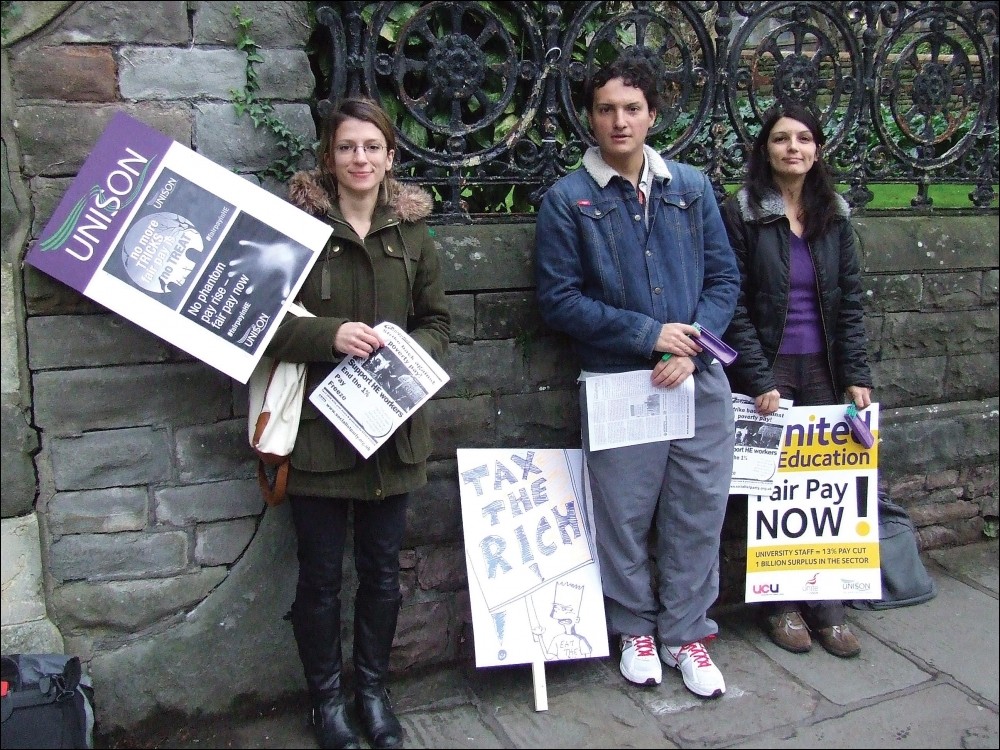
End the pay freeze: A united fight in post-16 education, support the strike tomorrow

Bristol university workers on strike in October 2013

Bristol university workers on strike in October 2013


On 3 December university and college workers will be taking action. This strike day involves UCU, Unison and Unite members working in universities who struck on 31 October, now joined by further education (FE) members of UCU in England and higher education (HE) members of EIS in Scotland.

In HE, the employers' organisation UCEA returned to negotiations with the unions, but did not improve on the initial pay offer of 1% that triggered the dispute. Rattled by the 31 October strike, they have asked the individual employers to impose 1%. University workers are fully aware, however, that their employers have multi-million-pound surpluses and reserves while staff incomes have fallen by 13% in real terms since 2008.

FE staff have similarly experienced a 15% real-terms pay cut in the last four years, and have just rejected their employers' offer of a 0.7% increase - that is, another below-inflation rise - with over 70% voting tostrike. This doubtless reflects the anger union members feel when research shows that over half the lecturers in FE work ten hours' unpaid overtime during an average week, for dwindling pay.

Many student unions and the NUS nationally have passed resolutions in favour of the action, with Socialist Students and other campaigning groups building support. Ultimately our interests are all the same - for a public, fully-funded education system, free at the point of use and democratically run.

This background makes the coordinated national strike action particularly positive - the more unions that can be brought out together, the greater chance of success. At the same time, it is important for each dispute to have a strategy and to keep its own momentum.

Industrially, we need to work to build for a 24-hour general strike against austerity; and politically, trade unionists and students need to consider the question of an alternative to the three parties of austerity. Education is been under attack - we need to fight to defend it!

Thursday, 6 June 2013

PCS rolling strike programme - Bristol rally today

 From: http://www.pcs.org.uk

As part of our national campaign to defend pay, jobs and conditions, all PCS members in DWP, HMRC and Valuations Office Agency - more than of half of our membership - are taking part in rolling joint regional strike action from 3-7 June.

The first day of strike action will coincide with the pilot to close 13 HMRC enquiry centres in north east England and Yorkshire and Humberside. As well as causing major disruption to the employer, reps will also be promoting our welfare and tax justice campaigns and our alternative to public sector cuts.

Strike day rallies are being organised in major cities by our regional offices, while branches are planning to organise further local rallies. For the latest check regional web pages in your area.

Bristol rally today - Thursday 6 June

11.30am, Ramada Hotel, Redcliffe Way, BS1 6NJ.

Speakers: Richard Capps (DWP Avon) and Dee Leary (HMRC Bristol West Country)

For more details contact our South west office: 01392 410 105.


Socialist Party article - http://www.socialistparty.org.uk/articles/16838/05-06-2013/pcs-rolling-strike-programme

Monday, 18 March 2013

NUT and NASUWT call joint action

From: http://electmartin1.blogspot.co.uk/2013/03/nut-nasuwt-joint-action-proposals-fall.html


Plans for joint action announced – but firmer action needed to protect teachers and education 

The announcement at today’s joint NUT/NASUWT Press Conference that plans are being put in place for joint strike action between the two main teaching unions, the NUT and NASUWT, will be welcomed by teachers who have been waiting since Christmas for national action to be called to oppose Gove’s plans to impose performance-related pay. However, as the details become clearer, we think that many members will feel, as we do, that these plans have to be strengthened if we are to successfully oppose Gove’s attacks on our pay, pensions and conditions.

A school-term lost without action being called


It was in early December that Michael Gove made his announcement that, under legislation to be imposed after Easter, fixed incremental pay scales will be abolished and all future pay-rises would be tied to performance. In addition, teachers moving to new posts face the risk of huge pay cuts as their existing points on the pay scale will no longer be protected. This huge attack will leave teachers’ livelihoods dependent on arbitrary judgements of ‘performance’ and on the health - or otherwise - of an individual school’s budget. As the history performance-pay has always shown, it will also have a deadening and demoralising affect on education as a whole. All of this comes on top of the ongoing attacks on teachers’ pensions and the relentless workload still being imposed on staff.


Given the scale of the attack, and the speed at which these plans were being imposed, a minority on the NUT National Executive, including ourselves, have argued that national strike action should be called THIS term - in time to try and persuade Gove to back-down before legislation was enacted. Regrettably, and despite contrary evidence from elections, surveys and most Union meetings, we have been told that members weren’t ready to support strike action, and certainly not unless the NASUWT took joint strike action too. Strikes have not been called for this term and nor has a serious enough campaign begun to explain the threats facing teachers’ pay in order to build for that action.

Can we fight off these attacks school-by-school?


This term’s delay means that legislation will now become law before unions have taken action. As a consequence, all schools will be expected to adopt new pay policies that link pay rises with performance by the summer.


Regrettably, instead of starting with unifying national action, the battle will now be starting with school-by-school struggles to persuade governors to adopt pay policies that circumvent most of Gove’s plans. Given where we are now having to start from, the plans announced today for the NUT and NASUWT to publicise a joint pay policy are correct. However (and we have not yet seen the details of the policy ourselves), even the best policy will not be able to protect teachers moving to other schools where governors have refused to guarantee to protect existing pay points. Short of winning withdrawal of Gove’s legislation, unions will therefore need to mount a battle that can persuade the vast majority of schools to adopt an acceptable pay policy. How should that be done?


The NUT and NASUWT have also announced today that the ‘Action Short of Strike Action’ (ASOSA) campaign, launched jointly in September over workload, observation protocols and appraisal policies, be extended to cover pay policies too. The threat of non-strike action, escalating to strike action if required, has succeeded in making gains in well-organised schools groups and Local Associations. However, even then, compromises over the finer details of observation policies were sometimes made in order to reach agreement. The same may well happen over pay policies. 


The real weakness of such a school-by-school action approach is that, faced with intransigent management at a school and/or Local Authority level, some teachers will not feel confident in taking isolated action. In addition, even the best-organised Association will struggle to have the capacity to monitor and support members across all the individual schools in their area. The danger will be that less strongly unionised schools become isolated and only a minority adopt acceptable pay policies.


In order to overcome this isolation, action will need to be co-ordinated across as many schools as possible and, where Local Authorities refuse to recommend acceptable policies, across the whole Association. However, this requires that both unions adopt a far more urgent approach to warning teachers about these pay threats and in encouraging ‘ASOSA’ than has been seen up to now. But the best way to overcome isolation, and to show both teachers and governors that unions are serious about opposing these pay attacks, is to launch a vigorous campaign of national strike action. This should be combined with a bold public campaign to explain how Gove’s plans threaten education.

These plans are not strong enough to defend teachers


In our view, the plans announced today for joint action do not show Michael Gove, our members or Heads and Governors that we are taking this battle as seriously as we need to be. The plans suggest that there will be no national strike action in the summer term, just the beginning of rolling regional action in one area, on 27 June in the North-West of England. The indications are that this should be followed by further regional strikes in the Autumn – but with no national strike action being called until nearer Christmas.


As in March 2012, when Martin, as a NUT National Executive member for Inner London, went all-out to help build a regional strike called in the capital city alone, we will work hard to build action that is called. However, then and today, many teachers will have understandable doubts about this proposed plan of action. Yes, regional action spreads out the ‘pain’ of pay deductions but, as London teachers questioned a year ago, will such a slowly unfolding regional action have sufficient impact?


Teachers are practical people. They will be prepared to put up with pay deductions if unions can show that this temporary loss is likely to achieve a victory that means that the long-term pay losses from the permanent imposition of Gove’s pay and pension robbery plans can be avoided. But the plans announced today are not yet up to the job. Both NUT and NASUWT members need to tell their Unions to go back and strengthen the proposed plan of joint action.

Unions should call national strike action next term

If, despite bullying from Ofsted and budgetary pressures, we are going to successfully persuade schools not to apply Gove’s wishes, then the planned action needs to be stepped up. If, and this is the only real guarantee of success, we are going to mount sufficient pressure on Gove to withdraw this legislation before the new rules lead to teachers’ pay progression being blocked from September 2014, then, again, a far more vigorous plan of action is needed.
 
Both unions need to raise their sights and shake off their timidity. We should have confidence that, when the scale of these attacks are explained to teachers, they will respond to a firm call to take national strike action. 

The NUT and NASUWT are right to call on the Secretary of State to meet with unions to discuss our demands over pay, pensions and workload and to suspend any implementation of his divisive performance-pay proposals.  But what are unions bringing to the table that is going to make Gove think again? Instead of starting with regional action, teaching unions should be calling national strike action next term, perhaps escalating from a one-day strike up to 48-hour strike action. That’s a program that would show that unions were deadly serious about defeating these attacks.

Defeating Gove or just influencing the General Election?


The problem facing teachers is that some of their union leaders, in both the NASUWT and NUT, are not confident about making a bold call to action. Some Executive members seem to be looking at the timescales for action in a very different way to us. We fear that some have wrongly concluded that unions cannot defeat the Coalition, and so think our campaign should be restricted essentially to localised campaigns over pay policies. In this scenario, wider strike action isn’t then really aimed at defeating Gove but, over a longer timescale, at influencing the outcome of the next General Election.


Firstly, that approach will leave many of our members suffering pay and pension losses, and ever greater bullying and workload thanks to performance-pay, before any General Election is called. Secondly, it’s clear that, whatever the result of that Election, we can’t rely on any of the main political parties to adopt policies that oppose the pro-cuts, pro-privatisation agenda that demands the imposition of performance-related pay. It’s a strategy that just postpones launching a serious battle, demobilising and demoralising our members – and risks serious defeat. Instead, that serious national struggle needs to be waged – and soon, before we run into a quagmire of local disputes.


This Government is not as strong as it seems. Instead of just hoping for the best from a future Labour Government, unions should be co-ordinating action now, rebuilding the momentum that has been lost since the co-ordinated national strikes of 2011, including building for a 24-hour General Strike that could really start to shake this Government off its present disastrous course.

NUT and NASUWT Conferences must call for a strengthened program of action


Teachers in both the NUT and NASUWT will be asking questions about the strengths and weaknesses of the plans announced today. There will be relief that a concrete plan of joint action has now been announced. However, we think many will fear, as we do, that the potential advantages of united action across both unions could be wasted if the joint program of action that is agreed upon is too weak to adequately defend members of either union.


Today’s Press Conference announced that joint rallies are being planned for April and May in a number of cities. Classroom teachers of both unions – and parents and trade unionists that might also be attending - need to be calling for a more vigorous campaign of action to defend teachers and education. But, in reality, it will be hard to change these plans unless delegates at the two unions’ Annual Conferences meeting this Easter have already voted to improve the plan announced today.


Of course, delegates will be urged to back the agreed plan and, particularly at the NASUWT Conference, that call to back the leadership will be influential. However, NUT Conference delegates need to make sure that a plan of action is agreed that is up to the task of defeating these attacks. If the NASUWT feel unable to call national strike action earlier than, say, November, then that must not stop the NUT Conference from deciding on additional actions besides those jointly agreed. 


There are other unions also calling for co-ordinated action at an earlier date. For example, at the TUC’s pre-Budget rally last week,PCS General Secretary Mark Serwotka publicly called for unions to take co-ordinated national strike action jointly with the PCS on June 26. As a minimum, surely that is a request that the NUT should support - and call on the NASUWT to do the same?


After months when calls for ‘confidentiality’ about talks between the two unions have prevented full and open debate within the NUT about the action that needs to be taken, today’s announcement needs to be the start of an urgent discussion leading up to NUT Conference, not a plan that is just presented as one that delegates are expected to rubber-stamp over the Easter weekend.


The Local Associations National Action Campaign (LANAC) will be seeking to aid that debate and bring together delegates who wish to propose a strengthening amendment to these plans. A fringe meeting on the Saturday evening of Conference in Liverpool (March 30) will be held to see if delegates can agree a common proposal to put to a Priority Motion expected to be tabled after this week’s meeting of the NUT National Executive.


Teachers should urgently discuss today’s announcements and let their NUT Conference delegates know what they think Conference needs to agree if we are to defeat Gove’s poisonous pay plans.

Martin Powell-Davies, NUT National Executive member for Inner London

Peter Glover, NUT National Executive member for Cheshire / Merseyside


Friday, 21 September 2012

PCS: Press release - Joint strike over transport and environment cuts

PCS MEDIA RELEASE
20 September 2012
For immediate use


Joint strike over transport and environment cuts

Twelve thousand Public and Commercial Services union members from the transport and environment departments will hold a joint strike tomorrow (21) over cuts and closures that threaten vital services to the public.

Following two months of rolling strikes across the Department for Transport, the union's 8,500 DfT members will be joined by 3,500 from the Department for Environment, Food and Rural Affairs in the walkout.

As well as picket lines across the country, members in London will march from 2pm from Smith Square, via Marsham Street, for a rally in Old Palace Yard opposite the Houses of Parliament.

PCS members in the Home Office, facing thousands of job cuts and draconian changes to their terms and conditions, are also expected to join the march.

Among the issues under dispute in the DfT are plans to close almost half of the UK's coastguard stations; the closure of all 39 of the DVLA's local offices and 10 enforcement centres; and cuts and the threat of privatisation in the Driving Standards Agency.

There are similar concerns over job cuts and privatisation in Defra. And all of this comes on top of a pay freeze and the looming threat of the imposition of local or regional pay, which would drive living standards down even further.

DfT members will be on strike all day and Defra members will walk out for three hours from 1.30pm.

PCS general secretary Mark Serwotka said: "Despite all the evidence pointing to the fact that austerity isn't working, this government is ploughing ahead with unnecessary and damaging cuts that will deprive our communities of vital public services.

"As we approach the TUC anti-cuts demonstrations on 20 October and beyond, we believe more co-ordinated industrial action like this will be necessary, not just between civil service departments but across the public sector, if the government refuses to change course on cuts to jobs, pay and pensions."

Sunday, 24 June 2012

PCS: HMRC staff in Bristol on strike tomorrow

FIGHTING JOB CUTS AND PRIVATISATION: STRIKE ACTION CALLED FOR MONDAY, 25 JUNE

http://www.pcs.org.uk/en/revenue_and_customs_group/latest-news/index.cfm/id/24455AFE-97FE-4F73-81A063A99040AC37 

Members in HMRC have given resounding support for a programme of group wide industrial action in defence of jobs. Your group executive committee (GEC) would like to thank all members who participated and for our members' continued support. As part of a sustained campaign to defend jobs and services we are calling on all members to take strike action on Monday, 25 June. From Tuesday, 26 June, we are asking all members to strictly observe a ban on overtime working.

Demands

In our ballot, members have voted to support strike action and action short of strike over the following demands:
No further job cuts in HMRC
An end to private sector involvement in HMRC
No compulsory redundancies or moves beyond reasonable travel
An end to consideration points

We are now embarking on our biggest ever group wide campaign. We’re in a period of uncertainty. A further 10,000 jobs are planned to be cut from HMRC.

Our members are under pressure to deliver more, with increased scrutiny, with less staff and resources. 30,000 jobs have gone already in HMRC. Even by the estimate of the public accounts committee this has resulted in the department losing the ability to collect £1.1billion in tax. This figure will only increase if the government and the department ploughs ahead with its cuts programme.
CUTS

Nobody has ever seen a compelling case as to why these cuts are needed. It is clear to the vast majority of the population that the government wants to make ordinary working people pay for an economic crisis not of their making. As part of this the government is demanding cuts and privatisation across government departments. No department or section of HMRC will be immune.

If the government was serious about reducing our national debt then they would provide the very department capable of solving the problem of the ever increasing tax gap and the billions of pounds of tax lying uncollected, with the necessary resources. Instead, they want to slash 10,000 jobs in HMRC by 2015.

Campaigning to Win

Your GEC met on 14 June to discuss the way forward. We are strongly committed to reaching a negotiated settlement on our issues, but we believe a concerted and wide ranging group campaign beginning with one day’s strike action on 25 June and followed with a rolling programme of activity and action will be critical to protecting jobs and services now and in the future.

We will also look to escalate our action should the department refuse to listen. We are embarking on our biggest ever consultation exercise amongst reps and members to determine our next steps in our campaign.

Our message to the department is this – we are serious about protecting our members’ interests and we will engage in a serious and determined campaign to defend jobs and services.
TAX JUSTICE FOR ALL

We’re launching a new campaign – Tax Justice for All. This brings together all the arguments we’ve been making about investment in HMRC as well as pulling in wider support for job investment in HMRC. The Tax Justice for All campaign encompasses our key demands, backed up with action and activity. We have made the case for investment in public services. We are now asking members in HMRC to support the campaign by taking action.
Taking our agenda forward

Key to the success of our campaign will be the involvement of members. Campaigning and action has so far directly resulted in HMRC securing £900million reinvestment in Enforcement and Compliance, ended the need for members to take medical appointments in their own time and protected jobs in Wick for a further two years.

We’re now calling on members to:
Support the action on Monday, 25 June and encourage colleagues to do the same;
Volunteer to help your branch representatives with workplace campaigning initiatives;
Strongly adhere to the overtime ban – by doing overtime members are undermining the argument for investment in jobs;
If you know of any non members ask them to join PCS today;
Get involved in organising local activity in your local area and present our arguments, outlined in the new Richard Murphy report Why are they increasing the tax gap? to your local MP.

Tuesday, 13 December 2011

Revenue & Customs workers' lunchtime strike

By Nick Chaffey - http://www.socialistparty.org.uk/articles/13323/13-12-2011/revenue-amp-customs-workers-lunchtime-strike

As part of national industrial action on Monday 12 December, angry civil servants at HMRC Southampton held a lunchtime car park 
strike meeting to rally support for the continued attacks on sickness
 policy.

PCS rep Dave said: "Members are angry at the attempt to make 
sickness a disciplinary issue and means members are coming into work ill
 and in some cases taking leave days rather than report sick.

"We will
 continue to support action on this issue. We need to build on the 
support for 30 November, 80% came out here.

"I think we now have to
 consider escalating the action". Other workers raised the lack of trust people have in
 politicians and all the arguments put around to justify the cuts.
 Support for a united stand against all cuts got a good response as well
 as the need to stand anti-cuts candidates against the cuts 
establishment.

Thursday, 17 November 2011

Bristol CWU: TV Licensing strike today and tomorrow

From the CWU Website: http://www.cwu.org/news/archive/tv-licensing-strike-today-and-tomorrow.html

Hundreds of TV Licensing workers employed by Capita will be on strike for a third day tonight and tomorrow in a dispute over pay.

Many workers earn just above the minimum wage while Capita half year profits have increased by 8 per cent to over £1 million a day. Last year board members awarded themselves £1.65m in bonuses and the Chief Executive, Chief Operating Officer, Finance Officer and other senior executives received pay increases of 17 per cent. CWU is asking for a pay rise in line with inflation - which runs at over 5 per cent - but Capita has refused to budge from an offer worth around 2.6 per cent.

Andy Furey, CWU assistant secretary, said: "This is a dispute about fairness. We have a clear case of double standards - one rule for senior executives who award themselves massive pay rises and bonuses and another rule for staff who are expected to suffer with pitifully low rises in pay.

"The truth is that working people are being made to line the pockets of the rich and Capita is a prime example of that. These are honest, hardworking people many of whom have never taken strike action before but are struggling themselves and then seeing their bosses take huge pay rises.

"Three days of strike action is unprecedented and we strongly urge Capita to return to negotiations to resolve this dispute before Christmas."

Alison Langford, Admin Assistant in Operations Support, Darwen, said: "I earn £234 a week BEFORE tax and national insurance. I've never taken strike action before this in my life, but I need a living wage. I was earning this much 30 years ago when I worked in production." Alison has been working for Capita for one year.

Jane Pascal, a part time admin worker in Bristol who has worked for TV Licensing for 15 years said: "We work really hard for Capita. We give a quality service whilst ensuring all their targets are met so why do Capita insist on treating us with such contempt and offering an inadequate pay rise well below inflation whilst giving their Directors a huge pay rise well above inflation? They can afford to give us a decent pay rise seeing as they earn profits of £1,000,000 a day and I feel they are just brushing us under the carpet like we don't matter. Well we are not standing for it, we'll fight for this as long as it takes. It's about time they started to appreciate their hard working staff." Yearly salary of £14,564.

Picket lines Friday 18th November:

Bristol: 7:30 - 10:30am 100 Temple Street, Bristol, BS98 1TL

Darwen: 7:30 - 10:30am India Mill, Bolton Road, Darwen, BB3 1YX

Staff in Bristol and Darwen, and a small number in Glasgow, work in call centre and support roles and will be on strike on Friday 18th November. Enforcement officers who work in the field are on strike from 4pm today, Thursday 17th November.

Wednesday, 14 September 2011

Germany: Solidarity with hospital workers

Support the striking workers of the Charité Facility Management company (CFM) in Berlin!

By Anna Shadrova, SAV, Sozialistische Alternative (CWI in Germany), Berlin


98.6 % of the unionised Charité Facility Management (CFM) workers in Germany’s capital Berlin have voted in an official ballot for a strike, with the main demand of winning a collective bargaining agreement, which will start on Monday, September 12.

The CFM is an outsourced and half-privatised, profit-oriented company at Europe’s largest university hospital, the Charité in Berlin. The Charité has been outsourcing next to all services that are not of a primary nursing or medical character into the CFM since 2006, including maintenance, sterilisation, call centre, security, kitchen and cleaning staff. Scandalously this policy was carried out by the so-called “red-red”, SPD-Left party, run Berlin city government which owns the hospital and which faces regional elections on September 17.

Workers there have no collective bargaining agreement. The trade union ver.di has been demanding such an agreement for years now but this has not been concluded up to now. For many of the roughly 2,600 workers this means wages of around 7 euro an hour leaving them with about 900 euro a month for a full-time job. The CFM-workers went on strike along with the Charité nurses in May this year. Their two-week-strike forced management to start collective bargaining negotiations but after three months of talks and a ridiculous offer by the CFM-bosses that did not include all groups of workers and for most did not mean any improvement, an overwhelming majority of workers have now voted for strike.

Since the main demand is a collective bargaining agreement with adequate wages, this struggle is a very important step in the fight against the advance of precarious working conditions and also the profit margins that lie in the privatisation of health care services. Already, the CFM is used as a role-model for privatisation in the sector.

Trade unionists from the Charité clinic along with other workers, SAV (Sozialistische Alternative – CWI in Germany) members and supporters of other organisations have organised a solidarity committee which actively supports the strikers wherever possible.

The struggling workers need all the solidarity they can get. Please send messages to cfm_solikomitee@yahoo.de and mail@cfm-charite.de

http://www.socialistworld.net/doc/5278

Monday, 22 August 2011

Bristol: Strike at Connexions

Report by Tom Baldwin
Staff from Connexions in Bristol took strike action last Thursday, joined by colleagues from across the former Avon area. Connexions is an advice service that helps young people get access to education, training and employment.

As the Unison strike leaflet pointed out, this is more vital now than ever. Most people on the picket line were striking for the first time.

They felt pushed into taking this step in the face of attacks to pay and conditions and a lack of willingness to negotiate by management.

The service they provide has already come under the butcher's knife. One third of staff have been made redundant and other posts aren't filled when people leave.

Yet the remaining staff are expected to carry the same workload. Now they too are under attack, they have been promised pay cuts of up to 18%! To add insult to injury, managers will retain significantly more of their pay, so much for "we're all in it together".

Workers aren't just expected to swallow enormous pay cuts, they are also being asked to work an extra three hours a week for nothing. Those I spoke to were very proud of the service they provide but frustrated that cuts get in the way of them helping more young people.

Having taken the step to join their first ever picket line they were prepared to take more action if management still refuses to come to the table. They also agreed with the need to link up their struggle with other workers facing cuts and expect Unison to join action of other unions against attacks on public sector pensions.